
The only point of the Summer Economic Statement is to provide four numbers:
1. The total fiscal package for 2027 will be €8.5 billion
2. Current (day-to-day) spending will rise by €5.9 billion
3. Capital spending will rise by €1.1 billion
4. Tax cuts will take up €1.5 billion
There. The Summer Economic Statement.
But these four simple numbers can tell us a lot. For instance, ICTU has called for a double indexation of tax credits and tax bands; double to make up for the freezing of these credits and bands this year combined with projected inflation for next year.
This is a reasonable demand. However, to fully index against inflation (likely to run in excess of 7% over the two years) would use up all the €1.5 billion the government has allotted for tax cuts.
When we turn to current spending, it appears even tighter. Current spending increases come to 5.9%. This will barely cover inflation and population growth. When we factor these in, current spending is projected to rise by only 1.7%. And that doesn’t factor in the rising costs of ageing demographics or climate change. This leaves little room for significant interventions in childcare, cost-of-living, child poverty reduction (e.g. a 2nd tier Child Benefit scheme), etc.
The Wrong Frame
However, we should be mindful of misleading framing. The government states that
- Current spending increase is €5.9 billion
- Current spending will rise from €99.3 billion to €105.2 billion in 2027
However, current spending could rise significantly more and still stay within the fiscal package. How? Let’s pretend the Government brings in a wealth tax (I know, I know) that raises €1 billion. This additional tax revenue could be invested in childcare, a cost-of-living package and/or child poverty reduction. What happens to the overall fiscal package?
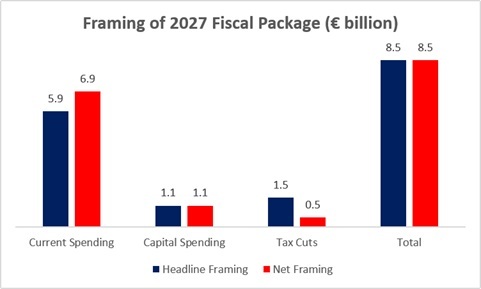
Nothing. The overall fiscal package stays the same: €8.5 billion. Current spending rises from €5.9 billion to €6.9 billion. But the tax-cuts package falls from €1.5 billion to €500 million after the wealth tax revenue is factored in. The overall fiscal package is based on net spending and tax. If the Government or commentators suggests that current spending cannot exceed €5.9 billion or exceed €105.2 billion, they are misleading people. Quite simply, current spending could rise significantly if additional tax revenue is raised.
And this gets to the nub of the debate over the budget. There is little doubt that over the short- and medium-term spending will have to increase given the impact of slowing growth, climate change, ageing demographics; never mind investing in a strong social state while ending our over-reliance on multinational tax receipts. That’s why the Commission on Taxation claimed:
‘. . . revenues raised from taxation and Pay Related Social Insurance (PRSI), as a share of national income, will have to increase materially over the coming years.’
We should be increasing overall tax revenue, not cutting it. We need to stop hollowing out our tax base as if this were 2006 all over again. By increasing tax revenue, we can develop a strong social state – enhanced public services, increased in-work benefits, poverty-busting social protection programmes – while maintaining a robust public investment profile. This can all be done within sustainable fiscal parameters.
The debate should be about what taxes to increase, or what new taxes to introduce, that would be the most economically efficient and socially equitable. Then the debate could turn to what progressive programmes should be prioritised.
But how likely is that to happen?


Leave a Reply