
You know we’re getting closer to budget day. Misinformation and ill-informed commentary about tax rates proliferate. In particular, the claims that middle-income earners are highly-taxed, more than most other EU countries. These are feeding into a ‘squeezed middle’ and tax-cutting narrative.
However, these claims are wrong. Middle-income earners are not highly-taxed. In fact, they are one of the lowest taxed in our EU peer group (other high-income countries). Let’s do something that could be considered revolutionary; let’s go through the evidence from the latest edition of the OECD’s massive 667-page ‘Taxing Wages 2026’.
Average or Effective Tax Rates
The average, or effective, tax rate measures how much tax you pay as a percentage of your gross income. For instance, if you have an annual income of €30,000 and you pay €10,000 in income tax (including USC) and PRSI contributions, your effective tax rate is 33%. It’s a pretty straight-forward calculation.
Note: All tables below refer to a single person with no child dependents on average full-time earnings.
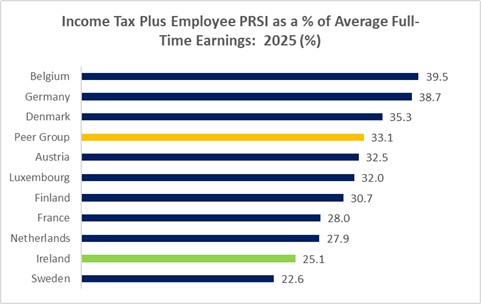
The average Irish tax rate for middle-income earners is 25%; that is, for an average full-time employee earning €60,250. This is well below the peer group average tax rate of 33%. We are second from the bottom among our peer group and the seventh lowest in the EU. Irish middle-income earners are not ‘heavily’ taxed. If anything, they are ‘under-taxed’.
There can be no way to spin this (though that won’t stop the spinners). Irish tax rates for middle-income earners are low – compared to some countries, ultra-low.
NOTE: some people might be surprised that the average tax rate in ‘high-tax’ Sweden is at the bottom of the table. That is because employees’ social insurance contributions (PRSI) are paid by employers. And these payments are very high. In Sweden, employers’ PRSI and payroll levies make up 28% of total wages and salaries; in Ireland, it is 9%.
What about other earners – the lower paid and the higher paid?
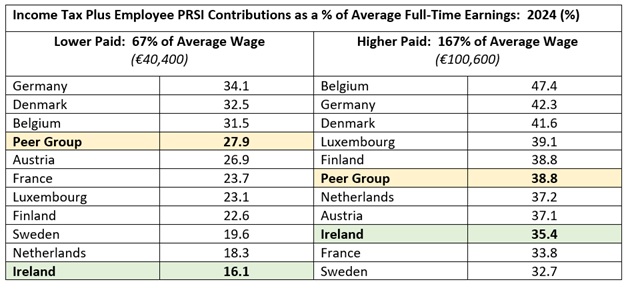
- For lower paid workers, the average tax rate in Ireland is at the bottom – 16% of the gross wage is paid out in tax/PRSI; our peer group average 28%.
- For the higher paid, Irish tax rates are still below our peer group.
To summarise, there is no evidence that Irish employees pay a ‘high’ rate of tax compared to other EU countries. If the middle is being squeezed, it’s not tax rates doing the squeezing.
This data can be found on page 82, Table 3.3.
Marginal Tax Rates
Marginal tax rates measure the amount of tax we pay on the extra Euro we earn. For instance, if you earned €30,000 in 2024, and got a wage increase of €1,000, your ‘marginal tax rate’ on that increase would be 27.1%: 20% income tax plus 3% USC plus 4.1% PRSI contributions.
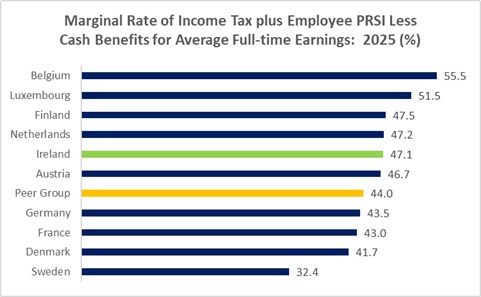
Irish marginal tax rate for average earnings is mid-table, only marginally above Austria. It is also only 3 percentage points above our peer group average. This can hardly be considered ‘burdensome’.
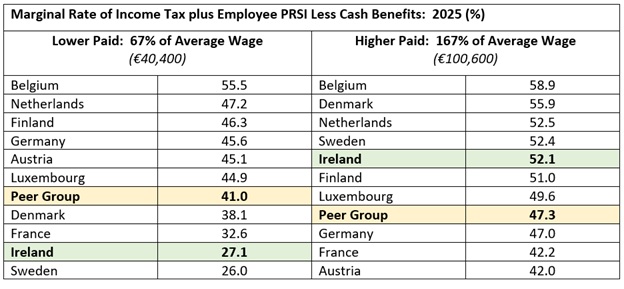
- Among the lower paid, the marginal tax rate is second from the bottom
- Among the higher paid, Ireland is mid-table, above our peer group average.
It should be re-emphasised: this is not a measure of the average tax rate. It only measures the tax rate on the additional Euro earned. For instance, among the higher paid, the German marginal tax rate is 47%. This is lower than the Irish rate of 52.1%. Does this mean that at the higher end, Irish employees pay more tax than German employees? No. As shown above in the table on average tax rates, German employees at the higher end pay 42% of their wage on tax and PRSI. Irish employees pay only 35%.
This data can be found on page 90, Table 3.7.
* * *
Let’s summarise:
- Average tax rates in Ireland are well below our EU peer group average – from the lower paid to the higher paid.
- Marginal tax rates are low for the lower paid, but rise above our peer group for average and higher paid employees. But it should be noted that for average Irish earners, the marginal tax rate is mid-table, ranking 5th out of ten countries.
There is a lot of confusion and misinformation regarding Irish taxation. It was refreshing to come across this article which stated clearly: ‘Irish income taxes are below average and closer to US than many EU peers, OECD data shows’. It explained how low average tax rates exist alongside higher marginal tax rates:
‘The marginal rate here is high, at 52% – but the impact is softened by a large share of income that is lightly taxed or not taxed at all.’
Unfortunately, we don’t get enough of this type of analysis. Instead, we get is a deluge of tax rates, numbers and metrics which, in many cases, is a kind of ‘flood-the-zone’ exercise masquerading as a tax-cut agenda.
The OECD database helps cut through all this but it will take a lot more work for this to make its way into the public debate.


Leave a comment