
The latest tax-cut kite comes courtesy of Michael Healy-Rae, TD. He proposes that income tax on overtime earnings be capped at 20%. Currently, if you are in the top tax rate, you will pay 40% on overtime earnings. Healy-Rae is proposing this should be reduced to 20%.
There are problems with this proposal.
First, it wouldn’t benefit most employees. 70% are not in the top rate of tax. For employees on the 20% standard tax rate, the cap of 20% would have no impact. The proposal is regressive – benefitting higher-income earners with no gain for most workers.
Second, it doesn’t address the issue of unpaid or underpaid overtime. This is where employees are required to work overtime but don’t receive pay (unpaid), or don’t receive additional pay (underpaid).
Lastly, it comes with a hefty price tag. The Parliamentary Budget Office estimates it would cost €240 million, rising to €330 million in 2031. This would further erode our tax base and push us further into reliance on volatile multi-national receipts.
In 2024, hourly overtime earnings were 4.8% higher than hourly regular earnings (my own calculation). So, there appears to be is a small premium. But Eurofound reported one Irish survey of professional workers:
‘Some 65% of respondents reported working overtime (time in excess of their weekly contracted hours): 32% worked 5 hours extra, 19% worked between 6 and 9 hours extra and 14% worked 10 hours extra or more. Of those reporting overtime, 75% stated that they were not compensated for that extra work.‘
Needless to say, Healy-Rae’s proposal won’t have much impact on this.
But his proposal does raise a larger issue – how do we compensate employees for overtime work. Currently, there is no statutory requirement for Irish employers to pay overtime. This makes Ireland an outlier as most EU countries stipulate the amount of compensation to be paid for overtime work.
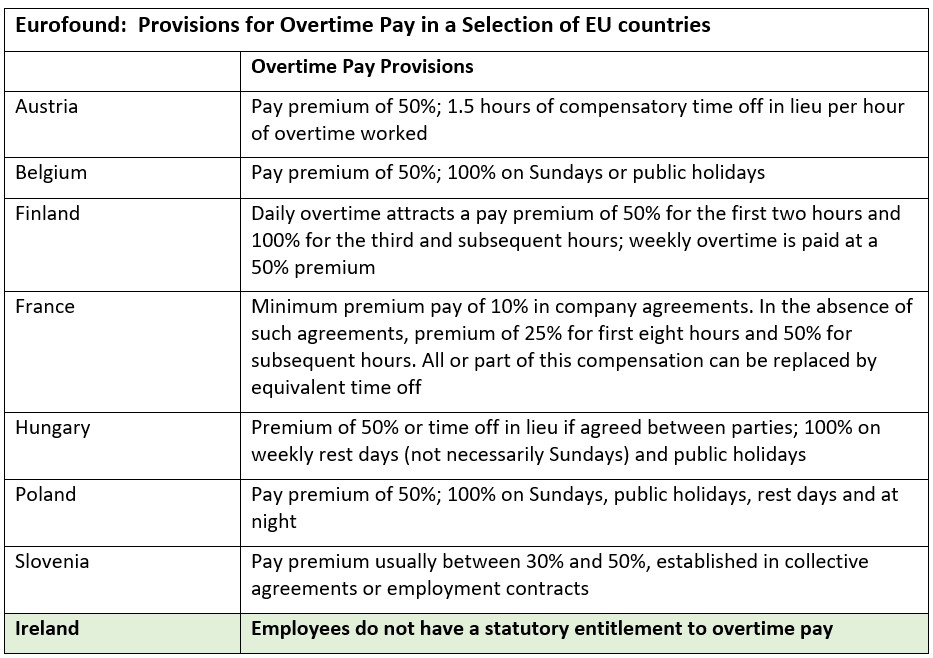
In some EU countries such as Germany, Denmark and the Netherlands, overtime pay is left to collective bargaining – primarily sectoral collective bargaining. Given that the majority of workers in these countries are covered by collective agreements, workers benefit (in Ireland is a third). For instance, in Denmark – with no statutory provisions but with 80% coverage – typical overtime pay premium is 50% and can go up to 100% for work performed on Sundays or at night.
There are some exceptions in Ireland. Overtime in the construction sector is covered by binding overtime pay provisions through a negotiated Sectoral Employment Order (SEO):
- Weekdays: 150% from normal finishing time up to midnight; 200% between midnight and normal starting time
- Weekends: 150% for the first four hours from normal starting time; double time after that up to midnight. For Sunday, double time for all hours worked.
- Public Holidays: double time for all hours plus an additional days’ leave
So here is an alternative to the tax cut proposal: the Irish Government should introduce statutory rates of overtime pay . The norm throughout Europe seems to be 50%. This would be a superior way to compensate workers:
- All employees would benefit – not just those in the top rate of tax
- All employees, regardless of what sector they work in, would get a similar benefit
- It wouldn’t cost the Exchequer
Ultimately, Healy-Rae’s proposal puts the cost of overtime payments on to the taxpayer (effectively subsidising the employer) whereas overtime pay should be part of every employees’ compensation package, paid by the employer.
But the most effective way that employees can ensure they receive appropriate overtime is to organise themselves in the workplace. Trade unionists in a particular firm would be more effective in policing unpaid or underpaid overtime.
Statutory rates of overtime would be the first step in that direction.


Leave a Reply