
At the Fine Gael Ard Fheis, the party leader Simon Harris went out of his way to cynically target the long-term unemployed.
‘The dole is a safety net, not a way of life. At a time of full employment, it is simply not acceptable for any person to remain on the Live Register year after year after year. . . We need a renewed focus on intensive engagement with the long-term unemployed — tackling barriers, creating opportunities and getting people into work. And let me be clear, for those who refuse to engage, there will be penalties.’
The Tánaiste got the headlines he wanted, highlighting his ‘way of life’ reference and the promise of ‘tough penalties’ for those who refuse to engage. In so doing, he painted a picture of a large number of people idling away on the dole, gaming the system and sleeping in. It wouldn’t be the first time a party leader, faced with faltering poll and satisfaction ratings, went looking for targets.
There are few chronically long-term unemployed.
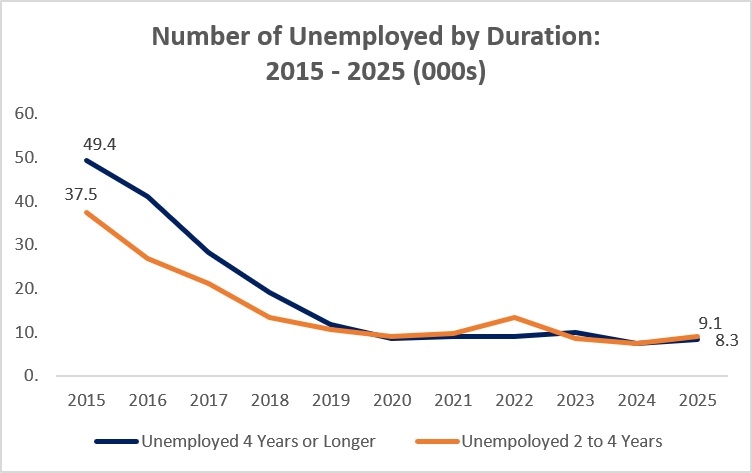
There are only 8,000 people unemployed ‘year after year after year’, in the Minister’s words; that is, unemployed four years or longer. There are a further 9,000 unemployed between two and four years. Compare that to the 2.8 million people in the labour force.
What is noteworthy is the fall in the number of chronically, long-term unemployed over the last 10 years. In 2015, there were 87,000 people unemployed for two years or longer – combining the numbers above. 10 years later, this fell to 15,000 – a fall of over 80%. The Tánaiste is trying to make an issue out of an issue that is becoming less of an issue in each passing year.
It’s not as if Ireland is an outlier in the EU. The number of chronically long-term unemployed as a percentage of total unemployed in is lower than the EU average and only marginally above our peer group.
The Tánaiste’s promise to introduce penalties for those long-term unemployed is even more bizarre as there are already penalties for people who do not engage with labour activation measures. An initial penalty is a reduction in social protection payment (e.g. €100 for Jobseekers’ Allowance – it used to be €44). Further failure to engage can result in a suspension of payments for nine weeks. The Examiner reports that 11,000 people on Jobseekers’ Benefits and Allowances were penalised by the Department in 2025, up from 10,200 the previous year. This was out of a total number of over 160,000 on some type of unemployment support.
So what is the Tánaiste talking about? There are penalties and they are being applied. Does he want harsher penalties (jail-time, work-farms) and a wider net? Talk of ‘tackling barriers, creating opportunities’ is all well and good. But the headlines the Minister was seeking was not the detail of a new labour activation programme. It was about get-tough news coverage as per the headline in the Sunday Independent:
‘Simon Harris vows to penalise people avoiding work’.
The Tánaiste could have used his Ard Fheis speech to launch innovative policies to increase opportunities for people who are disadvantaged in the labour market (few skills, minimal education, health challenges, etc.). An Employer of Last Resort programme could help address chronic long-term unemployment while at the same time providing work for the 162,000 people who want to work but are outside the labour force and, so, do not feature in unemployment figures.
Or he could have addressed the dire conditions that many unemployed face. 42% of unemployed experience enforced deprivation. Where are the proposals to lift living standards?
But, no, the Tánaiste used his speech to punch down on people who are economically and politically extremely vulnerable. This is not leadership.
This is political thuggery.


Leave a Reply