
Simon Harris claims his focus in the upcoming budget is on supporting people ‘who get up early every morning and go to work’. Yet:
- One of the first things his government did on taking office was to postpone the target date for introducing the Government’s living wage from 2026 to 2029. So much for early risers on low pay.
- Recently, the Government increased public transport fees by an average of 15% (or €200 for a short-leap fare per year). So much for helping out early risers on public transport.
- Then there’s his government’s housing minister admitting that rents may have to increase as a consequence of his Rent Pressure Zone policy. As if rents haven’t been rising fast enough.
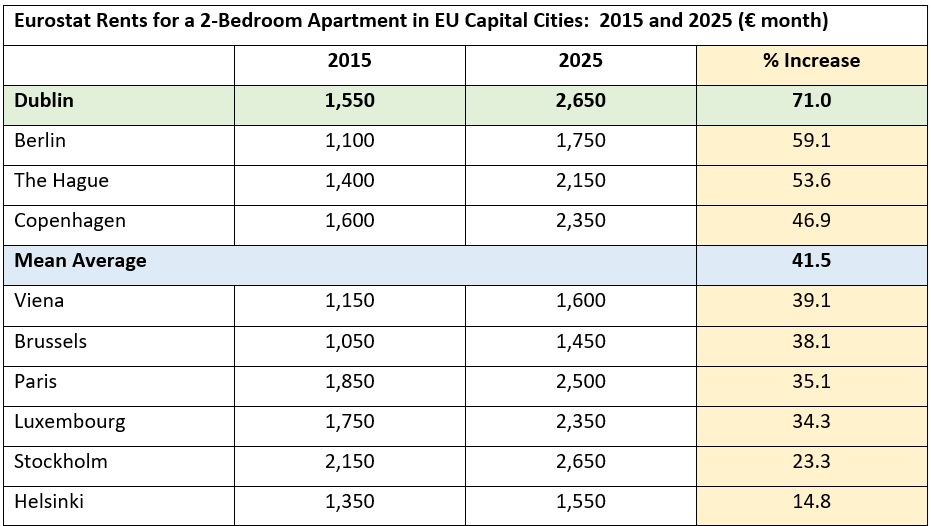
In the last decade Irish rents rose by 71%, well in excess of other cities. Hasn’t that been enough to woo investors? Apparently not.
- And don’t forget his Government’s decision in last year’s budget to freeze and, so, cut, in real terms, tax credits and tax bands for the early risers.
But there’s so much more for early risers to consider.
Wage Increases: Early risers who negotiate collectively with their employers receive, on average, 10% higher pay. However, the Government refuses to give most early risers this tool to negotiate higher wages, effectively handing employers a 10% wage suppression premium. As if VAT cuts for hospitality owners and developers wasn’t enough.
Visiting a GP: Compared to early risers in other European countries, Irish early risers pay a lot just to visit a GP. The Social Democrats’ Pádraig Rice, TD, stated in the Dail earlier this year:
‘GP care should be free. It costs nothing to see the GP in most European countries, including Austria, Czechia, Denmark, Estonia, Germany, Greece, Hungary, Italy, Lithuania, Malta, the Netherlands, Poland, Portugal, Romania, Slovakia, Slovenia and Spain. If you are in Croatia, Bulgaria, France or Latvia you pay just €1 or €2 to see your GP while in Belgium and Luxembourg it costs no more than €7. In Cyprus, it is at most €15 . . . Nowhere else in Europe would you be paying between €50 and €90 just to see the GP.’
Back to School Costs: early risers with children have experienced exponential increases in back-to-school costs.
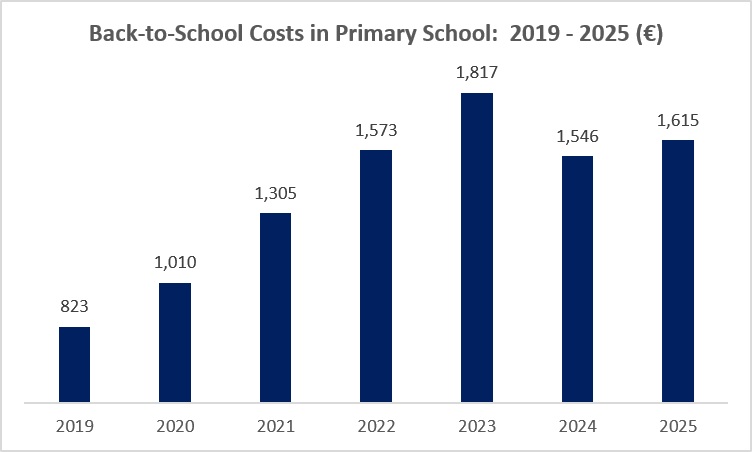
According to Zurich insurance, back-to-school costs at primary level have increased by nearly €800 over six years, effectively doubling. Back to school costs at secondary level are even higher at approximately €3,000 which helps explain why 24% of households had to borrow money cover secondary school costs.
Childcare: we all know that childcare costs exceed levels that exist throughout Europe. Pobal’s data shows the median cost of full-time private childcare is €210 per week, rising to €250 or more in most parts of Dublin. The Government has acknowledged this and set a goal of reducing the cost of childcare to €46 per week. Already, many households benefit from a means-tested National Childcare Scheme subsidies. But still, reducing fees by nearly 80% is a big task.
* * *
Incomes, housing, public services: there’s a lot of work that early risers must undertake before they head off to work. What’s noteworthy is that, unlike energy costs which are based on factors beyond government control, issues such as primary healthcare, costs of education, housing, and public transport costs are in government’s control. And giving early risers the industrial tools to negotiate higher wages would not cost the Government anything; indeed, it would increase revenue from the higher wage as higher wages result in higher tax revenue.
Making progress on these cost-of-living goods and services would help reduce financial burdens on households. And there are a lot of in-work early rising households that need help.
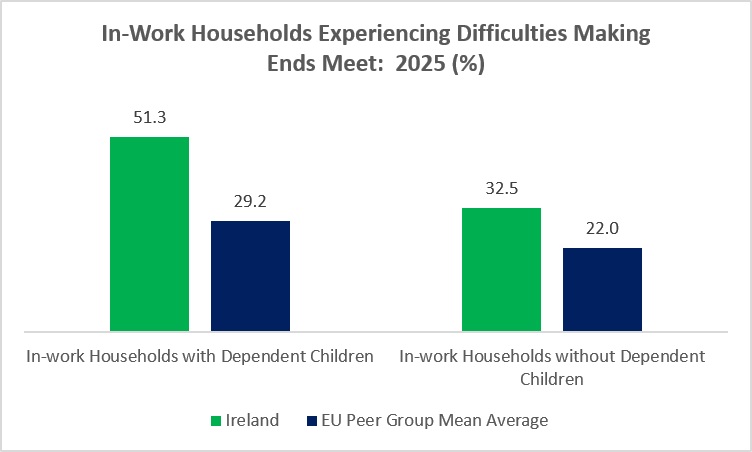
Using households earning above the 60% relative poverty line as a proxy for at least one household member in work, we see that over 50% with children are finding it difficult making ends meet. This is 75% higher than the average of our EU peer group.
So we should slightly amend Harris’s pledge: he wants to support people who get up early in the morning and go to work – except for the low-paid and workers who get sick or take the bus to work or rent or visit a GP or have children.
Bring on Budget 2027.


Leave a comment