
The economy benefits from productive companies: investment, wages, pricing and environmental sustainability. In times of crisis they are more resilient with fiscal buffers, reliable sources of capital and the ability to innovate in partnership with employees. What the current energy crisis has shown (or should show) is how inefficient Ireland’s road haulage sector is. It has the worst levels of productivity in comparison with our EU peer group, the lowest levels of investment and the lowest wages. In short, when the crisis hit, its frailties were exposed.
But instead of reforming and future-proofing the sector, the government is subsidising it after a number of hauliers spent days subjecting the country to an economic blockade. Let’s survey this sector.
Low Productivity
Productivity measures the efficiency of enterprises and their ability to generate value-added. This is the source of wages, profits, re-investment and economic growth.
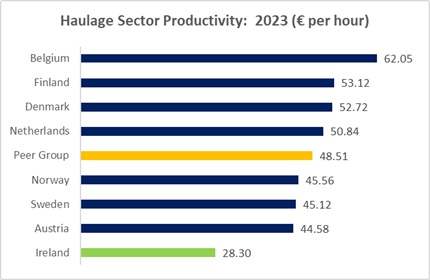
The Irish road haulage sector is at the bottom of the table. It would need to increase productivity by 71% to reach our peer group average. This is an appalling level of commercial non-performance.
Unsurprisingly, with such low levels of productivity, the Irish road haulage sector is a bottom-dweller when it comes to investment.
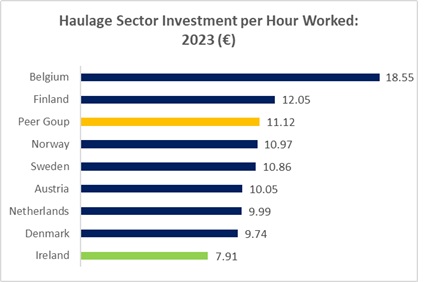
Ireland would have to increase investment in the sector by 40%. What would they invest in? Electric HGVs and other large trucks. Unsurprisingly, the Irish haulage sector purchases fewer e-trucks than our peer group. Irish companies bought 1 e-truck or bus per 1,000 employees; Danish companies purchased nearly 17 per 1,000 employees. Companies in our peer group purchased nearly 9. Professor Hannah Daly pointed out that:
‘ . . . In China, sales of fully electrified heavy goods vehicles outstripped diesel models in December last year. Meanwhile, Ireland is falling behind: only one single electrified HGV has been registered so far this year.’
While e-trucks still make up only a small part of the market, clearly our ‘competitors’ are pulling ahead of our performance.
Low productivity, low investment: no wonder wages are so low – ultra-low.
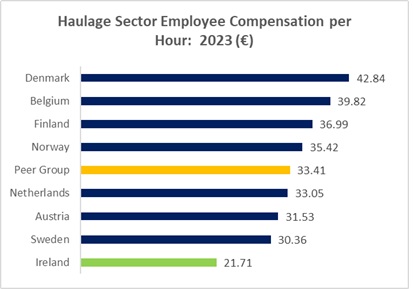
Irish hourly wages in the haulage sector would have to increase by over 50% to reach our peer group average. And if that isn’t bad enough, Irish employees in the haulage sector work over 40 hours per week compared to our peer group’s average of 31 hours per week.
The last Government published ‘Ireland’s Road Haulage Strategy 2022–2031’. It didn’t mention, never mind analyse, the sector’s poor productivity performance. Admittedly, it would be difficult to transform this largely domestically-owned sector (as it would for other sectors) but starting with an accurate picture would help.
Clearly, there are natural disadvantages the sector faces in attempting to scale up or expand; namely, that we are an island nation with little trade internationally. It is heavily reliant on national trade. However, other countries with similarly high levels of national trade are much more productive and prosperous.
- For instance, in Denmark and Sweden, two countries with much higher levels of productivity, national trade makes up over 90% of total trade – just as in Ireland.
- The difference could be that, in Ireland, own-account or self-employed make up 44% of transported goods. In Denmark, that figure falls to 15% and in Sweden the self-employed make up 7%.
This could be a big contributing factor – a fragmented sector with high levels of sub-contracting and little capacity to invest and absorb external shocks.
What can be done? ICTU’s New Economic Model outlines two potential steps.
- First, establish a sectoral planning committee focused on productivity. This could be based on the sectoral task-forces which were proposed by the previous Government but were never implemented. This would bring together all the major stakeholders, along with market experts, to plan out a more productive and decarbonised future. The Government does sponsor a ‘Road Freight Forum’ which meets three-to-four times a year but it is not representative of the sector (no employee representatives) and is little more than a box-ticking exercise.
- Second, grant-aid only those companies in the sector that are ‘Good Companies’. There are companies who are modern-facing and realise the importance of collective bargaining, reinvestment over dividends, decarbonisation, training and career development, etc. We need strong companies that will invest in the sector – where employees and employers sit down together to negotiate the future at enterprise and sectoral level. Subsidies to these companies make economic sense. For instance, we could introduce a trade-in scheme for adopting electric vehicles (h/t to Tom McDonnell for this suggestion). This would be a better alternative than never-ending fuel subsidies.
These measures won’t address our problems in the short-term. But by launching them now – sectoral planning and supports for Good companies – we can start to build a competitive, productive and resilient sector.
We can start future-proofing the haulage sector with progressive policies rather than subsidising inefficiency and poor commercial performance.
 Notes on the Front
Leave a comment