
The Taoiseach is worried these days:
‘The Government is concerned that wages will grow too fast next year, damaging Ireland’s competitiveness and undermining future economic growth, Taoiseach Leo Varadkar has warned.’
We could be mischievous and contrast this with the Taoiseach’s championing of the ‘early-risers’, those who get out of bed and go to work. The Taoiseach could be seen to be sending mixed signals: does this warning against wage growth suggest the ‘early-risers’ should get up even earlier if they want a pay rise?
But let’s not be negative – not this early in the New Year – and, instead, ease the Taoiseach worries. There may be threats to our ‘competitiveness’ and ‘economic growth’ but wages and wage growth is not one of them. Here’s where Irish wages stand in our EU peer-group table in 2016.
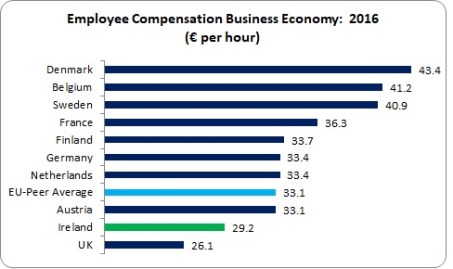
In the business economy (essentially, the private sector) Ireland is at the bottom of the table, only above low-pay, low-productivity UK. We’re a long ways from our peer-group countries.
But are wages growing too fast – that is, now? Are we in danger of (in that wonderful phrase) ‘over-heating’? Again, let us put the Taoiseach at ease.
In the last five years, wage growth in our peer group has been 9.8 percent; in Ireland it has been 5.2 percent – nearly half that of the other countries.
Only in the last year, has Irish wage growth equalled the other countries. Does this indicate a troubling trend? Let’s cut to the heart of this dismal competitiveness debate by looking at one sector: Information and Communication which includes digital companies (the Facebooks and Googles).
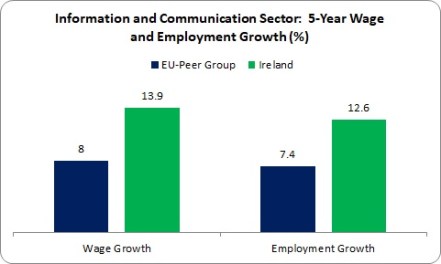
Over the last five years, wage growth in Ireland substantially outpaces our peer group. So this should have negative repercussions on jobs and growth, right? Well, no: Irish employment growth in this sector also substantially outpaced our peer group. One could argue that there are mitigating explanations (e.g. this sector isn’t as wage-sensitive as other sectors), and some of them may have a point. However, the point here is that a straight reductionist equivalence between wages and ‘competitiveness’ and ‘economic growth’ is simplistic.
Maybe that explains why countries like Denmark, Belgium and Sweden with substantially higher wages than Ireland (see the first chart – business economy wages are above €40 per hour while Ireland is less than €30) still rank much higher in the Global Competitiveness Index than Ireland:
- Sweden ranks 3rd in our peer group, Denmark ranks 6th, and Belgium ranks 8th.
- Ireland ranks last – even behind low-pay, low-productivity UK.
The work of relieving the Government’s concern is good and important. This will hopefully help them to focus on much more important threats to competitiveness and economic growth: rising rents and house prices, poor infrastructure (that same Global Competitiveness Index ranks our infrastructural quality 52nd in the world), skills and training, managerial quality – especially in the indigenous sector – and social services such as affordable childcare.
We’re even seeing that in the ‘disappointing number of financial companies’ planning to move to the IFSC in the post-Brexit environment. Instead, companies are moving to places like Frankfurt, Brussels and Paris – countries with higher wages, higher taxation, more financial regulations; they’re even introducing the Financial Transaction Tax (Ireland’s refusal to introduce the FTT was supposed to be an incentive to companies fleeing London). Being low-waged, low-taxed and low-regulated is no guarantee of foreign investment or business re-location.
No, it’s not the level of wages or the pace or wage-growth that we should be worried about when it comes to competitiveness. On that issue the Taoiseach can rest easy. Hopefully, though, his government will get a little more restless, a little more concerned, a little more urgent in 2018 when it comes to building a truly competitive economy.


Leave a Reply