
Today the new insolvency service goes live. Today is the beginning of a new kind of
poverty – insolvency poverty.
Our rulers, giving deep consideration to the problems posed
by household debt, have designed a solution.
Does it write down the debt caused by the financial institutions? Well, er, not exactly. The solution requires that men, women and
children undergo poverty-line existence for up to six years – and to do so
publicly by having their names published on a register. Included in this regime is the creation of a new
professional class – Personal Insolvency Professionals – who will assist people
to navigate their poverty experience and in many (most) cases will get an
upfront payment. Insolvency poverty and
insolvency poverty professionals -you really couldn’t make this stuff up. But they did.
When people apply for debt relief their living standards
will be based on the
Insolvency Agency’s ‘reasonable living expenses’. According
to the Insolvency website, reasonable living expenses are defined as:
‘. . . the expenses a person necessarily incurs in
achieving a reasonable standard of living, this being one which meets a
person’s physical, psychological and social needs.’
The
insolvency regime sets down a schedule of such expenses: food, clothing, household goods, utilities,
personal care. It will be for the creditors to approve the reasonable
living expenses regime applied:
‘ . . . the
decision on the reasonableness or otherwise of living expenses will be a matter
for the creditors to determine on a case-by-case basis . . .’
Imagine the scene:
creditors sitting around a conference table in a corner office
overlooking the Liffey, ticking off all the expense boxes for John and Mary,
discussing whether this item or that constitutes ‘reasonable’.
But the Insolvency Service is anxious to prove that their
expenses regime is ‘reasonable’. They claim
that their numbers are based on the model developed by the Vincentian Partnership for Social Justice. The VPSJ has done tremendous work in
ascertaining the minimum level of expenditure that constitutes a living
standard that no one should have to live below.
There are two points here.
First, the VPSJ’s minimum standard is a campaign tool to level-up – to
raise people’s living standards up to a minimum standard. Far too many people live below this minimum
living standard. The Insolvency Service
is using this minimum standard to level-down.
Second, while the Insolvency regime claims their ‘reasonable
living standards’ is rooted in the VPSJ estimates, they add this rider:
‘The
Insolvency Service has decided to use a model (“ISI model”) which is a modified
version of the consensual budget standards model originally developed by the
Vincentian Partnership for Social Justice.’
How
modified? Let’s look at a simple example of a single adult comparing the
Insolvency Agency’s reasonable living expenses and the VPSJ’s minimum standard. The Insolvency Agency uses two indices – one with
car needed and one with no car needed.
The VPSJ doesn’t make this distinction.
Rather, it uses urban and rural.
However, the Insolvency Agency makes it clear that for the most part, a
household in an urban area doesn’t need a car.
So the two different measurements are similar in this respect. Let’s see how they compare.
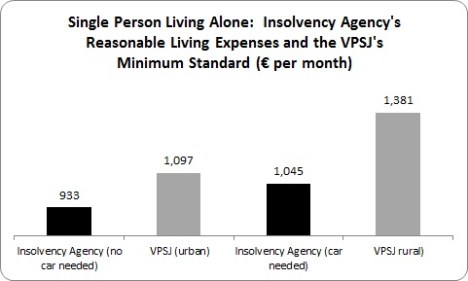
The
Insolvency Agency’s Reasonable Living Expenses is 15 and 24 percent below the
VPSJ’s minimum standard in urban and rural areas respectively.
Let’s look
at two examples which the Insolvency Agency highlights. The first is for a single adult household
with two children, aged 3 and 10.
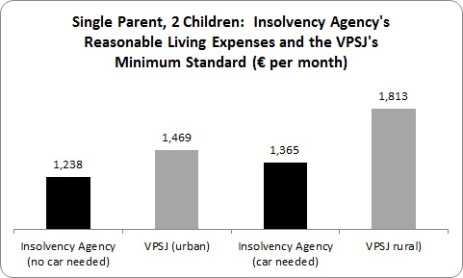
In this
example – a single parent with two children – we find the Insolvency Agency’s
Reasonable Living Expenses are between 16 and 25 percent below the VPSJ’s
minimum living standard in the urban and rural areas respectively.
The second illustration
is that for a couple with four children – aged 3, 5, 10 and 14.
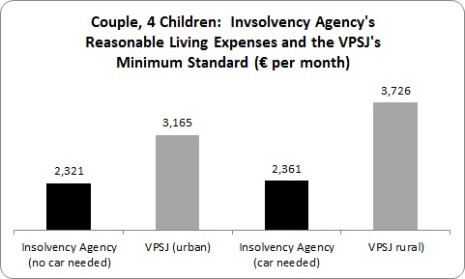
For a couple
with four children we find the Insolvency Agency’s Reasonable Living Expenses
are between 27 and 37 percent below the VPSJ’s minimum living standard in the
urban and rural areas respectively.
There is a
trend in these three examples: rural
households and households with children are particularly discriminated against
under the Insolvency Agency’s reasonable living expenses. Of course, there are just the guidelines –
but, as noted above, it will be left to the creditors to allow any
flexibility. The Insolvency Service notes:
‘Reasonable
living standards may be higher than these guidelines propose where acceptable
to creditors. This may occur where creditors can see value for themselves in
incentivising the debtor.’
So it may
not be so bad; but note that it is whether the creditors see a value for
themselves – not for the householder, not for the wider community.
Whatever flexibility
is applied, households will struggle to achieve a minimum living standard as defined
by the VPSJ. This will create a
poverty-line existence for those households who participate in this scheme – an
existence that can last up to six years, that will be made public and which
will not necessarily erase all debts on the other side (we discovered recently
that banks could still make claims after the six year period).
This is
nothing but the playing out at household level what was experiencd in the
general banking debt crisis. Creditors were
repaid and private debts were put on the public books. Now, we have private debts being repaid and
the burden placed on the households.
Irish people
has been hit by three damaging consequences:
first, the banking crisis tanked the economy which costs jobs and
incomes; second, private debt was put on public books which justified austerity
policies which destroyed even more jobs and incomes; and now, third, households
have to undergo up to six years of public poverty-line existence with no
guarantee that banks will wipe out the debt at the end of the period.
And with the
debate focused on the details of the insolvency arrangements (important details
to be sure), we are in danger of forgetting to ask the more fundamental question: is the best we can do to relieve households
and the economy from a debt crisis that originated in the private financial
sector?


 Notes on the Front
Leave a reply to Jason Loughrey Cancel reply