
The Government seems to have done a U-turn on the issue of
tax exiles. Despite the Programme for
Government’s commitment on the issue, the Sunday Business Post reports that
following an avalanche of submissions from the likes of the American Chamber of
Commerce, etc. the Minister for Finance looks to do nothing. Why?
Because it would undermine investment.
Minister
Brian Hayes was also at it – claiming that tax increases were effectively
over. Minister
Lucinda Creighton backed up her party colleague. And Minister
Richard Bruton also warned against further tax increases on high-income
groups; again, because of that ol’ investment problem.
Do we see a pattern?
If we increase taxes on high-income groups or the business sector we
will lose out on investment. How valid
is this argument?
Let’s bottom-line this:
if maintaining a low-tax regime, whether on high-income earners or the
business sector, is the key to ensuring high levels of investment in the
economy, then that policy has already been judged to be an utter and absolute
failure.
Okay, now let’s work through some arguments.
First, Irish high-income earners pay a lower tax rate than
equivalent earners in most other EU-15 countries. The following is from the OECD
Tax and Benefits Calculator, using a two-income household example where one
person is earning twice the average wage and another person earns 1.67 the
average wage. In Ireland, this equals
€118,750.
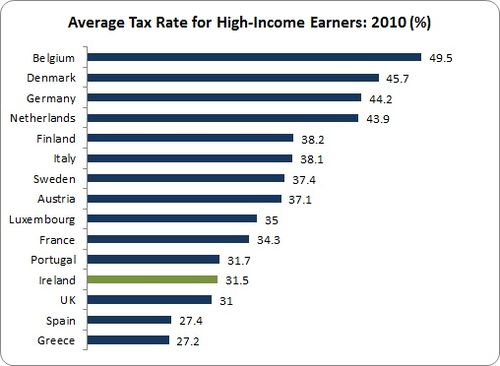
As seen, Irish high-income earners are taxed at relatively
low-rates. We’re right down there with
other peripheral countries (with the exception of Italy) and low-tax,
high-poverty UK. There has been tax
increases since 2010. The current rate
is 33.7 percent but we don’t know to what extent other countries have increased
taxes. We should also note that the
above doesn’t include local taxation (property taxes, service charges, etc.)
which are higher in a number of other countries. Nor does it include tax breaks (these are
just headline figures).
In effect, in 2010 two-income earners would have to pay over
€6,000 more a year to reach the average of other EU-15 countries; they would have
had to pay nearly €12,000 more to reach the average of other small open economies;
and they would have had to pay over €15,000 more to reach German levels.
Second, Irish
corporate tax rates are ultra-low compared to other EU-15 countries.
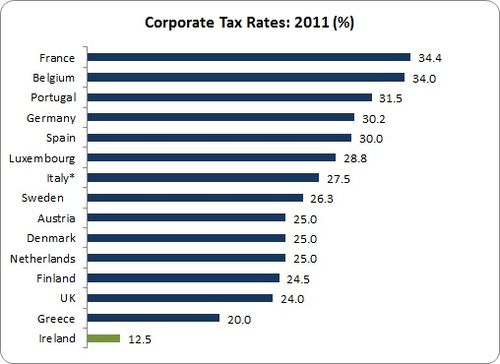
Of course, these are headline rates. Effective tax rates in other countries (after
tax breaks, allowances, etc.) would be lower than the rates above. But so would it be in Ireland – especially given that
Google’s tax rate (as a percentage of gross profits) was
less than one percent.
Third, employers’ social insurance (i.e. PRSI) in Ireland is even
lower relative to other EU-15 countries.
We are ultra-ultra-low.
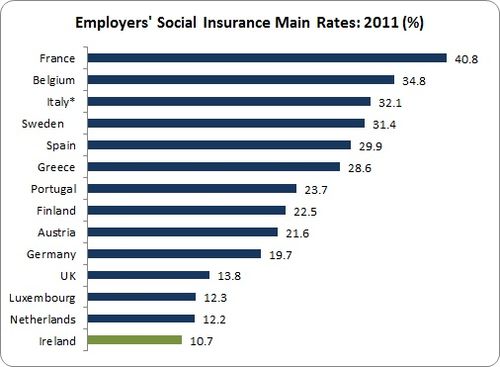
Yes, there we are again – at the bottom.
So what do we have?
All those other countries are doing what we have been warned
against: higher tax rates on high-income
earners and business. This is the type of
thing that would devastate economies according to Fine Gael. Obviously, investment must be flooding out of
those countries. In fact, with such high
tax/insurance rates, they must be facing into an investment crisis.
So what level
of investment does the IMF project for these countries by 2017?
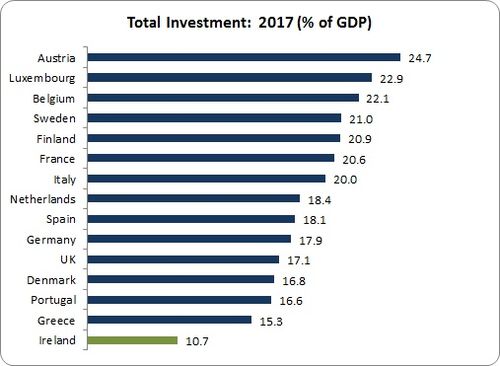
Wow. Ireland has
followed the Fine Gal prescription for higher investment and what do we
find? Ireland will have the lowest level
of investment in the EU-15. The average
investment rate in other EU-15 countries is will be 19.5 percent in 2017; the
Irish rate will be almost half. All those countries with higher tax rates on
profits, income and payroll – they will have twice the level of investment.
In short, low-tax Ireland is facing into an investment
crisis.
So is higher taxation a bar to high investment levels? Obviously not; otherwise Ireland would be a
league leader. In fact, higher taxation
can induce higher levels of investment – through higher public investment, public
consumption and progressive social transfers.
That is what we are seeing in other countries.
In Fine Gael’s Ireland, however, we must not scare the
high-income and corporate horses with talk of higher taxation. Otherwise, they won’t invest.
But as we see, they’re not investing anyway. Beyond the insipid tax debate lays a more fundamental
question: what is wrong with our
economic model?
That is one of the key questions for 2013.


 Notes on the Front
Leave a reply to Fintan Cancel reply