Notes on the Front

Commentary on Irish Political Economy by Michael Taft, researcher for SIPTU

Be Glad You’re Not Living in One of the Those Terrible High-Tax Countries

The Government seems to have done a U-turn on the issue of
tax exiles.  Despite the Programme for
Government’s commitment on the issue, the Sunday Business Post reports that
following an avalanche of submissions from the likes of the American Chamber of
Commerce, etc. the Minister for Finance looks to do nothing.  Why? 
Because it would undermine investment.

Minister
Brian Hayes was also at it
– claiming that tax increases were effectively
over.  Minister
Lucinda Creighton backed
up her party colleague.  And Minister
Richard Bruton also warned against
further tax increases on high-income
groups; again, because of that ol’ investment problem.

Do we see a pattern? 
If we increase taxes on high-income groups or the business sector we
will lose out on investment.  How valid
is this argument?

Let’s bottom-line this: 
if maintaining a low-tax regime, whether on high-income earners or the
business sector, is the key to ensuring high levels of investment in the
economy, then that policy has already been judged to be an utter and absolute
failure. 

Okay, now let’s work through some arguments.

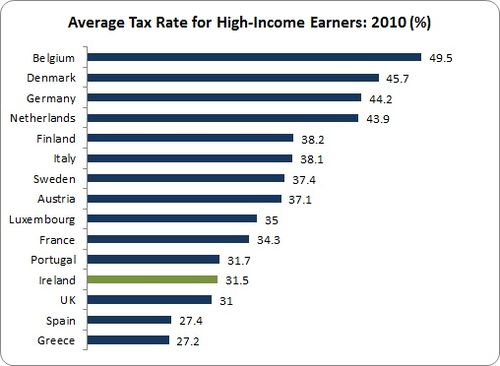
First, Irish high-income earners pay a lower tax rate than
equivalent earners in most other EU-15 countries.  The following is from the OECD
Tax and Benefits Calculator
, using a two-income household example where one
person is earning twice the average wage and another person earns 1.67 the
average wage.  In Ireland, this equals
€118,750.
Investment 1

As seen, Irish high-income earners are taxed at relatively
low-rates.  We’re right down there with
other peripheral countries (with the exception of Italy) and low-tax,
high-poverty UK.  There has been tax
increases since 2010.  The current rate
is 33.7 percent but we don’t know to what extent other countries have increased
taxes.  We should also note that the
above doesn’t include local taxation (property taxes, service charges, etc.)
which are higher in a number of other countries.  Nor does it include tax breaks (these are
just headline figures).

In effect, in 2010 two-income earners would have to pay over
€6,000 more a year to reach the average of other EU-15 countries; they would have
had to pay nearly €12,000 more to reach the average of other small open economies;
and they would have had to pay over €15,000 more to reach German levels. 

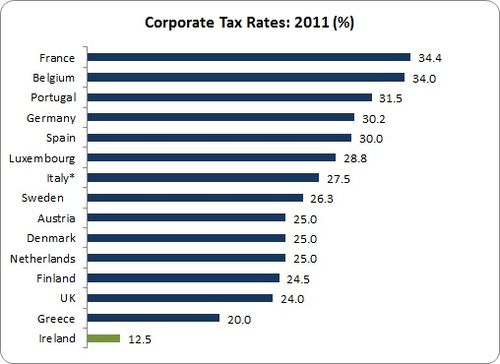
Second, Irish
corporate tax rates
are ultra-low compared to other EU-15 countries.
Investment 2

Of course, these are headline rates.  Effective tax rates in other countries (after
tax breaks, allowances, etc.) would be lower than the rates above.  But so would it be in Ireland – especially given that
Google’s tax rate (as a percentage of gross profits) was
less than one percent
.

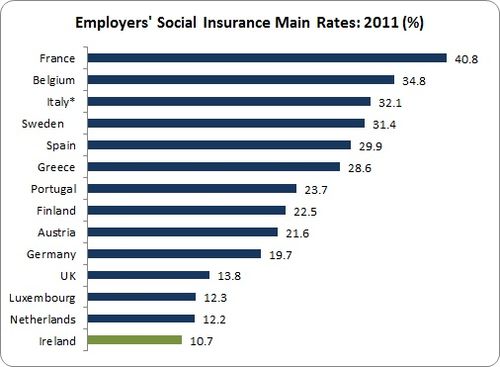
Third, employers’ social insurance (i.e. PRSI) in Ireland is even
lower relative to other EU-15
countries. 
We are ultra-ultra-low.
Investment 3

Yes, there we are again – at the bottom.

So what do we have?

All those other countries are doing what we have been warned
against:  higher tax rates on high-income
earners and business.  This is the type of
thing that would devastate economies according to Fine Gael.  Obviously, investment must be flooding out of
those countries.  In fact, with such high
tax/insurance rates, they must be facing into an investment crisis.

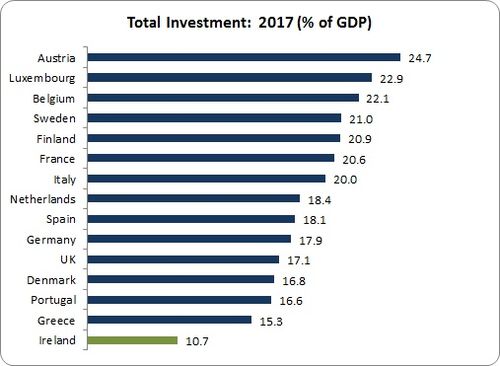
So what level
of investment does the IMF project
for these countries by 2017?
Investment 4

Wow.  Ireland has
followed the Fine Gal prescription for higher investment and what do we
find?  Ireland will have the lowest level
of investment in the EU-15.  The average
investment rate in other EU-15 countries is will be 19.5 percent in 2017; the
Irish rate will be almost half.    All those countries with higher tax rates on
profits, income and payroll – they will have twice the level of investment.

In short, low-tax Ireland is facing into an investment
crisis. 

So is higher taxation a bar to high investment levels?  Obviously not; otherwise Ireland would be a
league leader.  In fact, higher taxation
can induce higher levels of investment – through higher public investment, public
consumption and progressive social transfers. 
That is what we are seeing in other countries.

In Fine Gael’s Ireland, however, we must not scare the
high-income and corporate horses with talk of higher taxation.  Otherwise, they won’t invest. 

But as we see, they’re not investing anyway.  Beyond the insipid tax debate lays a more fundamental
question:  what is wrong with our
economic model?

That is one of the key questions for 2013.

12 responses to “Be Glad You’re Not Living in One of the Those Terrible High-Tax Countries”

  1. Simon Avatar

    Interesting Piece alright. Do you have investment as a % of GNP by anychance?

    Like

  2. Michael Taft Avatar

    Simon – I don’t have any estimates for nominal GNP in 2017. The Government projects GNP to be 78.4 percent of GDP. So, working from the IMF projections for that year, Irish investment would be 12.7 percent of GNP (10 percent of GDP).
    If we use the Fiscal Council’s hybrid GNP measurement – which attempts to reconcile problems with both GDP/GNP measurements – then Irish investment would be 11.5 percent.
    Anyway it is measured, Ireland will still be a low-investment economy.

    Like

  3. tells.it.like.it.is Avatar
    tells.it.like.it.is

    Ah Jaysus, Michael, you’re not even trying to compare like with like.
    The vast majority of the EU-15 countries with higher average tax rates for high earners than Ireland also have much higher average earnings than Ireland, up to 56% higher in fact.
    In each case, the definition of high earner is made in respect of the local average wage.
    Not based on PPP, no attempt to take into account different wage-level distributions that may skew the averages, nor even any level-setting compared some absolute measure of high earnings … just a straight multiple of the local average.

    Like

  4. Michael Taft Avatar

    tells.it.like.it.is – please feel free to post your own estimations in the comment section here.

    Like

  5. Ciaran Avatar

    Michael,
    One practical question I have in relation to the chart based on the OECD Calculator – why did you calculate it on the basis of one partner earning twice the average wage, with the other earning 1.67 times the average wage?
    To answer your last question, our economic model is based on a regressive income tax and social insurance contribution regime, together with a Government-approved system of transnational money-laundering. Never mind that groups such as ISME, SFA and IBEC are indulged in their frequent assertions to the effect that things would be super-duper again if banks lent easy money to their members, while insisting simultaneously that their employees and customers should suffer.

    Like

  6. 6to5against Avatar
    6to5against

    Sorry Michael,
    You must be wrong, because Brian Hayes was on the radio last week and he said that we already had the most progressive taxation system in the world, and nobody in the studio even questioned him on it so it must be true.
    So obviously the facts are wrong.

    Like

  7. Michael Taft Avatar

    Ciaran – I used this formula as this is produces the highest work income for a household in the OECD calculator. It only goes up to 200 percent of average wage for a first earner and 167 percent of the average wage for a partner/spouse.
    6to5against – I never question my betters. I only seek to learn from them.
    However, on the issue of ‘progressivity’ I will be doing up a post in the near future on this issue.

    Like

  8. Ciaran Avatar

    Michael – thanks for clearing that up for me.
    6to5against – are you implying something scurrilous about the conduct of our broadcasters, who, as we all know, are union-infested and ‘left-leaning’?

    Like

  9. David Crowley Avatar
    David Crowley

    As for our (Ireland) low Corporate Tax Rate – must check the figures but I think our corporate tax as a percentage of our tax take is around 10-12%? but in Germany it is only about 5%. While this is only one factor, I think it sounds either our corporate tax rate is doing well or Germany’s isn’t.
    I think if our government actually tried to tighten a few loopholes in our corporate tax laws and let companies like Google/Intel/HP/Facebook/Ebay etc pay more tax in Ireland while still giving them tax breaks and the lower rate we could still keep their inward investment while maybe getting more tax from them

    Like

  10. Fintan Avatar

    Seamus Coffey has responding to this post on his blog.
    It’s social insurance is where we are lower, not tax (we are slightly above average)
    http://economic-incentives.blogspot.de/2013/01/is-ireland-low-tax-again.html

    Like

  11. Des Derwin Avatar
    Des Derwin

    Michael,
    Time to repost all this, Michael. R. Bruton now says, not that there should be no further tax increases, because it is hitting investment, but that Irish tax is too high as is and is hindering investment.
    http://www.irishtimes.com/business/economy/ireland/bruton-criticises-high-income-tax-rates-1.1352025

    Like

  12. Martin Kelly Avatar
    Martin Kelly

    That’s right Des, the budget comes in two months earlier this year and the blue boys are obviously staking out their positions, so far they have held the line while Labour caved in, eg 300 euro cut to carers on 125 euro cut to TDs and Minsters. There is progressive extraction for you. Still ruling by fooling. Martin

    Like

Leave a reply to David Crowley Cancel reply

Navigation

About

Commentary on Irish Political Economy by Michael Taft, researcher for SIPTU