
 One of the keys to an alternative budgetary strategy is to
stop cutting current public spending. This
would provide an opportunity to re-direct or re-invest productivity gains and
spending efficiencies into expanding growth and employment. This would be more effective at repairing
public finances than the current austerity strategy.
Let’s take an example.
The Government reduces the drugs bill by €400 million. This is a good cut. There is likely to be little if any
deflationary impact; jobs will not be lost, income will not fall, and growth
will not be cut. This is one of the few
examples where a cut actually equals a savings of the same magnitude.
What do we do with that cut?
Do we just remove it from public spending? If so, the deficit falls by €400 million but
not much else happens in the economy.
So, why don’t we do something creative with it – address a social
need, increase growth and employment, and reduce household costs? Why don’t we roll out an affordable childcare
programme?
Childcare
in Ireland is one of the most expensive in the OECD and has been identified
as a substantial cost to households in work, or attempting to return to work. What would be the economic and fiscal impact
of rolling out an affordable childcare network?
Let’s first examine the cost of rolling out such a network. Deloitte, on behalf of the National
Children’s Nurseries Association, prepared a detailed study – Review of the
Cost of a Full-Day Childcare Placement (it no longer seems to be available
on-line). They calculated the cost providing childcare places – wages, rent,
insurance, materials, food, etc. In 2007
they found that the average weekly cost of providing a full-time childcare
place was €227.
I updated costs – by increasing non-staff costs by 10
percent and staff costs by 17 percent (employing childcare assistants at
€19,300 is far too low for this important function). When I do this, the cost of providing a place
in a childcare centre comes to €260 per week.
Therefore, the €400 million drug bill saving would, if
re-directed, finance 30,000 affordable childcare places. Does this mean there is no deficit reduction?
Let’s see.
Employment: The €400 million investment in childcare
places would directly create 7,700 jobs – based on the ratios used by Deloitte.
Of course, a portion of this would be a transfer of staff from existing private
and voluntary crèches so that job creation would not be net. Still, there would be considerable job
creation from this. This doesn’t count
the jobs created/retained due to non-wage expenditure – purchasing materials to
run the childcare centres from private sector (purchase of food, materials,
etc.).
Impact on GDP: Being job dense, this investment would
increase in GDP by €350 million. This only
counts the wage element of the expenditure.
There would be additional growth from the non-wage investment.
Impact on Deficit: Using the Department of Finance’s Debt
Sensitivity Analysis, this growth would reduce the deficit by €175 million –
but this would be slightly higher when the non-wage impact is included.
Fees Income: If we assume an average weekly fee of €60
per week at 45 weeks, the potential income would be €80 million. This would reduce the gross cost and, so,
feed into deficit reduction.
There’s more. What’s
the impact on those using this service?
Let’s assume a household is paying €185 a week for childcare for one child. This new public sector-driven childcare
network costs €60 a week. Over the year
(45 weeks) the savings is €5,625. That’s
substantial. What happens to this money?
A large part will be spent in the consumer economy, some may
be saved, and some may be used to pay down debt. It is difficult to assess the economic impact
but it amounts to a mini-stimulus. The total savings to households could be as
high as €168 million (the total savings on childcare costs from 30,000
affordable childcare places) – with a high percentage being redirected into
other consumer spending.
So let’s summarise.
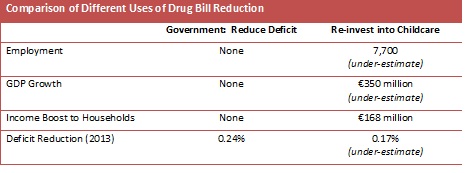
There is no impact on employment, growth and household
income from the Government’s strategy of pocketing the savings on the drugs
bill. By re-investing that savings into
childcare, all these categories turn positive.
And the difference on the deficit is trivial – with the reinvestment strategy
being an under-estimate as it does not include the impact of non-wage
expenditure or the reduction of childcare costs to households.
This is, of course, a back-of-the-Excel –sheet calculation
and, therefore, should only be treated as indicative. Much of this would replace existing activity, though where voluntary organisations exit, this new strategy could just upgrade – which would reduce the overall costs as many of these groups are already subsidised. There may be a reduction in informal childcare as many families cannot afford creche places.
But there are other boosts that are not
included in this short-hand balance sheet; namely, the impact on the little
ones in childcare centres that integrate care and education. This should lead us into a more integrated
package of childcare/early childhood education.
That is the ultimate goal – for this is an investment with one of the
best returns.
The point of this post, however, is to narrowly focus on the
comparative advantages of taking savings and directly reducing the deficit, or
taking the savings and reinvesting into public services. In the case of childcare, it needn’t be a
state agency. A co-ordinated strategy
linking up local authorities, social and voluntary organisations, and
not-for-profit establishments could roll-out the network. The same case can be
made for early childhood education, or primary health care, or support services
for the elderly, or community services for the unemployed, drug rehabilitation
schemes, etc. etc.
This is the lesson, a lesson that the best businesses understand. You don’t downsize, you expand. Drive efficiencies and reinvest. Constantly seek out new opportunities.
And when it comes to children, the opportunities are countless. Serve them and they, in turn, will drive the
economy. So let them play.


 Notes on the Front
Leave a reply to Ciaran Cancel reply