
Notes on the Front

Commentary on Irish Political Economy by Michael Taft, researcher for SIPTU

I Want to be an Agent of Economic Recovery but They Won’t Let me Play!!!

SBNSUBCOVER-articleLargeOne of the keys to an alternative budgetary strategy is to
stop cutting current public spending.  This
would provide an opportunity to re-direct or re-invest productivity gains and
spending efficiencies into expanding growth and employment.  This would be more effective at repairing
public finances than the current austerity strategy. 

Let’s take an example. 
The Government reduces the drugs bill by €400 million.  This is a good cut.  There is likely to be little if any
deflationary impact; jobs will not be lost, income will not fall, and growth
will not be cut.  This is one of the few
examples where a cut actually equals a savings of the same magnitude.

What do we do with that cut? 
Do we just remove it from public spending?  If so, the deficit falls by €400 million but
not much else happens in the economy.

So, why don’t we do something creative with it – address a social
need, increase growth and employment, and reduce household costs?  Why don’t we roll out an affordable childcare
programme?

Childcare
in Ireland is one of the most expensive in the OECD
and has been identified
as a substantial cost to households in work, or attempting to return to work.  What would be the economic and fiscal impact
of rolling out an affordable childcare network?

Let’s first examine the cost of rolling out such a network.  Deloitte, on behalf of the National
Children’s Nurseries Association, prepared a detailed study – Review of the
Cost of a Full-Day Childcare Placement (it no longer seems to be available
on-line). They calculated the cost providing childcare places – wages, rent,
insurance, materials, food, etc.  In 2007
they found that the average weekly cost of providing a full-time childcare
place was €227. 

I updated costs – by increasing non-staff costs by 10
percent and staff costs by 17 percent (employing childcare assistants at
€19,300 is far too low for this important function).  When I do this, the cost of providing a place
in a childcare centre comes to €260 per week. 

Therefore, the €400 million drug bill saving would, if
re-directed, finance 30,000 affordable childcare places.  Does this mean there is no deficit reduction?
 Let’s see.

Employment:  The €400 million investment in childcare
places would directly create 7,700 jobs – based on the ratios used by Deloitte.
Of course, a portion of this would be a transfer of staff from existing private
and voluntary crèches so that job creation would not be net.  Still, there would be considerable job
creation from this.  This doesn’t count
the jobs created/retained due to non-wage expenditure – purchasing materials to
run the childcare centres from private sector (purchase of food, materials,
etc.).

Impact on GDP:  Being job dense, this investment would
increase in GDP by €350 million.  This only
counts the wage element of the expenditure. 
There would be additional growth from the non-wage investment.

Impact on Deficit:  Using the Department of Finance’s Debt
Sensitivity Analysis, this growth would reduce the deficit by €175 million –
but this would be slightly higher when the non-wage impact is included.

Fees Income:  If we assume an average weekly fee of €60
per week at 45 weeks, the potential income would be €80 million.  This would reduce the gross cost and, so,
feed into deficit reduction.

There’s more.  What’s
the impact on those using this service? 
Let’s assume a household is paying €185 a week for childcare for one child.  This new public sector-driven childcare
network costs €60 a week.  Over the year
(45 weeks) the savings is €5,625.  That’s
substantial.  What happens to this money?

A large part will be spent in the consumer economy, some may
be saved, and some may be used to pay down debt.  It is difficult to assess the economic impact
but it amounts to a mini-stimulus. The total savings to households could be as
high as €168 million (the total savings on childcare costs from 30,000
affordable childcare places) – with a high percentage being redirected into
other consumer spending.

So let’s summarise.
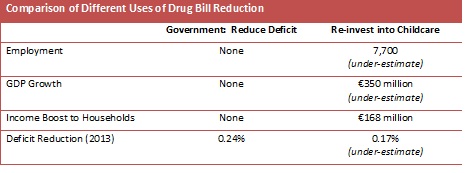
Childcare

There is no impact on employment, growth and household
income from the Government’s strategy of pocketing the savings on the drugs
bill.  By re-investing that savings into
childcare, all these categories turn positive. 
And the difference on the deficit is trivial – with the reinvestment strategy
being an under-estimate as it does not include the impact of non-wage
expenditure or the reduction of childcare costs to households.

This is, of course, a back-of-the-Excel –sheet calculation
and, therefore, should only be treated as indicative. Much of this would replace existing activity, though where voluntary organisations exit, this new strategy could just upgrade – which would reduce the overall costs as many of these groups are already subsidised.  There may be a reduction in informal childcare as many families cannot afford creche places. 

But there are other boosts that are not
included in this short-hand balance sheet; namely, the impact on the little
ones in childcare centres that integrate care and education.  This should lead us into a more integrated
package of childcare/early childhood education. 
That is the ultimate goal – for this is an investment with one of the
best returns.

The point of this post, however, is to narrowly focus on the
comparative advantages of taking savings and directly reducing the deficit, or
taking the savings and reinvesting into public services.  In the case of childcare, it needn’t be a
state agency.  A co-ordinated strategy
linking up local authorities, social and voluntary organisations, and
not-for-profit establishments could roll-out the network. The same case can be
made for early childhood education, or primary health care, or support services
for the elderly, or community services for the unemployed, drug rehabilitation
schemes, etc. etc. 

This is the lesson, a lesson that the best businesses understand.  You don’t downsize, you expand.  Drive efficiencies and reinvest.  Constantly seek out new opportunities.

And when it comes to children, the opportunities are countless.  Serve them and they, in turn, will drive the
economy.  So let them play.


8 responses to “I Want to be an Agent of Economic Recovery but They Won’t Let me Play!!!”

  1. CMK Avatar

    Michael, that’s an excellent idea which in an intellectually and politically healthy society would probably be adopted with little resistance. As set out above there are no drawbacks to the idea and it’s positive on all fronts. More of this type of thinking and things might improve. Alas, here in actually existing Ireland it’s likely the above idea would be shot out of the sky as soon as it got out in the open. Childcare here is primarily as business, like any other and with the same objective: making money for the business owners. No doubt you’re conscious of that. It’s likely that any attempt to further state provision in this area – regardless of its benefits to the broader economy – would be regarded by ISME, IBEC not to mention FG as akin to Stalin’s collectivisation of agriculture and a ferocious propaganda war would be waged on it. There would be no end of lies flung about that such a plan would be ‘unworkable’, ‘bureaucratic’ etc. There would also likely be court challenges at both national and European level by groups who have invested heavily in private sector childcare and would be undercut by this development. Not to mention Catholic groups hawking around the sceptre of ‘The State!’ being an inappropriate agent of childcare provision. The point I’m making is that any decent, workable, progressive proposal, such as the one above, will have to be fought for with an equal or greater degree of ferocity as that which will be deployed against it. Having said that the above idea makes perfect sense and is an example of how there is scope to improve lives even in times being made deliberately tough for people.

    Like

  2. tells.it.like.it.is Avatar
    tells.it.like.it.is

    Sounds like a recipe for partially providing a service in a far more expensive form than currently.
    There are circa 300k Irish children in the age range 0-4 years, so how would you allocate your 30k places?
    On the basis of a lottery? Might as well drop the cash from black helicopters flying overhead on random flight-paths.
    Or on the basis of perceived need? This would create yet another welfare trap, further incentivise under-reporting of income, and be grossly unfair to the working families actually paying the tax that would fund state-subsidized childcare for a small minority.
    Then in terms of the cost … at a stroke you’ve already inflated staff costs by 17%. It wouldn’t be long before the staff had all joined SIPTU, rebranded themselves as “early childhood teachers” and demanded the same payscale as INTO members, rising to ~65k. Then of course their holidays and working hours would also need to be lined up with primary teachers, leading to an unworkable 5 hours childcare a day for only 183 days a year. Minus off that in-service training days, personal days & rampant sick leave and barely half the year is covered.
    Then of course you’d have every two-horse town down the country campaigning for a state-subsidized creche alongside their 2 teacher primary school with only seven pupils on the rolls. And of course the local clientalist politicians will only be too happy to compete on whether FF or SF or Labour is best at wasting tax-payers money on such on an inefficient venture.
    In short, a complete train-wreck!

    Like

  3. CMK Avatar

    Yeah, just leaves things as they are with childcare workers being worked to exhaustion for the minimum wage and then let go when the childcare ‘business’ struggles to get enough ‘clients’ to remain viable. Adding to the stress of parents who have to work to keep things going, have to find childcare for their kids but find access to childcare financially prohibitive. But, sure, what the hell let’s just leave things as they are with a free market free for all where the income streams of childcare ‘businesses’ are subsidised by the state and where the people who are actually charged with looking after the children are mere disposable implements whose cost [.i.e pay] should be reduced and reduced and reduced. It’s probably fair to say that ‘tell.it.like.it.is’ (sic.) doesn’t have to rely on external childcare. Hopefully if Michael’s plan were implemented everything you complain of above will come to pass. That’s what’s called a decent society. And why shouldn’t childcare workers be paid 65K? We pay currency traders, bond traders and financial analysts many multiples of that and the nett effect of this combined activities is an inescapable economic catastrophe. Childcare workers actually provide a service and contribute to this society. A handful of childcare workers are making a more positive contribution than a floorful of traders in the IFSC, whose main task is to ensure that wealth remains protected offshore while the society they live in undergoes economic collapse.
    And if you’re concerned about wasting tax payers money you’d be arguing for a moratorium on paying unsecured bondholders. Ah, but I’m certain your rejoinder would be ‘we have moral and legal obligations to the bondholders that we can’t break’ but we don’t have moral obligations to ensure properly funded childcare. What planet are you on?

    Like

  4. tells.it.like.it.is Avatar
    tells.it.like.it.is

    “And why shouldn’t childcare workers be paid 65K?”
    Because it would mean that the stay-at-home parents they’re replacing would have to be earning at least twice that on average, in order to make it economically feasible.
    You are aware of the legally mandated minder:child ratios of up to 1:3? Which you’d then have to pad for sick-leave and holidays.
    The math just doesn’t add up if the childcare workers are taking home twice the average wage.
    (Yeah, I know, let’s just double the average wage then! Riiight.)
    As to your moral questions, I thought we were discussing economics here?

    Like

  5. Michael Taft Avatar

    Thanks CMK for you comments and, yes, ideas – regardless of how rational or beneficial – are part of a wider political struggle. However, ideas should be capable of appealing to common-sense, address directly the current needs of working people, and be sustainable. Childcare, to my mind, fulfils that criteria. So do other measures – early childhood education, wrap-around schools, free GP care and prescription medicine, social insurance-based earnings-related pensions; etc. All these address a real need that people face – a need that cannot be fulfilled by private markets (hence their name: ‘public goods’). But, of course, the extension of public goods; now that will be a political struggle.
    tell.it.like.it.is – a train wreck? A service commonly available on the continent? And if you think my 30,000 is too modest, I’ll support any proposal you have to divert unproductive expenditure into expansion of public goods.

    Like

  6. tells.it.like.it.is Avatar
    tells.it.like.it.is

    “A service commonly available on the continent?”
    The difference is that on the continent they can run such services at a reasonable cost.
    The problem for the Irish state is that it has priced itself out of the provision of any new labour-intensive services … as such services inevitably end up being captured by the servants and organized primarily with their benefit/lifestyle/career-paths in mind.
    Since childcare is essentially an enabler for the otherwise house-bound parent to earn an income, it is extremely cost-sensitive.
    It also needs to be provided 250 days a year without fail. Not for 250 days minus in-service training days, planning & meeting days, Monday-morning sickie days, a little bit of snow on the ground days, election days when the school is being used as polling station … etc, etc.
    In addition, it needs to provided for circa 11 hours a day, opening at 7.30/8am and only closing at 6.30/7pm (depending on location).
    The Irish state is simply incapable of providing such an always-on service without incurring extremely high current & future costs.

    Like

  7. Ciaran Avatar

    ‘tells.it.like.it.is’ (sic)
    You do know they have unions, public sector workers and all those other scary things on the continent as well, don’t you?
    Michael has set out an excellent proposal for dealing with the issue of childcare provision in this country. Your objections seem to be based largely on your fanatical hatred of the public sector, made evident by your use of anecdata such as ‘Monday-morning sickie days’ and other similar items from the IBEC/ISME propaganda playbook.

    Like

  8. tells.it.like.it.is Avatar
    tells.it.like.it.is

    @Ciaran
    Its not anecdata, the department figures show that primary teachers are 15% more likely to take an uncertified sick day on a Monday than a Thursday.

    Like

Leave a reply to tells.it.like.it.is Cancel reply

Navigation

About

Commentary on Irish Political Economy by Michael Taft, researcher for SIPTU