Notes on the Front

Commentary on Irish Political Economy by Michael Taft, researcher for SIPTU

The Minister Goes on Safari

Minister
Brian Hayes is on safari
, looking for big game to hunt down.  Who does he have in his sights?

 ‘I think we need to
realise that the one group of people in this country who have come through this
crash and still have their incomes intact are pensioners.’

The one group? 
Pensioners?  We’ll come back to
that below. 

Brian may have been looking at the EU
Survey on Income and Living Conditions
findings that show households headed
by a retired person saw their income rise by 3.6 percent between 2008 and 2010
whereas the national average saw a fall of 11.6 percent.  Of course, this fall was driven by
unemployment – a phenomenon which doesn’t directly affect retirement income.

If Brian was looking at this data, he should look harder.
Elderly 1

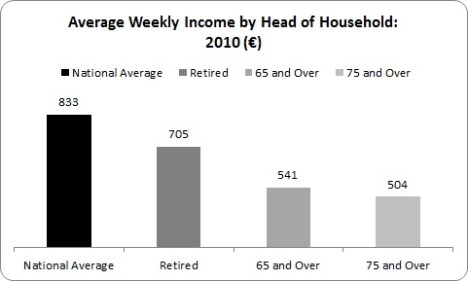
A household headed by a retired person, on average, takes in
approximately €700 a week.  This is 15
percent below the average household income in the latest year we have data for.  In households headed by someone over 75
years, weekly income was 40 percent below the national average. 

Of course, averages cover up huge variations.  The median figures give us a further insight.

  • 50 percent of households headed by a retired person, received
    less than €540 in weekly income
  • 50 percent of households headed by a person 65 years and
    over received less than €455 in weekly income
  • 50 percent of households headed by a person 75 years and
    over received less than €425 in weekly income

And as Older
and Bolder’s Patricia Conboy
pointed out – it’s not like elderly households
have escaped the austerity measures.  Not
only was there the recent cut of €12.5 million to home care services, there
have been other measures.  According to
Patricia:

‘Older people have
been affected by: the loss of the Christmas bonus, implementation of Universal
Social Charge, prescription charges, electricity levy, introduction of
household charge, reduction in the Fuel Allowance from 32 to 26 weeks,
increased tax on home heating fuel, reduction in medical card cover for
dentistry, increases in Vat and Dirt (tax on savings), cuts in frontline health
and social care services, rising costs of medical insurance; and they will be
affected by planned water and carbon tax charges.'

To be fair to Brian, he did say he wasn’t talking about
pensioners solely dependent on the state pension.  The problem is that most elderly are
dependent solely or in the main on the state pension.  So Brian is not talking about many pensioners
who are on ‘high’ earnings, nor does he specify what is ‘high’.

Brian is hunting for big game in the economic forest.  May I suggest another target?  For whatever about pensioners, there is
definitely one group which has come through this crash with their incomes
intact and then some:  management
and professionals
, particularly in the industrial sector.

In the first quarter of 2008, management and professionals
in the industrial sector received a weekly income of €1,284.  In the first quarter of 2011, their weekly
income increased to €1,430.  That’s not
just coming through ‘intact’.  That’s an
increase of over 11 percent.  Others in
the industrial sector didn’t come out so well. 

  • Clerical and sales staff experienced a cut of 1.1 percent in
    weekly income
  • Production, craft and transport workers receive a cut of 3.6
    percent

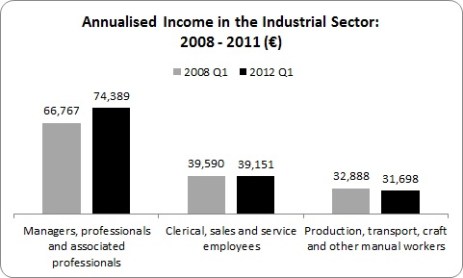
On an annualised basis, this is how these three categories
fared.
Elderly 2

Management grades saw their income increase by €7,600 a
year.  Production workers – which make up
60 percent of all employees in the industrial sector – saw their income fall by
nearly €1,200.

Of course, this doesn’t mean that everyone in the managerial
grades received an 11 percent income. 
Much of this can be accounted for by compositional changes.  A number of lower-paid traditional companies
have gone out of business, leaving more modern companies in place.  The average would be influenced by this.  But if this were the case, we should see
upward changes in clerical and production grades as well.  We don’t. 
All we are left with is a widening gap between management and workers’
income in the industrial sector.

If Brian wants to go after big game – the type whose income
is high and growing – might I suggest he change his sights?  Going after households whose income is well
below the average is neither equitable nor economically rational.  There’s bigger game in the
economic forest.

8 responses to “The Minister Goes on Safari”

  1. Colum McCaffery Avatar

    The essential thing that annoys people is inequality of income or, rather, hideous levels of income inequality, the very structure of inequality. Now one way that the political right seeks to maintain that structure – with all its relativities – is to talk about inequality between groups. They’ll have a go at age vs. youth, public sector worker vs. private sector worker, rural vs. urban etc. It is a conservative position; the idea is to have no change or very little change in relativities while reducing wages and welfare payments to the poor.
    Against that, far too many on the left advance an argument whose effect is not equally but similarly conservative. They identify the very rich (the 1%) as opposed to the merely rich (let’s say, the 10%) and argue that if that 1% could be soaked, then all else could remain the same.
    By identifying the management and professional category you are coming close to demanding change but the conservative flaw remains. Most of those in this category are rich but not very (1%) rich. However, as you concede, not all are rich. That’s too much like BH’s point about pensioners!
    For as long as the left defends or attacks groups, the structure remains unchallenged and the right wins. Let’s face it there are rich managers, there are rich pensioners, there are rich public sector workers, there are rich farmers etc. All that separates these groups is the proportions of rich within them.
    It would be far better to call the right’s bluff on each and every sectoral target. Let’s define rich in income terms (Yes, of course I realise that income is not the only measure!) and say that below that point income will not be touched but above that point, “Go ahead, cut!”

    Like

  2. de Charette Avatar
    de Charette

    \”A household headed by a retired person, on average, takes in approximately €700 a week. This is 15 percent below the average household income in the latest year we have data for.\”
    Honestly Michael, I am really surprised this kind of blatant like-with-unlike comparison made it into your post.
    Of course retired people have lower than average income on average.
    They also have massively lower than average expenses.
    They enjoy much lower housing costs (the vast majority having either paid off their mortgage or living in social housing), virtually no child-related expenses (food, clothes, education), much reduced transport costs (no commuting, free mass transit), are much more likely to have medical card coverage, and are subsidized left and right.
    Their household balance sheets are also much healthier on average, often debt-free and with accumulated saving and/or retirement lump sums to invest.
    OK, their golfing expenses do tend to be higher than average.

    Like

  3. Eamonn moran Avatar
    Eamonn moran

    “The problem is that most elderly are dependent solely or in the main on the state pension.” I am finding it hard to marry the above sentence with the fact that the State Pension is
    €230 and the average income for people over 65 is 541 and the average of people over 75 is 504. Both of these figures are over double the state pension. If the Average income is over double the State pension then how does your sentence hold true? Brian hayes has an excellent point but makes it badly. there has been massive transfers of wealth from young to old over the last 10 years, through growth in Personal and government debt, Increased inequality of distribution favouring older cohorts and the Unions/Governments most recent cowardly moves of lowering pay of only new entrants. The result of the latter means some retired public servants are earning more in pension entitlements than the new entrants are making in Salary. Retired people do not need as much Income as younger people who have mortgages and dependents but the unions and gov reps are protecting every penny of those above 50 years of Age.

    Like

  4. Eoin Avatar

    The other group he focused on in that article were students. He stated that ”It’s not sustainable in my view that nearly 50 per cent of all kids going to college at the moment are getting a grant.”
    Does anyone know where Hayes may have sourced this figure from?Seems quite high!

    Like

  5. Michael Taft Avatar

    de Charette – yes, retired are, on average, encumbered with lower expenses. However, the point of the post is that there are higher income groups who haven’t suffered during the recesion which the Minister could target. If it is high-income regardless of occupation, etc. – as Colum suggests above – then we could tax them; catch even the wealthy pensioners. Do you agree?
    Also,I don’t think the 20%+ of elderly who suffer at least one enforced deprivation experience spend much of golf fees.
    Eammon – as stated in the post, the income refers to household.
    Eoin – I don’t know. You might go on the USI site to see if they give a figure.

    Like

  6. de Charette Avatar
    de Charette

    Sure, we should tax people with high incomes, and we do.
    The point was though that its misleading to appeal to raw income statistics when questioning retirees capacity to absorb some cuts.
    Having 15% less household income than the average, but few expenses and much accumulated wealth, is likely to lead to a higher-than-average standard of living.
    BTW the most interesting thing shown by your age-graduated data on retirement income is how much better off are those who were privileged with early retirement (at age <65 years). Many of this cohort are enjoying very generous pensions and lump sums funded from the public purse, a lifestyle that is highly unlikely to ever be attainable to the tax-payers currently funding it.

    Like

  7. Eamonn moran Avatar
    Eamonn moran

    @ de charette
    “BTW the most interesting thing shown by your age-graduated data on retirement income is how much better off are those who were privileged with early retirement (at age <65 years). Many of this cohort are enjoying very generous pensions and lump sums funded from the public purse, a lifestyle that is highly unlikely to ever be attainable to the tax-payers currently funding it.”
    I think it can be explained in a different way. Its income per household. At 75 someone is more likely to be widowed than 65 and therefore only one income instead of 2. Now it also means that they need less income but I think this explains the issue you raised in a different way.

    Like

  8. de Charette Avatar
    de Charette

    Eamonn, that may be a contributory factor, but the life-expectancy data suggests that its not the main driver here.
    If it was, then we would expect to see the biggest drop-off in household income between the 65 y.o. and 75 y.o. bands (as partner bereavement is more likely to happen in the 75+ age category).
    In fact we see a relatively small 7% drop-off, much smaller than the drop-off at the 65 y.o. boundary. Michael doesn\’t quote a separate figure for the <65 age group, but it must be much higher than €705 in order to drive the overall retiree average all the ways up to €705, around a third higher than the average for all those aged over 65.

    Like

Leave a comment

Navigation

About

Commentary on Irish Political Economy by Michael Taft, researcher for SIPTU