
Minister
Brian Hayes is on safari, looking for big game to hunt down. Who does he have in his sights?
‘I think we need to
realise that the one group of people in this country who have come through this
crash and still have their incomes intact are pensioners.’
The one group?
Pensioners? We’ll come back to
that below.
Brian may have been looking at the EU
Survey on Income and Living Conditions findings that show households headed
by a retired person saw their income rise by 3.6 percent between 2008 and 2010
whereas the national average saw a fall of 11.6 percent. Of course, this fall was driven by
unemployment – a phenomenon which doesn’t directly affect retirement income.
If Brian was looking at this data, he should look harder.
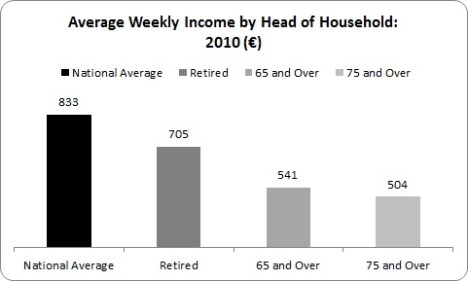
A household headed by a retired person, on average, takes in
approximately €700 a week. This is 15
percent below the average household income in the latest year we have data for. In households headed by someone over 75
years, weekly income was 40 percent below the national average.
Of course, averages cover up huge variations. The median figures give us a further insight.
- 50 percent of households headed by a retired person, received
less than €540 in weekly income - 50 percent of households headed by a person 65 years and
over received less than €455 in weekly income - 50 percent of households headed by a person 75 years and
over received less than €425 in weekly income
And as Older
and Bolder’s Patricia Conboy pointed out – it’s not like elderly households
have escaped the austerity measures. Not
only was there the recent cut of €12.5 million to home care services, there
have been other measures. According to
Patricia:
‘Older people have
been affected by: the loss of the Christmas bonus, implementation of Universal
Social Charge, prescription charges, electricity levy, introduction of
household charge, reduction in the Fuel Allowance from 32 to 26 weeks,
increased tax on home heating fuel, reduction in medical card cover for
dentistry, increases in Vat and Dirt (tax on savings), cuts in frontline health
and social care services, rising costs of medical insurance; and they will be
affected by planned water and carbon tax charges.'
To be fair to Brian, he did say he wasn’t talking about
pensioners solely dependent on the state pension. The problem is that most elderly are
dependent solely or in the main on the state pension. So Brian is not talking about many pensioners
who are on ‘high’ earnings, nor does he specify what is ‘high’.
Brian is hunting for big game in the economic forest. May I suggest another target? For whatever about pensioners, there is
definitely one group which has come through this crash with their incomes
intact and then some: management
and professionals, particularly in the industrial sector.
In the first quarter of 2008, management and professionals
in the industrial sector received a weekly income of €1,284. In the first quarter of 2011, their weekly
income increased to €1,430. That’s not
just coming through ‘intact’. That’s an
increase of over 11 percent. Others in
the industrial sector didn’t come out so well.
- Clerical and sales staff experienced a cut of 1.1 percent in
weekly income - Production, craft and transport workers receive a cut of 3.6
percent
On an annualised basis, this is how these three categories
fared.
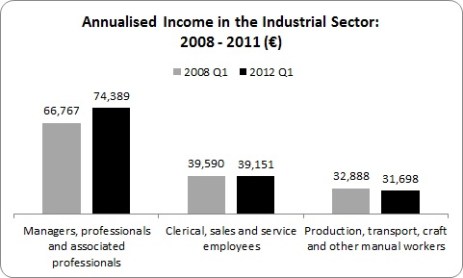
Management grades saw their income increase by €7,600 a
year. Production workers – which make up
60 percent of all employees in the industrial sector – saw their income fall by
nearly €1,200.
Of course, this doesn’t mean that everyone in the managerial
grades received an 11 percent income.
Much of this can be accounted for by compositional changes. A number of lower-paid traditional companies
have gone out of business, leaving more modern companies in place. The average would be influenced by this. But if this were the case, we should see
upward changes in clerical and production grades as well. We don’t.
All we are left with is a widening gap between management and workers’
income in the industrial sector.
If Brian wants to go after big game – the type whose income
is high and growing – might I suggest he change his sights? Going after households whose income is well
below the average is neither equitable nor economically rational. There’s bigger game in the
economic forest.


 Notes on the Front
Leave a reply to de Charette Cancel reply