Notes on the Front

Commentary on Irish Political Economy by Michael Taft, researcher for SIPTU

If This Isn’t Class War, What Do We Call It?

I’m usually not partial to terms like ‘class war’ but readers might be able to provide an alternative description to what is happening.

First, we find that AIB employees were informed over the airwaves that there would be 2,000 redundancies plus with no guarantee that it will all be voluntary. A spokesperson from SIPTU – which represents porters, caterers and security staff at the bank – put it this way:

‘Our members in security and catering never received any bonuses during the Celtic Tiger period, and they work long and unsociable hours. It is immoral that these hardworking people should now be sacrificed for the sins of senior management.’

But isn’t that the way – management makes mistakes and the cleaners get fired.

Then the Restaurant Association of Ireland steps up their attacks on low-paid workers. Never letting truth get into their argument, they contend that hospitality workers are over-over-paid. This is just the latest in a long-running campaigning against low-paid workers’ living standards, especially hospitality workers. Yet, profits in the upmarket hotels are on the up and up, according to the industry monitor TRI Hospitality Consulting:

‘Dublin hotels shrugged-off the economic woes of Ireland during February and recorded an astonishing growth in profits of more than 40%.’

And its not just upmarket Dublin hotels – even Supermac’s is getting in on the act, taking in over €6 million in profit, an annual jump of 18 percent. Geez, no better time to hammer down workers’ wages, I guess.

And then there are those pesky public sector workers. The new Government, taking up where the old Government left off, pursues a policy which they know will realise few savings but do considerable damage to the economy – namely, cutting the public sector payroll. Then, when they actually realise few savings while the economy continues to haemorrhage, they blame . . . yes, you guessed it . . . the workers.

Of course, all of this could be seen as a necessary ‘correction’ in the labour market – but that’s just a euphemism.

Employee: ‘You mean you’re cutting my wages?’

Employer: ‘I’d prefer to call it a wage-correction.’

Employee: ’15 percent?’

Employer: ‘There’s a lot of correctin’ to be done’.

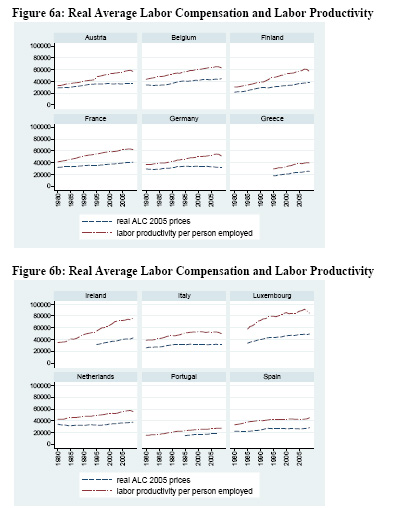
Let’s take a step back and look at the broader canvas. Since 1980 labour productivity outstripped real labour costs (i.e. after inflation).
Class War 1

Question: who pocketed that excess productivity? This is the extra compensation to capital – or the corporate owning class. And given that corporate tax has been falling historically, the compensation to owners just gets better and better.

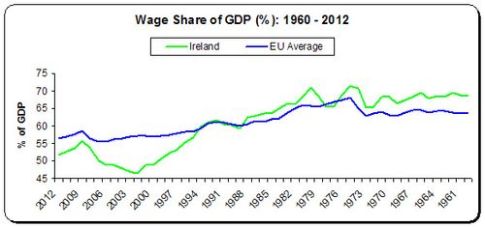
Let’s look at another graph – this time from the EU Commission database, AMECO.
Class War 2

We can observe a long-time decline of wages (including the social wage) as a proportion of GDP. There are any number of contributory factors but central has been the collapse of the post-war Keynesian settlement and the rise of neo-liberalism – a rise which doesn’t look like fading away any time soon. What is of particular note is how wages have collapsed in Ireland and lags EU norms.

If we lose sight of the key facts – that inequality is growing; that the corporate sector, having hit a bit of a bump in the recession is reasserting itself big time; that the institutions that once promoted workers’ interests are in retreat – then we will fail to understand what is happening in Ireland.

We will fail to understand the linkage between what is happening to bank employees, low-paid workers and public sector workers.

It ain’t an accident, y’know.

4 responses to “If This Isn’t Class War, What Do We Call It?”

  1. michael burke Avatar
    michael burke

    Michael, very useful post.
    Capital here also gets to retain large part of value created by labour via the medium of low taxes.
    This economy has the highest post-tax return on capital of the advanced economies, behind only Greece.
    This is a source of economic weakness, not strength.

    Like

  2. B Collins Avatar
    B Collins

    Same here. Am guessing you’ve read about the Wisconsin teachers’ strike.
    And this great Facebook repost that’s making the rounds:
    “Remember when teachers, public employees, Planned Parenthood, NPR and PBS crashed the stock market, wiped out half of our 401Ks, took trillions in TARP money, spilled oil in the Gulf of Mexico, gave themselves billions in bonuses, and paid no taxes? Yeah, me neither. Duly copied, duly pasted.”
    Sounds like class war to me.
    Continue to follow Notes on the Front with great interest.
    –BC

    Like

  3. Daniel Dunne Avatar

    Ever was it so Michael, ever was it so.
    But I would disagree a bit with your arguments about the deficit and the public sector.
    The problem is that the size of the public sector spend depends on the willingness of taxpayers to think socially.
    Ireland is already an unsympathetic culture where thinking socially about shared problems seems to be an alien concept, one reason why the property bubble was cheered on by voters, and why there were few social dividends of the Celtic tiger beyond motorways.
    The case for social goods is undermined by (perceived) inefficiency, unaccountability and (sometimes) unjustifiable salaries in some bits of the public sector.
    As you know I’m sympathetic to your perspective, but I think where the left falls down all the time is in what you once referred to as “bringing the people with you”.
    Solidarity requires more than sectoral self interest, a big cultural shift if required
    On the economic level, the use of the “public payroll” as a kind of Keynesian pump-prime is not going to create much stimulus in an small open economy like ours. And the primary structural deficit (separate to the banking blackhole), is still real – no matter how much we might dislike Colm McCarthy.
    Even the most well-meaning government made up of gramsci-ist class warriors would have very very difficult choices to make.
    The real mess is the EU. We’ve had market integration without either fiscal or cultural/identity integration, while at the same time removing many of the state mechanisms which once would have made the stimulus thing an option. And that was before we gave up our budgetary sovereignty through the guarantee etc.
    The left needs to chose its battles carefully. We need a broad coalition to defend certain floors of decency and key social goods. The work of building a culture that sustains a more equal society is long term, that’s for sure. The restoration of the 8.65 minimum wage, mandated clearly by the electorate is a small mercy, but it’s something.
    As regards the private sector, I think it’s important to keep publicizing the facts about the profits being made, as you do. And to address spurious justifications of exploitation made by the likes of IBEC SFA and that other crowd…Keep it up.

    Like

  4. Michael Taft Avatar

    Daniel – thanks for that thoughtful comment. Let me address some of the issues you raise. First, you are correct re: thinking socially; or resolving social problems collectively rather than as individuals/consumers. One thinks of health and pensions – we are urged/forced to purchase these on the private market and for those without income/savings – well there’s always poverty-line safety nets. Quite unsatisfactory.
    The Left/trade union movement has to share in the blame for this development. We ignored the potential of the ‘social wage’ (collective consumption of goods and services) and focused on nominal wages, take-home pay, keeping minimum wage earners out of the tax net. All those ‘gains’ are gone as they were built on flawed pro-cyclical policies.
    I’d like to stress that I don’t believe we can spend our way out of the crisis – if that spending is taken to be expenditure on public services. Actually, this was tried under FF in Jack Lynch’s days (vulgar Keynesianism it was called). However, we can invest our way back to growth and fiscal stability. And investing in public services in tandem with building collective consumption strategies is part of that strategy.
    Take education, for instance. It is acknowledged – even by economists hostile to ‘stimulus’ – that education is a ‘good investment’. I would start at the bottom so to speak – with pre-primary education, public child care options with a strong education stream, wrap-around primary schools and adult literacy.
    This is an investment that will pay off big-time (albeit, over a long-time span than commercial investments). And in the process it will employ thousands. This is win-win.
    Similarly with primary healthcare – free access (to GP, prescription medicines, all out-patient care): this will pay off in better health outcomes, lower loss-of-work, reduced costs at third-level, etc. I couldn’t pick a better policy than FF’s own primary health strategy published in 2001.
    So it is about investment and restructuring – around the concept of collective consumption. But this has to be part of a broader expansion strategy re: infrastructural, economic and enterprise investment. In this sense, the divide between the public and private melts away.
    Therefore, investment and collective consumption should go beyond floors of decency (but if that’s all that we can achieve in the short-term given the strangle-hold the Right has on debate and policy – then I’d take it).
    They are instruments of growth, employment, prosperity and equity. That’s not a bad slogan for us progressives.
    [As for structural deficits – even the ESRI notes: when the economy grows, the structural deficit falls of its own accord which suggests that it is intertwined with the cyclical deficit.]

    Like

Leave a reply to Michael Taft Cancel reply

Navigation

About

Commentary on Irish Political Economy by Michael Taft, researcher for SIPTU