
I’m usually not partial to terms like ‘class war’ but readers might be able to provide an alternative description to what is happening.
First, we find that AIB employees were informed over the airwaves that there would be 2,000 redundancies plus with no guarantee that it will all be voluntary. A spokesperson from SIPTU – which represents porters, caterers and security staff at the bank – put it this way:
‘Our members in security and catering never received any bonuses during the Celtic Tiger period, and they work long and unsociable hours. It is immoral that these hardworking people should now be sacrificed for the sins of senior management.’
But isn’t that the way – management makes mistakes and the cleaners get fired.
Then the Restaurant Association of Ireland steps up their attacks on low-paid workers. Never letting truth get into their argument, they contend that hospitality workers are over-over-paid. This is just the latest in a long-running campaigning against low-paid workers’ living standards, especially hospitality workers. Yet, profits in the upmarket hotels are on the up and up, according to the industry monitor TRI Hospitality Consulting:
‘Dublin hotels shrugged-off the economic woes of Ireland during February and recorded an astonishing growth in profits of more than 40%.’
And its not just upmarket Dublin hotels – even Supermac’s is getting in on the act, taking in over €6 million in profit, an annual jump of 18 percent. Geez, no better time to hammer down workers’ wages, I guess.
And then there are those pesky public sector workers. The new Government, taking up where the old Government left off, pursues a policy which they know will realise few savings but do considerable damage to the economy – namely, cutting the public sector payroll. Then, when they actually realise few savings while the economy continues to haemorrhage, they blame . . . yes, you guessed it . . . the workers.
Of course, all of this could be seen as a necessary ‘correction’ in the labour market – but that’s just a euphemism.
Employee: ‘You mean you’re cutting my wages?’
Employer: ‘I’d prefer to call it a wage-correction.’
Employee: ’15 percent?’
Employer: ‘There’s a lot of correctin’ to be done’.
Let’s take a step back and look at the broader canvas. Since 1980 labour productivity outstripped real labour costs (i.e. after inflation).
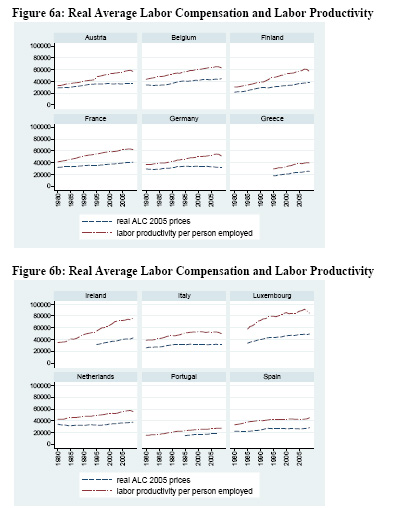
Question: who pocketed that excess productivity? This is the extra compensation to capital – or the corporate owning class. And given that corporate tax has been falling historically, the compensation to owners just gets better and better.
Let’s look at another graph – this time from the EU Commission database, AMECO.
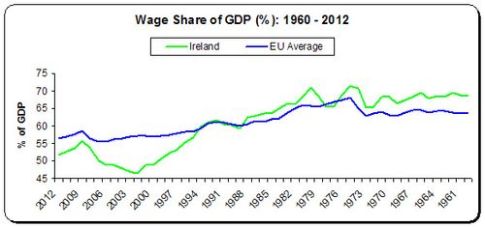
We can observe a long-time decline of wages (including the social wage) as a proportion of GDP. There are any number of contributory factors but central has been the collapse of the post-war Keynesian settlement and the rise of neo-liberalism – a rise which doesn’t look like fading away any time soon. What is of particular note is how wages have collapsed in Ireland and lags EU norms.
If we lose sight of the key facts – that inequality is growing; that the corporate sector, having hit a bit of a bump in the recession is reasserting itself big time; that the institutions that once promoted workers’ interests are in retreat – then we will fail to understand what is happening in Ireland.
We will fail to understand the linkage between what is happening to bank employees, low-paid workers and public sector workers.
It ain’t an accident, y’know.


 Notes on the Front
Leave a reply to Daniel Dunne Cancel reply