
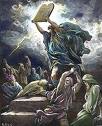
 They’re really bringing out the big guns. And they don’t come much bigger than Peter Sutherland – former Attorney General, European Commissioner and Director General of GATT. Already, the media are quoting his Irish Times article in interviews with all and sundry – as if he were some Old Ireland prophet descending the mountain top with tablets of reform. He commands the Government to revise its fiscal strategy to avert disaster. Couldn’t disagree. Except: if we bow down before his commandments, not only will we never find the promised land, we will be stuck in the desert for years to come.
Peter starts out fair enough – saying we have three intertwined crisis: economic, banking and fiscal. But then he employs a sleight-of-hand:
‘While the economic and banking crises are very troubling, these problems are shared to varying degrees by many countries across Europe . . . In addition, the scope of the banking crisis is by now well understood, with an emerging consensus on the scale of potential losses. And the Government’s strategy for handling the banking crisis is well-advanced, even if it is still to evolve in the coming months.’
Do you see it? He manages to glide over the economic and banking crisis. Except:
-
We don’t have an understanding of the ‘scope’ of the banking crisis and there is no consensus on the scale of potential losses (€10 billion? €30 billion? €50 billion?). And whether the Government’s strategy is ‘well-advanced’ or ‘evolving’ it is still a disaster, ignoring the reality that most observers accept: the game is up, recapitalisation is a total waste of money, and nationalisation is coming. The only debate is when.
-
Our economic crisis is in a league of its own. The EU Commission predicts the average growth rate in Eurozone countries for 2009 will be -1 percent. Ireland’s is estimated at -5 percent. That’s five times worse than the average. The only EU country in a worse state is poor Latvia – now occupied by the IMF
But Peter is only interested in the fiscal crisis, as if this caused the economic and banking meltdown.
‘Rather, the key differentiating factor . . . is the sustainability of the public finances. Ireland’s projected 2009 deficit of 11 per cent of GDP far exceeds the next highest in this group (Spain at 6.2 per cent). Its projected 2010 deficit of 13 per cent is more than twice the next highest (Spain). This has created a terrible crisis for Ireland.’
Well, if being twice the next worst is a ‘key differentiating factor’ I would have thought being five times as bad (as in the declining growth rate) would merit some consideration. But there you are.
Next we are treated to a perplexing set of comparative tax and expenditure facts with Spain which leads Peter to rail:
‘While much attention has focused on the decline in tax revenues, this is comparatively minor relative to the sharp growth in the ratio of public spending to GDP.’
He claims government spending (using EU gross figures from the EU so they don’t readily tally with net Exchequer spending) has increased from 36 percent to an estimated 45 percent of GDP. Well, that’s hardly surprising.
Between 2008 and 2010, the EU Commission estimates that unemployment in the other Eurozone countries will increase by 2 percent; in Ireland its estimate to grow by 4.2 percent –more than twice as fast. And the Commission is being kind: it estimates Irish unemployment to be 10.2 percent by 2010. We now know it will be much higher with some commentators suggesting it will be closer to 15 percent.
So, it’s not that we are being spendthrifts. Our spending percentage growth is an outcome of (a) a huge rise in unemployment and, so, unemployment and related expenditure, and (b) a falling GDP. With both unemployment and economic decline accelerating faster than the Eurozone average, it’s no wonder we are in a league of our own.
On his way, Peter plays fast with some figures to frighten the natives. He states that
‘. . . the very large Government deficits mean the ratio of debt to GDP is set to grow quickly . . to 68.2 per cent by the end of 2010.’
Frightened? Don’t be. We would still be well below the Eurozone average (over 11 percent below). And Peter conveniently leaves out an inconvenient (for his argument) fact. The EU Commission calculates the ‘gross debt’. However, Ireland has €20 billion cash in hand thanks to the National Treasury Management Agency’s foresight in ‘pre-borrowing’. We also have €15 billion in the Pension Reserve Fund. Combine those assets, and our net overall debt comes down to under 50 percent of GDP – far, far below the Eurozone average.
This is not to underestimate our annual deficit. But from many commentators we not getting economic prescriptions; rather we are getting economics dressed up as accountancy. And when we are presented with ‘facts’ that don’t tell the full story – we are in danger of running around the desert in search of false manna. And that’s what Peter would have us do:
‘ . . . it is imperative the Government revises its fiscal strategy within a very short time horizon . . . this must include a significant increase in the tax burden . . (it) also requires that the Government move more aggressively to curb public spending. While the focus has been on current spending . . . it is also time to suspend many of the larger-ticket items in the public capital programme. The priority must be to improve the financial position of the State – those public capital projects that promise high benefit/cost ratios can be restarted once fiscal stability has been restored . . . ‘
Good grief. The economy is starved of capital, of money and Peter wants to starve it even more:
-
More taxation, to suppress spending even further, resulting in more job losses in our domestic-demand dependent sectors such as retail
-
More current spending cuts, hobbling the only sector of the economy capable of increasing its consumption and, so, economic activity
-
And here’s coup-de-grace: cut capital spending: suspend job creation, allow our infrastructure to degrade further so that when we come out of this thing we will be even further behind advanced industrialised economies.
How in god’s green acre is this going to revitalise the economy? Peter saves his best howler for last:
‘ . . . domestic consumption is more likely to be boosted by increased confidence in fiscal stability than by the current situation.’
Can you imagine the conversations around the dinner tables of the nation?
‘I’ve got some great news, dear.’
‘What? You find a job? Rich ol’ Aunt Assumpta pop it? Junior quitting school to work the mines?'
‘No. I’ve been studying the Government’s fiscal consolidation projections and we’re realigning government expenditure with pre-decline trends and this will improve our bond yields by a clear 50 base points.’
‘That’s great! Let’s go out and buy that furniture suite we’ve needed since we broke up our old one for fuel.’
It gets that absurd.
Why do we bring these museum pieces out of basement storage to pontificate on our troubled times? Peter Sutherland served for three years in a Cabinet that managed to savage the economy through similar deflationary policies and a singular inability to understand how you grow an economy. Now he’s determined to see those marvellous policies revived.
Like the old Ireland prophet – now out of time – Peter should stay on the mountain top, above the clouds, in the thin air; and leave us lesser mortals to sort out the real problems of the real economy.


 Notes on the Front
Leave a reply to Yvonne Cancel reply