
It’s that time of year again. Media leaks suggest the Low Pay Commission has recommended an increase in the National Minimum Wage of 79 cent. This would raise the wage floor from €14.15 to €14.94 next year. Employers’ groups are calling this increase intolerable, claiming they can’t afford it, that it will drive up the costs of doing business, that it will erode competitiveness, etc.
Ibec’s Maeve McElwee claimed the 79-cent increase:
‘. . . risks damaging employment and competitiveness while driving up price inflation.’
This is a standard refrain from representatives of business owners: job loss, higher inflation and loss of competitiveness. What is noteworthy is that these same representatives rarely, if ever, put forward evidence to substantiate their claims and demands.
Here’s some evidence that should be considered.
Rising Profits
According to the CSO productivity database, profits are rising faster than wages throughout the domestic economy and in a key low-waged sector. This excludes wages and profits from the foreign multi-national sector.
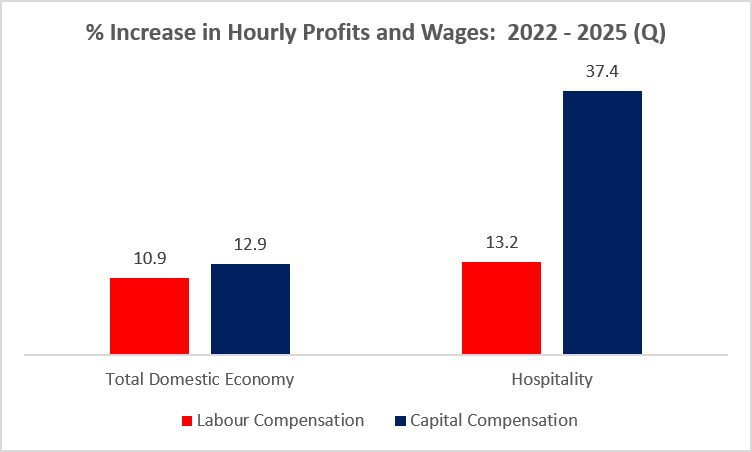
Since 2022, the start of the substantial increases in the minimum wage that were intended to reach 60% of the median wage by 2026, profits are rising faster than wages in both the domestic economy and in the hospitality sector. That doesn’t show an inability to afford a wage increase.
Small and Medium-Sized Enterprises
Another complaint is that SME’s – businesses employing less than 250 – are being hit even harder by costs; especially, labour costs. So how are they doing?
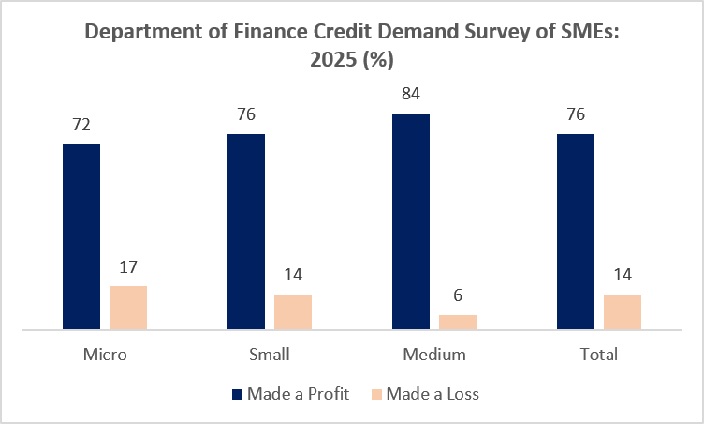
The Department of Finance publishes a credit demand survey each year. They ask SMEs if they made a profit, a loss or broke even. Micro businesses employ less than 10, small businesses employ 10 to 49 while medium-sized businesses employ 50 – 249.
Overall, 76% of SMEs stated they made a profit with only 14% saying they made a loss (the rest broke even). 72% and 76% of micro and small businesses respectively turned a profit. This result was an improvement over the previous two years – in both higher profitability and fewer loss-makers. This doesn’t look like a domestic business sector in crisis – at least when it comes to making a profit.
VAT Cuts
The recent VAT cuts primarily benefitted the restaurant sector. But it also benefited hotels and pubs where food is served; and the hairdressing sector.
According to the Minister for Finance:
‘This [VAT cuts) will cost €681 million in a full year . . . Furthermore, it will support more than 150,000 jobs in these sectors right across the country.’
That works out, on average, to €4,500 per employee that the Government has given to business owners. The employers’ organisations seem determined not to let employees share in that VAT cut.
Another Postponement
The previous government’s strategy was to increase the minimum wage to 60% of the median wage by 2026. One of the first thing this government did was to postpone the target date to 2029. What employers’ organisations want now is, in effect, another postponement. They won’t say so. They’ll say they support the principle of a living wage. But when it comes to implementing it, they’re publicly and privately lobbying the Minister to ignore the living wage.
* * *
With profits rising and more businesses turning a profit, with substantial subsidies and calls for an effective postponement of raising the minimum wage to 60% of the median wage – all we get from employers are demands to suppress wage increases, accompanied with Orwellian language. Azets, a professional services firm, called for the minimum wage to be frozen out to 2030, effectively a real cut of nearly 10%. They claim this would:
‘. . . drive the next phase of Irish economic growth, creating jobs, strengthening communities and building a more resilient economy for the future.’
Yes, if we cut wages the prosperity will flow. This is the dismal logic in a public debate where evidence barely gets a walk-on.
Some things never change.
 Notes on the Front
Leave a comment