
Employer representatives in the restaurant sector are claiming difficulties in finding people to work. The Restaurants Association of Ireland stated:
‘What we’re hearing on the ground is that people who were working in the sector moved on to the PUP payment – and rightly so during Covid – and now won’t return to hospitality because they’re on the PUP payment and claiming cash in hand in other jobs.’
When employers’ representatives refer to people as cheats and layabouts, it’s not exactly an advertisement for working in that sector. But to what extent are the sector’s problems due to people refusing to move on from PUP (Pandemic Unemployment Payment)? Or are there other, more long-standing problems in the sector which the pandemic has exacerbated.
The ESRI recently published ‘COVID-19 and the Irish Welfare System’ which examined the extent to which employees were financially better off not working during the pandemic due to unemployment benefit and the PUP. They found very few were. Only five percent of employees would have had income from social protection that exceeded their previous earnings. 85 percent of employees would have had unemployment payments that were less than 75 percent of their previous earnings.
While the study did not detail the impact on particular economic sectors, with the small numbers having a ‘financial incentive’ to remain on social protection payments it is not likely to be a major factor in hospitality recruitment.
But there’s an even more provocative finding. The paper quotes previous ESRI research that shows that, even where income from unemployment payments exceeded previous earnings, people still return to work.
‘It is important to bear in mind that not all those with weak financial incentives to work will opt for unemployment or inactivity . . . of those that would have had a higher disposable income out of work than in work . . . 90 per cent were actually in employment.’
So even when they could get more from social protection, people still opt to work.
This narrative of layabouts, especially among young workers, is not new. Back in 2009, when young people’s Jobseekers Benefit was slashed, it was justified on the basis that they had to be ‘incentivised’ to work. Otherwise, they’d just lie around all day in their underwear, drinking Red Bull and watching repeats of Friends on obscure digital channels.
Yet, in 2007 – the year before the crash – the employment rate among 20-24 years was the highest in the EU. The highest: at 81 percent while the EU average was 52 percent. But within two years these same people had to be penalised for fear they would turn into a den of sloths. The narrative was as nonsense back then as it is today.
So what might account for alleged staff shortages in the hospitality sectors? Many migrant workers, who accounted for a large proportion of employees in these sectors, may have gone home and not returned. Other former employees might have transitioned to other sectors or taken up full-time education or re-training.
But there could be other reasons. SIPTU conducted a survey of workers in the hospitality sector prior to the pandemic. The results are extremely concerning:
- 64 percent suffered psychological abuse
- 76 percent reported verbal abuse by managers or owners in their workplaces
- 63 percent witnessed or experienced bullying.
- 52 percent did not get break entitlements
- 70 percent didn’t get a Sunday premium
Many of these findings were replicated in a recent survey by Unite. These working conditions would actively disincentivise people from entering the sector.
And wages: hospitality wage levels in Ireland are the lowest in our EU peer group (i.e. other high-income countries).
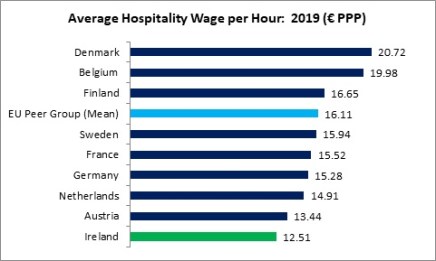
At those wage levels, combined with poor working conditions (never mind the continued health risks for younger unvaccinated workers) – no wonder some employers are finding it hard to recruit staff.
Martin O’Rourke, SIPTU Organiser for the hospitality sector stated:
‘Before the pandemic arose at all, the situation was that the Irish hospitality industry had to go abroad looking for chefs and had to seek special provision from the Government to secure work permits for them. The truth is this: many, many hospitality workers are sick of the precarious nature of the industry and poor treatment. Some were laid off with scant regard, weren’t availing of the wage subsidy scheme and instead were dumped on the PUP. Many have voted with their feet and left the industry.’
So what can be done to address the issues in the hospitality sector to ensure that it is a contributor to economic and social recovery? A start would be for employer representatives to sit down with employee representatives at a Joint Labour Committee or similar sectoral body to negotiate issues such as pay, working conditions, guaranteed hours, holiday and sick pay, overtime rates and career progression within the sector. Together employers and employees could start to make the hospitality sector fit for purpose.
Or even something much simpler. As one pub owner put it:
‘ . . . treat workers well and make sure they are paid “what they’re worth”.’
What a novel idea.

 Notes on the Front
Leave a comment