
The latest Red C poll suggests one thing: progressives should start preparing for Government. At the beginning of January I suggested that we should view the 2020 general election as a three way contest – between Fianna Fail, Fine Gael and the Progressive bloc. All the polls taken since the beginning of the election have borne this out. Indeed, it shows the Progressive bloc winning.
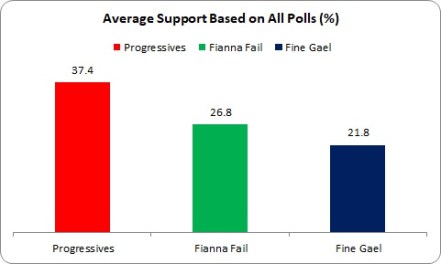
This is an average based on five polls: two Red C polls, along with one each from B&A, MRBI and Ireland Thinks. Not only do they show the Progressive Bloc out in the lead, this support has been growing.
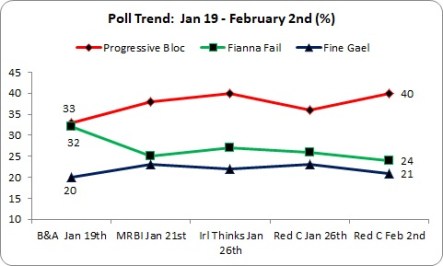
The Progressive bloc has seen its support grow over the campaign with the last poll showing a combined support of 40 percent. Fianna Fail and Fine Gael on the other hand have struggled in the low and mid-twenties.
The idea that progressive parties could, together, form a government that could command a majority in the Dail is now on the agenda. There are still considerable hurdles. Without a strong internal transfer between the progressive parties, progressives may fail to maximise the seats. And there may still be reluctance between some parties dealing with other parties within the bloc. However, there are two things we should bear in mind:
First, the momentum is with progressives. The fieldwork for the last Red C poll was conducted between the 25th and 30th of January. This is with more than a week left in the campaign. If that trend continues into the polling booth, we could see the Progressive bloc break the 40 percent mark.
Second, with Fianna Fail and Fine Gael squabbling over who will not, not, not negotiate with Sinn Fein, the only government option for the two conservative parties is a repeat of the current arrangement – either in a coalition or a repeat of the confidence and supply arrangement. It would be a missed opportunity if progressive parties baulked at providing a parliamentary alternative to another round of conservative government.
What would the composition of such a progressive government look like? Based on the average of all the polls, these are the proportions. This is based on the categories that I used here.
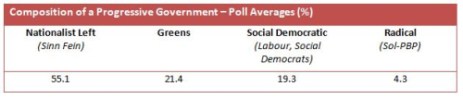
In a progressive government, Sinn Fein would be the largest party. However, it would only make up approximately half. The Greens and social democratic parties would constitute significant blocs. While the radical parties might seem to be a small part, their poll support could be concentrated in a few constituencies resulting in winning seats beyond what the polls show. And with progressive independents, the Progressive bloc is even bigger.
The key point here is that all parties are needed to construct an alternative, and this means that no particular party is privileged. However, this should not be seen as a make-up-the-numbers exercise. To my mind, a progressive government would be at its strongest when all the currents that make up progressive politics are involved, maximising the political and programmatic options.
With days left, what should progressives do? As I suggested in a Modest Strategy for Progressives, there are two things: maximise support for your progressive party of choice, and keep transfers within the progressive bloc. The parties are not going to do the latter, not formally anyway. However, as activists – in parties, trade unions, and civil society groups – we can. Whether it’s on the doorstep, in the workplace, on social media, in our families and neighbourhoods – a bottom-up demand for progressive transfers can help win those seats on the last count without a quota.
But mentally, we should start preparing for government; be prepared to start that process immediately after the votes are tallied. As stated previously, the issue isn’t ruling out negotiating with conservative parties. The issue is ruling in negotiating with each other in the progressive bloc. We should start considering the main elements of such a programme, the priorities, the concrete targets.
So we should make it clear that the goal is to put together a progressive government. That could provide a considerable boost to all progressive parties. And if it falls short (if it does it won’t be by much), then Fianna Fail and Fine Gael will be returned to government in one more turn of the screw. But this could well be the last turn.
For the historical trends – both long term and short term – are telling us one thing: that a progressive government is on its way.
It could well start next Saturday.


Leave a Reply