
After all the post-budget commentary – the articles, interviews, studio debates – I’ll attempt to summarise the broad direction of the budget with three charts based on the detailed tables at the end of the budget’s Economic and Fiscal Outlook. These are the Government spending projections. I have used the GDP deflator for inflation and the IMF’s population projections.
Capital Investment
After the slashing and burning of public investment during the austerity years the projected increase in capital spending is welcome.

Investment is projected to increase by nearly 50 percent in real (i.e. after inflation) terms per capita out to 2023. Of course, we still need a debate over the best use of that money but the large envelope is certainly what the economy needs.
Public Services
Projected spending on public services (Government consumption), however, tells a far different story.
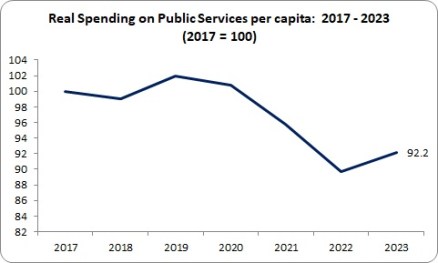
The Government’s projection will result in a real cut of nearly 8 percent in spending on public services per capita. This will occur at a time when a rising age demographic will require even more age-related expenditure.
Social Protection
Social protection payments will experience a similar trend as spending on public services.
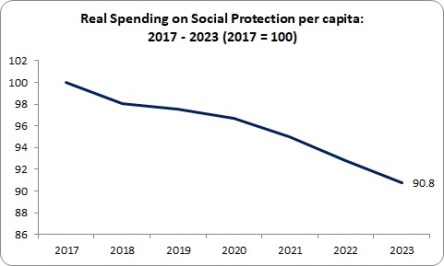
Like public services, the Government’s projection will see total social protection payments cut in real terms per capita. This includes both cash transfers and benefits-in-kind. Again, this is taking place against rising pension payments.
* * *
The story is simple. The increase in capital spending is being funded by real cuts in public services and social protection. We should note, however, that the Government has given itself some wriggle room. They have pencilled in €3.6 billion in ‘unallocated’ spending in 2023. But even if this were to be divided between public services and social protection, they would still experience real cuts.
And the Government still has fiscal space that it doesn’t intend to use. But dipping into that could undermine their plans to run strong surpluses.
So these are just projections. And there is always the danger of external shocks. Even a ‘soft-Brexit’ could see revenue decline and spending rise (through business closures and job losses). In the event of a ‘hard’ or ‘no-deal’ Brexit, all bets are off.
The point here is that the Government’s starting point is to squeeze public services and social protection to pay for increases in public investment. That’s their strategy. It may not finally come to that.
But it won’t be for want of planning for it.

 Notes on the Front
Leave a comment