
Is the economy over-heating? Are we reaching full capacity? Are we in danger of slipping into heighted inflation and balance of payments deficits? The problem is we may not know and may not have the tools to measure this.
There are basic measurements that should be able to help us determine our ‘temperature’. First up is the output gap. This measures the gap between actual output and the potential output of the economy. A negative output gap means the economy is performing below its potential. During a recession, the output gap is negative. A positive gap means the economy is operating above its potential. The higher the positive, the more the economy is overheating. A 0 percent means the actual and potential of the economy are aligned. This is the goal of sound economic management.
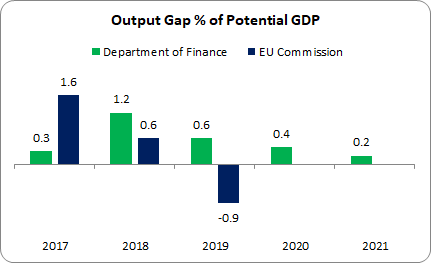
The Finance Department is projecting a very positive gap in 2018, falling to a near alignment in 2021. The EU Commission, however, shows the economy to be over-heating last year but falling well below its potential next year.
On either reading, the economy is not over-heating. Should we be guided by these projections? No. The Finance Department is highly critical of the methodology behind measuring the output gap.
‘It must be acknowledged that the concept of potential growth is more complex to assess for a small, open economy such as Ireland, which inter alia is characterised by significant cross-border mobility of labour and capital. Indeed, the positive output gap . . . currently estimated for this year, which is inconsistent with limited inflationary pressures evident in the economy, highlights the health warnings attached to estimates of the cycle using this framework.’
The Department attempted to create an alternative measurement and what they came up with was a more practical graph showing that as the economy recovers the negative output closes and starts to stray into positive – that is, slightly over-heating – territory. It’s what common sense would dictate.
A second measurement to identify over-heating is through the balance-of-payments. This calculates all transactions between Ireland and the rest of the world, consisting of imports and exports of goods, services and capital, as well as transfer payments such as foreign aid and remittances.
A negative balance can pose trouble as a country is importing more than they are exporting (not a greats space for a small open economy to be in), or borrowing more than they are lending. During the speculative boom years, Ireland’s balance deteriorated into negative territory. Following the crash it has been improving.
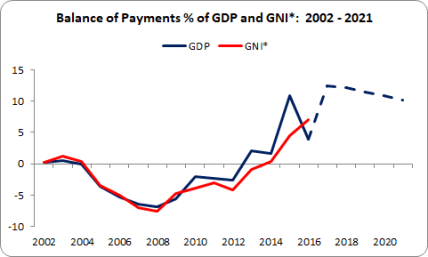
If we look at the balance of payments as a percentage of GDP or a percentage of GNI* (which removes all the multi-national noise from the accounts) we have seen a sustained recovery. While using GDP as a benchmark is just as problematic as using it for the economy’s well-being, we can see that the Government’s projections out to 2021 (in dash) shows a slight falling back. If this holds for GNI*, it is reasonable to assume that our balance of payments will remain in fairly good health for the years ahead – with the all the downside caveats like an exploding Brexit, exploding Trump, etc.
So where does that leave us? It leaves us using common sense. It should also compel us to, without complacency or fear-mongering, focus on the real problems. Here, Chris Johns has some sensible words:
‘Overheating is one of those things that is often mentioned, but there is no commonly accepted definition of the term . . . It’s talked about with dubious confidence . . . Policy should be about acknowledging all risks and problems, particularly the ones that are real, rather than threatened. Dealing with the problems of today and building resilience to a wide variety of potential shocks, most of which we cannot foresee, is at the heart of good policymaking. I suspect the overheating warnings are partly a device for pressuring the Government for tighter fiscal policy. There are good reasons for budgetary caution . . . but overheating is not high on that list. Coded warnings risk being unhelpful, and lack both transparency and the context of an overall analysis of what is really needed.’
There is a clue buried in the output gap. If we can remove the obstacles to a higher potential GDP then we can prevent the economy from sweating. The problem is that potential GDP cannot be directly measured; it is one of those benchmarks that are tied up with a methodology which the Department of Finance is rightly critical of. Nonetheless, we can agree on some obstacles.
- If we’re not building enough houses in a planned sustainable manner to accommodate people at affordable rates then we’re going to be in social and economic danger of limiting our capacity to grow.
- Affordable childcare: If you’re trying to entice more people into the labour market then making childcare fees expensive is hardly the ticket.
- If people want to work more but are prevented by management practices (precarious working, uncertain hours, bogus self-employment) then full participation in the economy will be, for those caught in this trap, elusive.
And if the fear is that the economy will overheat as we build more houses or provide childcare then the fiscal tool of taxation is still available – property and asset taxation, diesel taxation, reversing the temporary reduction in VAT. Oh, yes, and abandon the tax cuts.
We shouldn’t let the debate about over-heating side-track us from the necessary investments in the productive economy. If we cut back on these then we may satisfy this graph or that. But the economy itself will be unable to withstand the inevitable downward cycle, social problems will mount and we will find ourselves weaker.
That would be pretty poor fiscal politics.


Leave a Reply