
Now that women have secured a basic human right denied them by the constitutional caprice of the now defunct 8th amendment, what is the next step? It depends on how people see the issue. If it was about secularizing the constitution, then the next step would be to dis-establish the church in the provision of health and education. If it was seen as a woman’s issue – an issue of choice and autonomy – then the next step would be to address issues that continue to deny women their rights. (By the way, we can take these and other steps in tandem).
In the workplace, this means the continuing discrimination against women – in pay and working conditions. The usual way of measuring this is the gender pay gap, a simple calculation that measures the earnings inequality between men and women. This has rightly received a lot of attention. However, there are problems with this measurement.
A pay gap can be due to structural factors, not outright gender discrimination. For instance, occupational segregation could explain the difference in earnings. While 24 percent of women work in the low-pay distributive and hospitality sectors, only 19 percent of men work there. Because of this and other factors (occupational segregation, educational achievement, number of working years), this simple measurement is called ‘unadjusted’. The EU Commission states:
‘. . . the unadjusted GPG (gender pay gap) entangles in its measurement both possible discrimination between men and women, in terms of "unequal pay for equal work", as well as the impact of differences in the average characteristics of men and women in the labour market.’
Eurostat has been working on an ‘adjusted’ gender pay gap – one which removes these structural factors. What is left is called the ‘unexplained’ pay gap and it is in this measure we will find actual pay discrimination.
So how do these compare? Ireland performs comparatively well in the ‘unadjusted’ pay gap with a lower percentage than the average of our EU peer group (13.9 percent as opposed to 16.9 percent). However, when we turn to the adjusted, or unexplained, gender pay gap a different picture emerges.
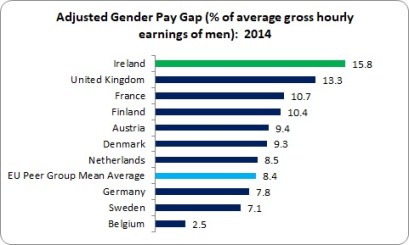
Ireland shoots up to the top. This suggests that actual pay discrimination is the highest in our peer group.
There are a number of strategies to end the gender pay gap: legislation (and highly resourced monitoring and compliance) and transparency which the Government intends to introduce, requiring companies to publish gendered payroll breakdowns.
One strategy that doesn’t get much mention is the attempt to rebalance, however, slightly, the power relationships in the workplace; namely, collective bargaining. Where collective bargaining exists there is a tendency for the gender pay gap to fall. There are two examples of this in unadjusted figures.
First, in the public sector – where workers benefit from collective bargaining – the gender pay gap is much less than in the private sector, where only 15 percent of workers benefit. In the public sector the gender pay gap is 9.7 percent; in the private sector it is more than double – 19.7 percent.
Second, those economic sectors with higher levels of union density (the number of workers who are members of trade unions this can be used as a proxy for collective bargaining) tend to have lower gender pay gaps.
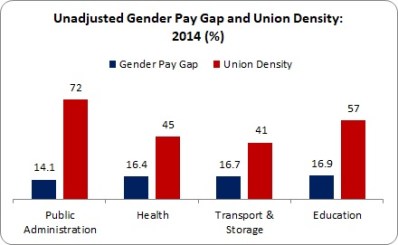
These four sectors have gender pay gaps lower than all the other sectors reporting (curiously, some sectors don’t report for ‘confidential’ reasons). These sectors also have high levels of union density compared to a economy-wide level of 27 percent.
These are strong and positive co-relations between the ability of employees to negotiate collectively with the employer and a lower gender pay-gap. The European Trade Union Confederation also found this:
‘ . . . systems with a focus on centralised bargaining (sectoral and cross-sectoral) and high collective bargaining coverage tend to have been more successful in integrating gender equality issues into collective bargaining . . .the most successful gender equality outcomes are found where sectoral and company bargaining co-exist.’
This shouldn’t be too surprising. When people work together – whether in a social organization campaigning for the repeal of an odious amendment or in the workplace campaigning for equality – positive change can occur. These are persistent lessons – people assuming power over their own lives.
And when people work together, the next steps and the steps after that become a little bit easier.
* * *
Note: this data was presented by Ethel Buckley, SIPTU Deputy General Secretary, to a Unite seminar on collective bargaining.
 Notes on the Front
Leave a comment