
The Government produced their draft Stability Programme Update containing projections for the economy and the budget up to 2021. They will firm up on these numbers – along with the projected fiscal space – in the Summer Economic Statement. But it is not likely to differ in any substantial way.
There’s been lots of commentary: the validity of GDP, rising employment, available budgetary resources, etc. Let’s take a step back and look at the long-term, using the CSO’s GNI* which attempts to factor out distortions in our GDP. What we find is an ever slowly shrinking social state.
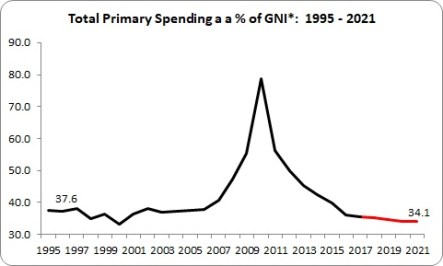
There’s been a long-term stagnation at best. Since 1995 there has only been one year that public spending was lower than it what it is projected to be in 2020/21. (Note: during the crisis years, spending as a percentage of GNI* shot up. This was not due to increased public expenditure which actually fell (though bank debts were included). It was GNI* falling by 22 percent between 2007 and 2011. So a fall from that peak was inevitable).
There is a projected slow reduction in public spending (as a proportion of output) between 2017 and 2021.

We find primary public spending falling, with current spending (public services and social protection) falling faster. Fortunately, investment is on the rise.
The above doesn’t mean that public spending is being cut in nominal terms. It is actually increasing, from €71.4 billion to €83 billion – an increase of 16.3 percent between 2017 and 2021. This may seem like a substantial amount. But when you factor in prices and population rise, the increase comes to 7.4 percent. This increase, however, reflects greater emphasis on investment. Current spending will rise by only 3.2 percent up to 2021, or less than 1 percent annually. That is going to be a tight squeeze.
How does this compare with our peer –group in the EU; other Northern and Central European economies? We can compare the Government’s and EU Commission’s projections for 2019.
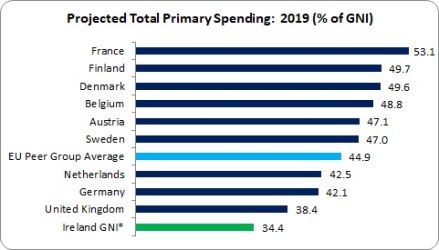
Ireland would have to spend an additional €23.5 billion just to reach the average of our peer group. However, this doesn’t take account of the different factors that drive spending in particular countries. For instance, because of the older age demographic other EU countries have to spend more on pensions than Ireland.
So if we exclude expenditure on pensions (taking the proportion of pension expenditure in 2016 and applying it to 2019 levels), we find that Irish primary public spending comes in at 29.6 percent of GNI* compared to our peer group average 35.1 percent. While reduced, this still leaves a gap of €12.3 billion.
However, we also have to factor in our higher young demographic, which should drive education and family support expenditure higher than our EU peer group. There are other factors: prices, defence spending (which, however, is a discretionary category), dispersed population, and categories which constitute expenditure but are counted as household and not government spending (e.g. our old friend – water and waste spending).
Therefore, we should be careful about using comparative headline rates. However, there is strong evidence that Ireland is an under-spender compared to our peer group.
Becoming a more European-type spending economy is not an easy task. One could argue for higher taxation but there is no gold at the end of the fiscal rainbow. Clearly, we have a low ‘social wage’ (employers’ social insurance). In other countries this finances enhanced in-work benefits and health services. But increasing the social wage would require systemic multi-employer collective bargaining structures to ensure equity – and we don’t have these structures.
We could be entering into a difficult fiscal and economic cycles. Even before the EU starts bringing multi-national tax avoidance under control (and, so, reducing our revenue), companies are taking unilateral steps to reform their tax strategies which could put downward pressure on Irish corporate tax revenue. Then there’s Brexit. Then there’s the still the high level of general government debt, though estimates vary depending on the measurement.
We seem to be stuck in a structural trap – a trap that is becoming tighter. How do we break out of it? Here are three responses:
· First, abandon net tax cuts. If there are to be tax cuts then these should be funded by tax rises in other areas. And within this, push out the boat a little. A good start would be to let the 2019 property valuations come on stream without amendment.
· Second, constitute a collective bargaining structure which would integrate an increase in the social wage with overall wage increases. This would have the benefit of strengthening our automatic stabilisers (e.g. pay-related unemployment benefit) which would keep domestic demand up if there are job losses with a Brexit gone wrong.
· Third, engage in real ‘public sector reform’ (not the crash n’ burn of the austerity years). This would focus on increasing productivity through the introduction of employee-driven innovation (discussed here). However, this process requires trust between all partners. The Government could help to build such an environment by committing itself to full pay-restoration and an end to the two-tier pay structure and negotiating in good faith the time-scale.
In other words, we don’t have to immediately reach for the tax hike cudgel. But we do need a long-term vision of where we want to be in the future. And being in in a low-spend, low-tax society where people continue to purchase public goods in private markets and doing without benefits that other European workers enjoy – well, that’s not much of a future.


 Notes on the Front
Leave a reply to Michael Taft Cancel reply