
Measuring wages in an economy is pretty straight-forward – take the total amount of wages and find the proportion it makes up of GDP. That is called the ‘labour share’. Measuring profits should also be pretty-straight forward. But Irish economic data is anything but.
Why measure profits? Because they are vital to a market economy (but see below for important caveats). Investment comes out of capital compensation which is a proxy for profits. Investment in a market economy – whether private or public – is key to productivity, growth, employment and wages.
But measuring Irish profits is more than problematic. In our EU peer-group, profits make up 38 percent of GDP; in Ireland, it exceeds 63 percent. We know this is not real – no more real than our GDP, largely due to the interaction of multi-national accounting practices and Eurostat’s new way of measuring GDP.
Given that normal data can’t provide us a clear picture, we have to use the CSO’s GNI* (a measure of gross national income unique to Ireland). This excludes outflows from the economy (e.g. repatriated profits) along with a range of distorting features such as re-domiciled profits, aircraft leasing and intellectual property. Given that the GDP income method is made up of labour income, profit income (including self-employed or mixed income), and taxes on production and imports, I assume labour and taxes are relatively without distortion. To get the profit share, I subtract labour and taxes from GNI*. This is not an ideal method and hopefully others will have a better way of deriving profit income. How do we measure up?

Even with all the distortions removed, Ireland is still a highly-profit economy. Of course, this doesn’t tell us how those profits are distributed. Revenue Commissioners tell us that as much as 40 percent of corporate tax revenue comes from just 10 companies, which is highly concentrated (and fiscally reckless). However, much of this tax revenue does not come from profits generated here whereas the GNI* strives to give a picture of domestic economic activity.
Nor does it tell us how these profits are used. If high profits lead to high investment then there is a social benefit. However, such investment can be directed to unproductive activities. This happened prior to the crash when a number of domestic companies used profits to speculate in the property market. Profits can also just be thrown on a big cash pile, or used to over-compensate senior executives, or distribute excessive dividends. When this is done at the expense of investment, wages or employee benefits, then real economic harm is perpetrated.
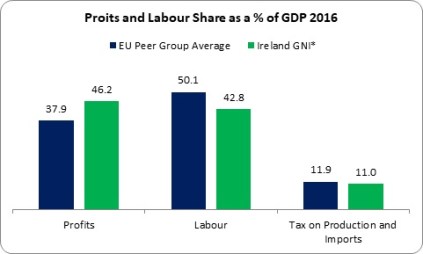
If Ireland’s share of wages and profits equalled the average of our peer group, this would mean an additional €14 billion for wages, equivalent to a 17 percent rise in employee compensation. Such a rise would assist in reducing low-pay, reducing government subsidies (e.g. Family Income Supplement) and increasing tax revenue which could be re-invested into social and public services.
Does an economy need high profits to be ‘competitive’? It does not appear so. All the countries in the chart above – all below Irish profit levels – rank higher in the Global Competitiveness Index.
To re-balance the economy, there is a need to strengthen labour rights in the workplace so that employees can more effectively bargain with their employer (discussed here). But how do we ensure that profits are directed into productive investment? This is a more difficult proposition.
· First, we would need hard data on the profitability of domestic firms, in order to calibrate efficient incentives. In particular, instead of grant-aiding and lending we could invest in new and existing domestic firms and take equity.
· Second, we need to promote investment-rich foreign direct investment – something that will become an imperative as the rules regarding multi-national taxation change. This will require greater emphasis on education, skills and infrastructure such as housing to attract FDI.
· Third, we need to create and expand companies that are essentially investment-driven; namely, public enterprises. Public enterprises do not create profits for shareholder value (though during the recession the Government milked these enterprises for dividend payments); they pursue profits to boost investment which is paid out of retained earnings.
And between all three we need new hybrid models – public, domestic private and foreign multi-national – so that we can make these companies work together for the productive economy.
We need a profitable economy – to invest productively, to compensate labour, to raise productivity, and spread prosperity throughout society. We have the profits. It is debateable whether they are being put to best use.

 Notes on the Front
Leave a reply to Seamus Coffey Cancel reply