
A couple of days ago I discussed a proposal to make childcare affordable. We all know that Irish childcare is one of the most expensive in Europe. However, when it comes to children we have more problems. For it appears that households in Ireland find it extremely difficult to afford education.
Eurostat, based on the Survey of Income and Living Conditions, has produced a new dataset: difficulty paying for formal education (thanks to Conor McCabe’s Facebook post for alerting me to this). The data surveys households’ ability to cover the costs of formal education using six categories ranging from great difficulty to very easily.
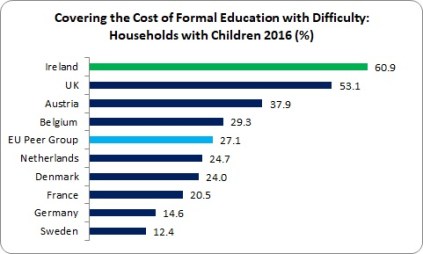
61 percent of Irish households with children are covering the cost of formal education with difficulty. The only country near us is that other liberal market economy – the UK. This is twice the level of our EU peer group with a mean average of 27 percent. And compared to Sweden, with only 12 percent of households finding it difficult, we are in a different, distant and much lower league.
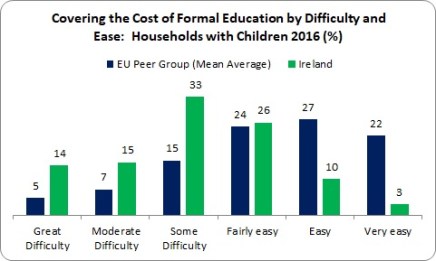
At one end, 14 percent of Irish households with children are covering the cost of formal education with great difficulty, compared to 5 percent in our EU peer group countries. At the other end only 3.5 percent of Irish households can afford formal education very easily; in our peer group the figure is 22 percent (in Sweden it is 46 percent).
No matter how you juggle these stats there is only one word for this: obscene. It is an attack on parents’ living standards, it is an attack on children’s’ educational opportunities. And it is an attack on the productive economy which, in the future, will rely even more on education and innovation as the driving force in growth. If you wanted to sabotage our economic future, you couldn’t do better than making education difficult to afford.
Unfortunately, the Eurostat data doesn’t break down difficulty and ease by educational level. It would be interesting to see how households cope with primary, secondary and third-level education costs. However, such is the breadth of difficulty for Irish households (over 60 percent), we would probably find it difficult across the board.
So whether it is childcare or formal education, Irish costs are high and households are struggling. There is no sense in saying that ‘children are our future’ when we are making that future unaffordable.
In this post I wrote about how the broad Left is struggling to get its economic message across. Well, here’s an opportunity: progressives and trade unionists should champion the living standards of families –affordable childcare, free education , family benefits (pay-related maternity and paternity benefits, a new child-raising allowance), and greater work-life balance – labour flexibility on families’ own terms.
For the stakes are high – today’s living standards, children’s’ life-chances, tomorrow’s prosperity. Indeed, they couldn’t be higher.


 Notes on the Front
Leave a reply to Michael Taft Cancel reply