
Employment rising, wages rising, moving away from the bad ol’ recession days: the recovery is sinking roots in the economy. However, there is no one measurement that can wrap all these up into a neat statistical table. But what we can surmise is that the Irish economy has problems with translating national income into living standards.
A common stat is to look at national income, or GDP, per capita. We know that GDP is not a fit measurement for the Irish economy. The 2015 switch to new national accounting standard also impacts on GNP and even the CSO’s GNI* which attempts to remove distortions such as re-domiciled companies, aircraft leasing and multi-national R&D and intellectual property. This makes comparisons before and after 2015 difficult. However, in 2016, Irish national income per capita is above the average of our peer group.
So some commentators have looked at employment. Here we find that employment in the third quarter of 2017 still remains pre-crash levels – about 40,000 below 2007 levels. But when we exclude construction (which was highly inflated 10 years ago owing to the property boom), employment is now 60,000 above pre-crash levels.
Wages, too, are rising, albeit slowly. Overall, weekly income is 2.4 percent above 2008 levels though in the last year it increased by 1.7 percent. Of course, not everyone is benefitting. Public sector and hospitality workers still find their income depressed below pre-crash levels.
There is no doubting that indicators show improvement – even if this improvement is not evenly shared. For example, social protection pay is still well below pre-cut levels. But there’s another measurement that can help fill out the picture: Eurostat’s attempt to measure living standards.
At one time this was measured by consume spending. The assumption was that the more people spent, the better off they were. One problem with this is the source of that spending: if spending is wage-based, it is likely to be sustainable. However, if spending is credit-fuelled, this can end badly as we know from experience.
Another problem is comparing spending across nations. In Ireland, people have to spend considerable amounts on GP visits, prescription medicines and childcare. In other EU countries, much of this expenditure is done by the state; i.e. free GP care or below-market childcare costs. So the data may show the Irish spending more, but they are spending on goods and services that other Europeans don’t have to spend.
A way out of this problem is Eurostat’s Actual Individual Consumption. This measures both consumer (household) spending and state spending on goods and services that individuals consume but don’t pay for. Combined, this gives us Actual Individual Consumption and gives a better, but by no means the definitive picture. So how do we fare over the years?
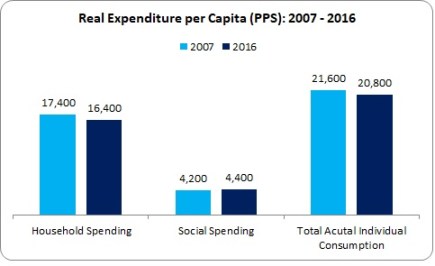
In 2016 household spending was still below 2007 levels. Social spending has seen a slight increase (the social component is derived by subtracting household spending from the total) but this leaves the total Actual Individual Consumption below 2007 levels. It’s hard to know when we will reach pre-crash levels. While there was a big pick-up in 2015 (over 6 percent), this fell back to less than ½ percent in 2016. So we will have to wait to see what the medium-term trend might be.
We should note that whatever the trend might be in the future, currently we are well below the average of our peer group.
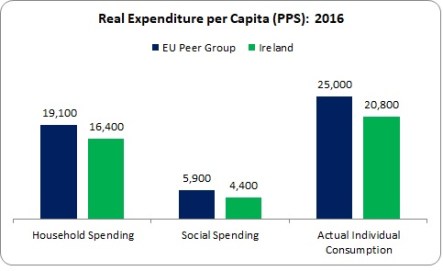
To reach the average of our peer group, every man, woman and child would have to spend an additional €3,000 each. The state would have to spend an additional €6.8 billion.
This shouldn’t be taken as the last word. Along with other measurements – employment, wages, poverty and deprivation, precariousness – it is only part of the picture. And spending on social services, while high, can be inefficient, Further, this data tells us nothing about the distribution of spending (is it more equal than other countries). But in this aggregate picture, we lag a long ways behind the living standards of our peer group. In fact, we rank last.
Which is all the more frustrating given that Ireland ranks 4th in terms of national income per capita – even ahead of Germany.
This should lead to a national conversation as to why we find it difficult to translate national income into living standards.
And what steps we can take to address this.


Leave a Reply