
The following is a story about how a single stat that seemingly tells a positive story actually conceals a structural economic flaw.
Ever since the OECD produced a table (you can find it here on page 8 of this Department of Finance presentation) that purportedly showed Ireland has one of the most progressive taxation systems in the EU, many commentators and politicians have convinced themselves that this is practically the last word on the subject. Rarely is there an attempt to investigate what’s happening underneath those data points. For me, our ‘progressive taxation’ system is a contestable distinction and points to a structural problem in the Irish economy.
Leave aside other considerations (tax on capital vs. tax on labour, impact of employers’ social insurance). Let’s assume the progressivity of Irish personal taxation. What is this really telling us? The Public Policy synopsis of the tax system is broadly correct – Irish low-paid workers (measured as two-thirds of average wage) are the least taxed in the EU. The average EU tax rate for the single low-paid is 20 percent; in Ireland, it is three percent. Now this refers to headline rates and doesn’t count reliefs, allowances and exemptions apart from personal tax credits. However, the broad thrust of EU taxation is geared towards higher rates on the low paid.
That ultra-low tax headline tax rate on the low paid is one of the driving forces behind Ireland’s progressive taxation system; that, and the low social wage, or employers’ PRSI. This might seem progressive. However, it doesn’t tell the full story.
Staying with the OECD data, how much do single low-paid workers earn annually in our EU peer group?
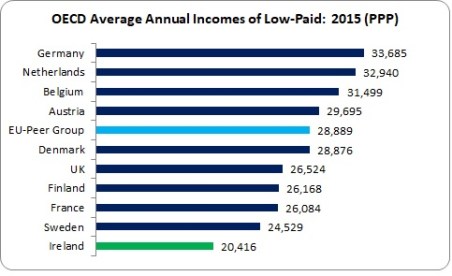
The above, presented in purchasing power parities, shows Irish low-paid at the bottom; i.e. wages at two-thirds of average incomes. To reach the average of our peer group, Irish low-paid incomes would have to rise by over 40 percent.
So, yes, we have a ‘progressive’ taxation system based on low-tax rates for the low-paid. But it is built on a low-wage structure. In effect, the tax system is used for a ‘welfare function’ – not as it should be: an efficient revenue-raising process that supports the productive economy.
Why is the tax system used as a welfare function? I would argue that this conceals the low-to-non-existent level of bargaining power the low-paid have in the labour market. This lack of power – and the lack of labour market institutions that would support the low-paid – requires the state to subsidise the low-paid. It can do this through social transfers such as Family Income Supplement. Or it can do so through the tax system – as it does now – through exempting low incomes from taxation which at the same time subsidises low-pay employers.
This has negative impacts in the economy:
- Reduced tax revenue (including social insurance, or PRSI) reduces the resources to invest in public services and social protection which are of more benefit to the low-paid – public transport fares, housing costs, health care, temporary pay-related unemployment benefit (low-paid workers are more likely to be in-and-out of the labour market), etc.
- It distorts the tax system for those higher up the income scale. This can help explain why the entry into the top rate of tax is so low – approximately 10 percent below the average income – though our two-rate tax band structure is also a contributing factor.
Yes, the reduced taxation on the low-paid (Ireland’s ‘progressive personal tax system’) provides a cash benefit to those in such employment. It also subsidises low-pay employers. All this comes as a cost.
Ultimately, the low level of tax is poor compensation for the lack of bargaining power the low-paid possess. Without collective bargaining rights or coverage under multi-employers collective bargaining agreements, the low-paid have little chance to receive a fair share of the income they produce in the workplace.
This is the vicious trap the low-paid find themselves in. In effect, the Government is telling them:
‘We’re not going to empower you in the work place to bargain better wages and working conditions, we’re not going to provide the range of public services available to the low-paid in other countries, we’re not going to give you strong social protection benefits – but, hey, we won’t tax you much.’
You don’t start with the tax system to unravel this. You start in the workplace. You start by providing support for the low-paid – and this doesn’t mean cash transfers. You start by increasing workers’ bargaining power which for so many low-paid workers is virtually nil. The low-paid don’t need progressive taxation as much as they need progressive bargaining power.
That would be a better deal.
And provide a better, more progressive stat.

 Notes on the Front
Leave a reply to Dermot Donnelly Cancel reply