
Short answer – to the top. But that is only part of the story. The CSO tracks average weekly incomes by type of employee:
- Managers, professionals and associated professionals: in the last year this category averaged €1,218 per week
- Clerical, sales and service employees: these workers averaged €484 per week
- Production, transport, craft and other manual workers: these workers averaged 509 per week
The manager and professional category makes up 38 percent of all employed.
The index below follows average weekly incomes between 2010 2nd quarter to 2017 2nd quarter.
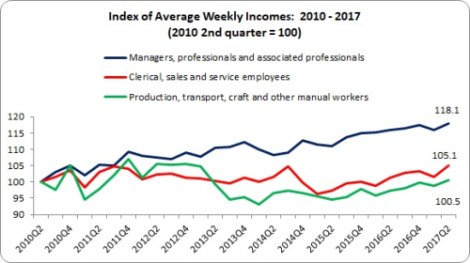
Since the start of thios CSO series – 2010 2nd quarter – we see the average weekly incomes of managers and professionals rising by 18 percent (or €188). Clerical and sales workers – essentially ‘white-collar’ workers – saw their weekly incomes rise by 5 percent (€24), while manual workers received only a marginal increase – €3.
In the last year, however, the rise in managers/professionals’ weekly incomes has eased off a bit with others experiencing an increase. But they have a long way to go.
We should be cautious about the numbers above for we may be seeing a compositional effect at work. Over the seven years covered in the data, it may be that new jobs have been created for managers/professionals with higher pay rates – not that everyone in this category back in 2010 received, on average, an 18 percent pay increase over the seven years. Nonetheless, it shows a widening of the gap.
While many would immediately refer to wage-equality issues (and these are legitimate), we have to look under the hood, so to speak. Clearly, professionals are in a stronger position vis-à-vis their employers to leverage their skills in order to bargain a higher rate – especially if there is a shortage of their skill in the market. Other workers may not have this leverage; and with collective bargaining coverage falling, most cannot rely on strong trade union representation. So what leverage do they have?
So while this may be one measurement of wage-inequality, we should note that Ireland’s higher paid are not very highly paid when compared to our EU peer group. We can get some insight into this by comparing the incomes by decile.
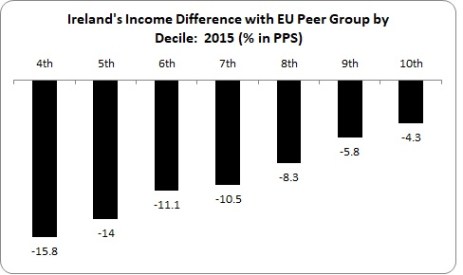
Starting with the 4th decile (that is, the fourth lowest income group – this is the decile where income from work exceeds social transfers in Ireland), we lag behind the mean average of our EU-peer group by a considerable amount. This gap lowers the higher up the income scale we go. But even in the top income groups – where we would find managers and professionals – Ireland is still below average.
So if managers and professionals are more successful in leveraging their advantages in the workplace, their incomes are not above-average by our peer-group standard.
What lessons can we draw from all this?
First, while wage-inequality – within Ireland or in European comparison – is a concern, there are other important measurements: namely, the share of labour income in the economy (discussed here) and the inequality in wealth assets – real and financial property.
Second, the main concern is not that professionals can leverage their workplace advantage; it’s that white and blue collar workers have little power. This inequality in bargaining power is a primary determinant in wage distribution among the workforce.
This lead us to the inequality of power in the workplace of which the wage inequality outlined above is a result.
To address that inequality, there must be renewed emphasis on collective bargaining and challenging employers’ ability to ignore their employees. This is one of the biggest issues for trade unionists and progressives and something this blog will spend a lot more time on in the New Year.


Leave a Reply