
Andrew Phelan wrote of his experience on Facebook:
‘So government decide to throw €50 a month our way to help towards Crèche fees. Ok. It’s tiny but I guess every little helps. What does the Crèche do, literally the same month it’s introduced? Increase the fee by €40 a month of course. Then blame the workers for the increase because they have to pay their wages.’
It isn’t surprising. Last year I warned that this would be the likely result. Why is this happening? Let’s first recap the affordable childcare scheme. It is a series of subsidies provided directly to the provider – not the parents. At its minimum, there will be a universal non means-tested €20 weekly subsidy for all childcare places, rising to higher levels on a means-tested basis. This is intended to be the first step in providing affordability to all parents.
The main problem is that a huge swathe of our childcare system is based on a market model which  requires each individual provider to balance expenditure and revenue just to break even (for-profit providers require surplus revenue). Any additional cost must be, by and large, passed on to the parents.
So when the Government provides a subsidy to the provider, it is not surprising that the full subsidy is not passed on to parents. This can be for legitimate and necessary reasons. There are at least two issues here.
First, childcare fees have, on average, remained static for years. This can be attributed to falling demand (e.g. parents losing their jobs or working hours) and falling disposable income. With rising employment and incomes, providers will now start increasing fees to cover their increasing costs.
Second, there is an urgent need to upgrade and professionalise the sector. The average wage in the sector is €11.93 per hour, with managers averaging of €14.75 while early years assistants earn an average of €10.88 per hour. These are not handsome amounts, even at managerial level. With a staff turnover rate of 28 percent (which costs the provider in terms of recruitment and training), crèches need to increase wages. And as qualifications increase, so do wages: NFQ levels 9/10 earn 29 percent more per hour than those with a NFQ level 5.
When one considers that 25 percent of community (i.e. non-private) staff are on employment schemes; that half of all staff are part-time with 39 percent on seasonal contracts; given this, If childcare is to provide full-time income with professional qualifications and career paths, expenditure must increase.
Therefore, it shouldn’t be surprising that the subsidy provided under the Affordable Childcare Scheme is not being fully passed on to parents.
What happened last year, in anticipation of the Affordable Childcare Scheme? Fees increased.
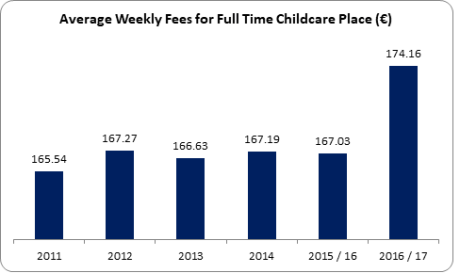
Full-time places increased by over €7 per week, or 4.3 percent. This average hides up huge disparities around the country with Dun Laoire, Wicklow and Final exceeding €200 per week while Carlow, Monaghan and Leitrim come in at less than €145 per week. Even at the lower end these are substantial costs for households.
This is before the subsidy. And if the subsidy itself is absorbed by upward expenditure pressures the question is: where lies affordability? The Department is explicit:
‘Childcare fees are determined by childcare providers. The Affordable Childcare Scheme will provide a subsidy towards the fee charged by the provider, but the sum that parents will have to pay will then depend on the childcare provider’s own fee policy.’
Which makes this comment from Minister Katherine Zappone curious:
‘I am really very keen that crèche providers ensure that if they feel they need to increase their fees, they show restraint, that any indication or examples of a pattern where fees are being increased that are not reasonable, that don't cover the cost, this will mean I will take action. Some of the action will be to consider regulation or price caps.’
The Minister has no power over fees charged. And bringing in price caps could only exacerbate the market-model, forcing providers to suppress costs. And that means wages as they make up 70 to 80 percent of expenditure in this labour-dense sector. Workers could end up paying for any cap.
In any event, the issue is not increased fees (though Andrew's example above is pretty grim). Even if fees remain static (or fall marginally due to the subsidy) parents will be denied affordability.
There is a way out of this – treat childcare as a public service, in the same manner as primary education. This doesn’t mean that all childcare need to be state provided (though in many EU countries it is provided by local authorities as a public service which is why they are affordable). Public, community, non-profit and proprietor-managed facilities could be brought into a public network where wages, costs, and fees are set by an independent agency working to an affordability criteria. After that, the childcare place receives the subsidy.
When the principle of public service is accepted we can create a childcare system which provides quality service, quality wages and working conditions, and reasonable fees. The alternative is tweaking a system that cannot provide affordability.


 Notes on the Front
Leave a reply to Michael Taft Cancel reply