
Workers at Dublin Bus are on strike. They certainly have had a difficult time of it since the recession started: no wage increase since 2008, have not been paid a 6 percent increase owed to them since that time, suffered job losses and service cuts, reductions in over-time pay and increased hours (e.g. a 13-hour working day), and now working under the threat of creeping privatisation – all this while Dublin Bus has experienced profits (surplus) in the last two years. A good summary can be found here where Dan MacGuill – the Journal.ie Fact Checker – analyses a leaflet distributed by the NBRU. Dan finds that all the claims made on behalf of the striking workers are pretty much true (and anyone who follows Dan’s column knows that this is a high benchmark).
Here I just want to focus on the levels of subvention to the Dublin Bus; that is, the amount of subsidy the Government pays for public transport. Public transport is not a for-profit operation (any more than a hospital or a school). It is a public service and this is recognised throughout Europe. So how does the public transport subvention in Dublin compare to other European cities.
I discussed this last year at the time the National Transport Authority decided, with little evidence, to privatise up to 10 percent of Dublin bus routes. Here is what the data tells– which is a bit patch-work (unfortunately, there is no unified database on public transport subsidies). This comes from here and here and relates to 2009 / 2010.
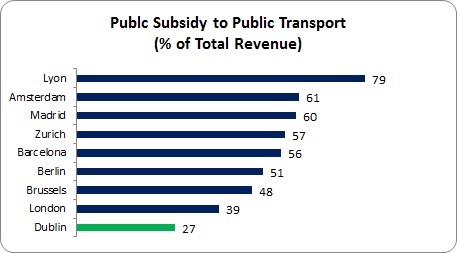
This data measures the public subsidy as a percentage of total revenue to public transport (the other main source would be fares). This is a bit dated so there is a reasonable chance that Ireland has fallen even further down the table. Te Dublin Bus Annual Reports, as reported by Dan, shows that the public subvention has fallen to 20 percent of total revenue. The nominal subvention fell from €86 million in 2008 to €58 million in 2015 – a cut of nearly a third.
- If the subvention were increased to the average of the other cities, Dublin Bus could be receiving over €200 million more per year from the state.
- If the subsidy increased to the London level, Dublin Bus could be receiving an additional €90 million.
These are approximate figures and, so, should be treated indicatively (we don’t know what’s happened in other cities since 2010) but it shows how low public transport support is in Dublin.
It’s not just the impact on wages and services; it also affects fares. According to the Irish Mirror, Dublin commuters are paying the highest bus fares among 16 EU countries while Dublin is the fourth most expensive EU city to buy a monthly ticket covering bus, train and tram travel.
An average EU subvention could transform bus services in the Dublin area –substantial expansion in services combined with fare reductions. In addition, given that bus transport is highly labour intensive, an expansion of services would return a considerable amount of that subvention to the Exchequer through additional tax revenue.
To the extent that a portion of the subvention goes to providing wage increases, the state recoups a large portion of this. It would recoup nearly 30 percent of pay increases to those on the standard rate and nearly 50 percent for those on the higher rate – and this doesn’t count the revenue from increased consumer spending.
Investment in public transport is key to a prosperous city – moderating consumer costs, increasing mobility, reducing congestion and environmental damage. However, Minister Shane Ross’s response to this is curious to say the least. He claims the Government won’t be a ‘soft touch’ to both employers and employees. I’m not sure what this means but it would appear to miss the point entirely. Public transport supports are incredibly low, services have been cut, fares are incredibly high and wages and working conditions in Dublin bus are on the floor.
What we need is a ministerial vision of public transport in Dublin, not ministerial sound-bites or tweets. It’s not a matter of pulling out a cheque-book as the Minister puts it – it’s about creating an accessible and sustainable city for all.
That, ultimately, is what the Dublin Bus workers are striking for. If we want to succeed, they need to succeed.


 Notes on the Front
Leave a reply to ourlittesecret Cancel reply