
One must be careful in dealing with a survey such as The Future of Ireland. Questions tend to be open to all manner of interpretations while conclusions can be vague. Unlike a disinterested scholarly attempt to ascertain how people view the future, OMD’s effort is aimed at helping ‘. . . brands navigate the future of Ireland.’ Sugar-soaked cereal brands will no doubt take note.
Nonetheless, the exercise is worthwhile, if only to start a conversation on the long-term. And the survey results should give progressives heart while at the same time throwing up challenges as to how we make our politics relevant in the future.
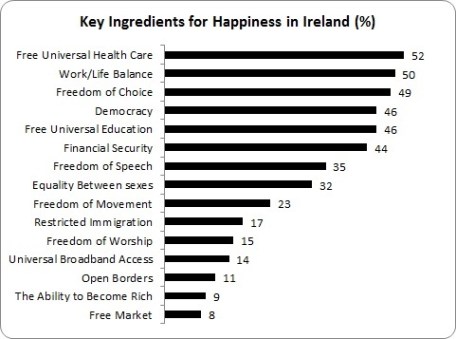
The survey asked people to indicate what makes up key ingredients for happiness:
- Free universal healthcare and education are profoundly progressive policies – which can only be delivered through public markets. This is a strong indication of support for collective social provision and mirrors the support for increased expenditure in health and education in polls prior to the budget.
- Work/life balance features strongly. It is difficult to see how this can be facilitated without a stronger social state and labour market reforms. A strong social state can provide for greater time with children after birth without financial penalty, family leave and care, more holiday time and work sabbaticals. Labour market flexibility (the good kind, on the employees’ terms) would facilitate more flexi-working, reduced working hours, stronger rights in the workplace to prevent exploitation (unpaid overtime, etc.) and an end to precariousness.
- Financial security ranks far higher than the ability to become rich. Financial security, again, involves a strong social state: free health care when we are sick, labour market policies that maintain full employment, an end to precariousness, strong social insurance programmes when we become unemployed or injured at work, free education to defray child-related costs.
Just as provocatively, freedom of choice ranks higher than the ‘free market’. We shouldn’t’ confuse the two. It has long been argued that the free market limits choice as market power becomes concentrated; never mind the argument that poverty and low incomes are themselves a denial of choice. What choice is there in the Dublin housing market? What choice is there between different enterprise models? Choice is socially constructed (and if this article is anything to go by, too much choice denies effective choice). All this to say that freedom of choice is, or should be, contested political terrain.
In my own reading (and I would like to hear others’ readings) what comes through for people, looking ahead in the future, is greater activism combined with greater security and autonomy.
Throughout the survey there are a number of interesting findings:
- While people want free universal healthcare, seven out of ten agree that they will take greater responsibility for their own health and wellbeing in future.
- Only 28 percent expect people to become more involved in their local communities and voluntary associations – though 73 percent would be happy to see such a trend. 46 percent plan to become a volunteer in a charity or club but only 20 percent intend to become politically involved.
- Though the majority don’t expect it, nearly half of the population would welcome Basic Income, with only a quarter unhappy about it.
- Again, though only a minority expect it, free high speed internet access for every household in Ireland by 2025 would be welcome by 83 percent (does this suggest that, along with free healthcare and free education, progressive should commit to making communications and ‘connectedness’ freely available through a public, rather than private?).
So what do people expect to be the main influencers in the future? This is not the same as welcoming it.
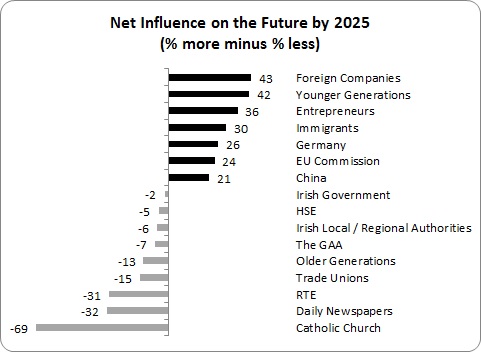
Two broad themes among others arise out of this: first, people expect international actors to have more influence than national ones. Germany, the EU, China will have more influence than the Irish government, HSE and local government.
Second, business entities (foreign companies, entrepreneurs) will have some of the biggest influences. Compare this with less influence expected of trade unions.
None of this is surprising – international and business interest dominate the economic agenda and political debate today. How does this impact on progressive politics? Do we retreat into denial, raging against actors and institutions that people expect to play a prominent role?
Or do we contrast this with a major ingredient for happiness as shown in the top table: democracy. How do we engage people who express greater support for collective social provision, democracy and social participation but who also expect institutions that could be regarded as indifferent if not hostile to these values to play a more prominent role? This becomes a central question for progressive strategy that stretches far beyond the maneuvering over the next election.
One shouldn’t read too much into this – though, in truth, there is little that should surprise us in all this. What it does suggest is that progressives should start some hard thinking about the long-term, re-thinking our programmes and policies to ensure they fit into the values that people aspire to, and the influences they expect to be prominent. What is the progressive perspective on foreign companies and entrepreneurs, one that can coincide with social provision and democracy? How do we create a progressive engagement with the EU, rather than just being angry at the ECB (even after years of bailouts, recession and austerity, the Irish public have a far more positive view of the EU than the average European)? These are the challenges; in particular, for the trade union movement.
The future of Ireland is progressive – but only if we make it so; only if we leave behind the old shibboleths and take up the challenge of relevance; a relevance that incorporates collective provision, participation, choice and autonomy.
Difficult? Yes, but when has it been otherwise.


Leave a Reply