
Good grief. The Taoiseach has informed us that were it not for the raw guts and determination of the current government, the country would have descended into blackout, riots and mass cannibalism. Phew! Thank the lord Fine Gael was at the helm.
The Taoiseach told a meeting of the European Peoples’ Party, that Ireland was ‘over the edge’, that the army was ready to stand guard in front of banks to prevent bank-runs, that the ATMs were nearly cleaned out, that the Troika enslaved the Government to its three-headed will and that capital controls were about to be imposed. This is part of the narrative of how Fine Gael saved western civilisation on the periphery of Europe.
The problem with this self-serving narrative is that it’s a myth.
Take,for, instance Government Ministers and backbenchers telling us that when they took office there was only enough money to survive another six months. Huh? Correct me if I’m wrong but didn’t the previous Government sign a deal with the EU Commission, the IMF and the ECB that guaranteed us €85 billion for the next three years (it was called the Memorandum of Understanding)? We weren't running out of money; we had a promissory note of tens of billions – that’s why it was called a bailout.
Let’s go through a short chronology to test the Taoiseach’s revisionism.
First, the Fianna Fail-led government introduced four budgets in the space of 14 months – between October 2008 and December 2009. In total, these budgets introduced over €9 billion in austerity measures.
Second, the 2010 budget – which was intended to signal the beginning of the end of austerity – took another €4 billion plus out of the economy.
Third, the beginning of the end turned out to be just the end of the beginning. The Finance Minister called in Opposition spokespersons in the Autumn of 2010 to advise them of the deteriorating fiscal situations. The Department started drafting a medium-term fiscal plan. This was published in late November under the Orwellian title, National Recovery Plan 2011-2014
Fourth, the Memorandum of Understanding was signed in early December.
Let’s take a breather here and draw some conclusions. First, austerity was not imposed from ‘outside’, by external bodies like the Troika; it was imposed by our own domestic elite. Second, the overwhelming majority of austerity measures had either been enacted or had been planned and published prior to the arrival of the Troika. Third, the ‘Troika programme’ as such merely the rubber-stamped National Recovery Plan the Government had already published. The current Finance Minister confirmed this recently:
‘Mr Noonan in a written reply to questions from the (European) Parliament said that the (Troika) programme reflected the previous government’s National Recovery Plan published shortly before Ireland applied for a bailout. This set out “the macroeconomic, structural reform and fiscal policies to address the crisis.’
In effect, the Government was pursuing the Troika programme years before the Troika landed on our shores. If that’s the case, why did we need the bailout? Precisely because we followed the orthodox troika prescription – deflationary fiscal policies combined with banking policies that socialised private debt. The troika arrived to fund the already existing austerity programme that international lenders had lost faith in.
In short, the Troika became austerity’s lender of last resort – because no one else would fund such irrational fiscal and banking policies; policies which the Troika championed from Greece to Portugal and throughout the Eurozone. When the current government took office, the economy has already been pulled back from the edge – through the massive bailout money provided by the Troika (we would have been really skunked without the bailout money given that international markets had pulled down the shutters).
What happened after the Memorandum was signed? The Irish people destroyed Fianna Fail at the polls and elected a government which promised an alternative. But from the first day in office, the Fine Gael-led government adopted Fianna Fail’s National Recovery Plan wholesale – a plan which had been rubber-stamped by the Troika.
What about those targets – to bring the deficit down below 3 percent by 2015? That target was not imposed by the Troika. That target was imposed by the Stability and Growth Pact, the Maastricht guidelines. Even if the Troika never existed we would have been bound by those treaty rules.
Did the Troika dictate particular budgetary terms to the current Government? No. How do we know this? Because the Finance Minister told us repeatedly. On the RTE News at One programme (November 27th 2011) the Minister stated:
‘They (the Troika) actually don’t look at the individual budget measure . . . We haven’t gone into absolute detail (about the budgetary proposals) because they don’t do that level of scrutiny . . . We show them the general approach but they don’t get into detail.’
And the Minister told the Dail only a few weeks after taking office:
‘ . . the IMF and the European partners made it quite clear that whatever changes we made to the conditions in the memorandum of understanding would be fiscally neutral. In other words, if we substituted a range of measures, whether taxes or expenditure savings, by another range of measures, the fiscal impact would be the same.
So what have we got? The current government removed the Fianna Fail logo from the National Recovery Plan and substituted its own . Oh, and the actual deadline for reaching the 3 percent deficit target was knocked back a year – from the original 2014 in the Fianna Fail plan to 2015.
In short, the current government didn’t have its own fiscal programme – it (and the Troika) just followed the Fianna Fail blueprint.
And what about the army battalions standing guard outside the banks and the ATMs running dry and capital controls to stop money fleeing the country? The fact is that the money drain had stabilised by the time the current government took office.
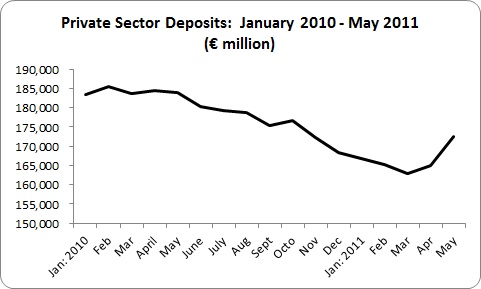
This stabilisation (which lags) occurred in the wake of the bailout – because now the Government and, crucially, the banks were guaranteed a revenue stream from the Troika for the next three years. Were there plans for capital controls? Hopefully. Hopefully, a Government at any stage has contingency plans for any range of emergencies. But contingency planning is not the same as imminent challenges. Preparatory troop manoeuvres? Hmmm.
In conclusion, austerity was home-grown – a massive redistribution from people to finance capital; it wasn’t imposed on us. Almost all of the austerity measures were enacted or planned before the Troika arrived. The Troika didn’t dictate time-tables or target dates or particular budgetary measures. All the current government did was take-over Fianna Fail’s National Recovery Plan and re-labelled it as their own.
Was the Troika’s presence undesirable, bothersome, frustrating? Absolutely. What government wants international bureaucrats poking around the office, opening drawers, demanding they be reported to? Did the Troika introduce a new set of policies – or policies that wouldn’t have been pursued in their absence? No.
Are we clear about that? Ok. Now pull up a chair and let me tell you about the time I came across this bear marauding the village not just any bear but a ferocious genetically-modified bear with just one eye in the middle of its terrible head ready to savage an orphanage I stripped to the waist and wrestled the bear to the ground . . . .


 Notes on the Front
Leave a reply to Sam Hamill Cancel reply