
Given the release of the new Living Wage estimate for 2015 – €11.50 per hour – most people would agree that, in an ideal world, all work should pay at least a Living Wage. Certainly, many good things would flow from this: a substantial reduction in working poverty, higher consumer spending and investment and improved public finances (through higher tax revenue and reduced subsidies to low-pay employers). On every level, things would be better.
But that ideal world seems a distant place. Today, one-in-five in the workforce suffer multiple deprivation experiences – approximately 360,000. According to the Nevin Economic Research Institute (NERI), 25 percent of employees earn less than a Living Wage – one-in-four. These are grim statistics. But the ugly truth is that many of our domestic sectors are reliant on low-pay and poor working conditions to survive. If we tried to move to a Living Wage overnight, thousands of enterprises would collapse, resulting in higher unemployment and poverty.
So are we trapped in this unacceptable space, only capable of making incremental improvements within narrow parameters that lock us in a low-road economy? No. A Living Wage is possible. But we have to employ a number of strategies to achieve this.
Let’s start with a simple exercise and assume our goal is to raise the statutory floor – the national minimum wage – to the Living Wage within seven years. How much would the minimum wage have to increase every year to achieve this? We don’t know by how much the Living Wage will increase over the next seven years. So let’s make two assumptions.
If the Living Wage increased annually by 1 percent, an average annual increase of 4.5 percent in in the minimum wage would be necessary – or 46 cents per hour.
If the Living Wage increased annually by 2 percent, an average annual increase of 5.5 percent in in the minimum wage would be necessary – of 57 cents per hour.
At first, these might seem like big increases. However, between 2000 and 2007, the minimum wage increased annually by 6.5 percent – well above the increases necessary out to 2022 to bring the minimum wage in line with the Living Wage. Of course, in that period we had strong economic growth, strong wage growth, increasing consumer spending – much of which resulted from the speculative boom. But the climb up the mountain isn’t as steep as one might think.
But it's not just a matter of making upward adjustments in gross pay to achieve the Living Wage. There’s another way of looking at this issue – how can we limit increases in the Living Wage? After all, the increase in the 2015 Living Wage was only 5 cents, or less than a half a percent. If this were maintained out to 2022, the average annual increase in the minimum wage would only need to be 4 percent, or 40 cents per hour. This would be quite do-able.
However, the 5 cents increase in the Living Wage in 2015 is largely down to our deflationary environment. Prices are not rising. When normal economic service resumes, this situation will change.
So what other steps can we take? We can begin to socialise living costs. In other words, we can use the state to intervene in key markets to reduce living costs. If this were to occur, people would not need as high a Living Wage to obtain an adequate income and businesses would not need to increases wages as high.
Let’s take one example: rents. This makes up a substantial proportion of expenditure.
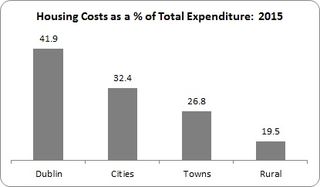 In Dublin, 42 percent of all expenditure for someone on a Living Wage goes on rents, rising by 9 percent in 2015. This proportion reduces outside Dublin but even in the cities (Cork, Limerick, Galway and Waterford) rents make up a third.
If rents – especially in Dublin – were reduced, this would have a major impact on the Living Wage. A back-of-the-excel-sheet calculation shows that if rents were to fall by just a €50 per month, this would reduce the Living Wage in Dublin by over 40 cents per hour. Put another way, workers in Dublin could see the Living Wage drop by over 40 cents per hour without any impact whatsoever on their living standards – if rents were slightly more affordable.
How could rents be made more affordable? Many will claim that if supply was increased, rents would fall. This is true – at least in supply-demand models. But a housing policy which rolled out public provision of affordable-rent accommodation for the low-paid would ensure that rents would fall while quality could be increased. This is what socialising living costs means – public intervention in markets to provide cost-based goods and services.
Public transport is another example: higher subventions into public transport could lower fares. A modest reduction of 20 percent in Dublin Bus fares would result in a fall of 20 cents per hour in the Dublin Living Wage.
There are other examples: costs for healthcare, education, energy and insurance are all amenable to public sector interventions with a view to socialising costs – reducing high living costs and, so, reducing the Living Wage. For families, affordable childcare would be the single biggest public intervention that could be made to reduce high costs.
In debates over living standards we tend to focus on increasing wages to ensure a minimum adequate income. This is, of course, necessary. But let us also focus on socialising high living costs with programmes that can deliver goods and services at cost-price or even below-market rates. This would not just benefit the low-paid but all income earners and those reliant on social protection. This would have a positive impact throughout the economy and society.
The cliché is often repeated: ‘politics is the art of the possible’. That’s not exactly true. A better formulation would be ‘politics is the art of changing what is possible’.
A Living Wage is necessary. And a Living Wage is, most definitely, possible.


Leave a Reply