
It is often stated that everyone has made sacrifices during this crisis. Whatever about ‘everyone’, there are certain groups that clearly have ‘made sacrifices’; or, rather, have been sacrificed. And one of these groups is young people.
We have seen emigration rates rise substantially, high levels of unemployment, substantial cuts in social protection payments and even insults (the infamous ‘unemployment as a life-style choice’). Let’s look at another grim metric – Eurostat’s severe material deprivation rate.
As stated before, this benchmark is particularly dire. Severe material deprivation is defined as enforced inability to pay for at least four of the following items:
To pay their rent, mortgage or utility bills * to keep their home adequately warm * to face unexpected expenses * to eat meat or proteins regularly * to go on holiday * a television set * washing machine * a car * telephone
Eurostat looks at the plight of young people throughout Europe, aged 15 and 29 years. For 2012 this is the percentage of young people suffering severe material deprivation.
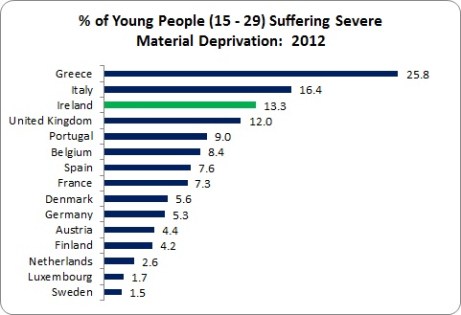
Unsurprisingly, Greece leads the league. But there’s Ireland right there at the top. More than 13 percent – or more than one-in-eight young people live in severe material deprivation conditions. This is more than double the average of other non-Mediterranean countries (a particular comparison given that our Ministers continually claim that we are not Greece or Italy, etc.).
The growth in severe material deprivation among young people over the course of the crisis has been alarming to say the least.
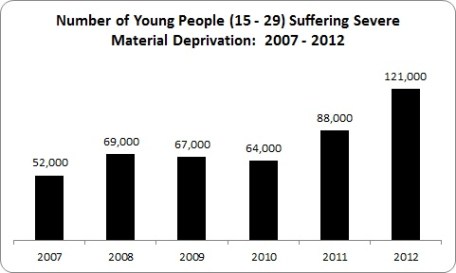
The numbers accelerated after 2010 with the cumulative effects of the crisis and the cuts in social protection payments.
In percentage terms, the rise in severe material deprivation among young people here has been the highest in the EU-15 – even higher than Greece (though Greece started out at a very high rate prior to the crisis). In Ireland, the rise has been 133 percent; for other EU-15 countries it has been 45 percent.
Another interesting stat is the distinction between young people living with parents and those not living with parents. In this measurement, Eurostat uses 16 to 29 years. We find that:
- 11.9 percent of young people living with their parents suffer severe material deprivation
- For young people not living with their parents, the figure rises to 15.4 percent
There are two points to note in all this.
First, our high levels of emigration have kept Irish severe material deprivation levels lower than what they would have been otherwise. The following adds up the number of young people (15 -29) emigrating in the years 2010 – 2012 as a percentage of the population of young people in 2012.
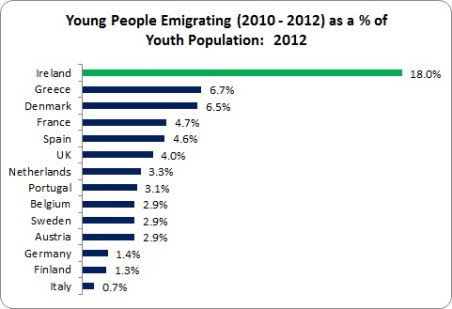
In 2012, there were approximately 900,000 young people aged 15 – 29. In the three years 2010 – 2012, 165,000 emigrated – or 18 percent. This far exceeds any other EU-15 country. This is intended as a snapshot (more detailed analysis would look at net migration, etc.). The point here is to imagine if our emigration rate was half of what it actually was, with 80,000 staying here. It is reasonable to assume that deprivation rates and unemployment would be even higher. And this doesn’t count the high levels of Irish emigration in 2013 and 2014.
The second point is that severe deprivation levels are likely to have increased in 2013. While Eurostat hasn’t posted the Irish numbers yet, the CSO – using a different deprivation measure – shows deprivation to have increased among the general population, children and students. So watch out for that deprivation bar to extend further.
While none of the above is too surprising given what we know about general deprivation rates, it should still shock us. Becoming numb to high levels of deprivation merely feeds into the ‘new normal’ that is being prepared for us - a new normal where high levels of poverty, debt, emigration and low-pay are somehow an unfortunate but unavoidable part of the post-recession landscape.
We shouldn’t’ accept this – even if some Minister comes along claiming that, like unemployment, youth deprivation is a ‘life-style’ choice.


 Notes on the Front
Leave a reply to Niall Cancel reply