
Let’s recap. The Government has been forced to:
- Stop Irish Water’s access to PPS numbers
- Provide certainty to household payments
- Reverse the sanction of reducing water flow to a trickle for non-payers
- Provide new statutory guarantees to keep water service under public control
- Scrap the system of social protection subsidies and tax breaks which would still leave hundreds of thousands of people in work without financial support
- Delay the introduction of bills
- Increase the cap from nine months to at least four years
- Make the roll-out of water meters redundant in the medium-term
- Introduce new governance measures (probably when the Evira/Irish Water boards are reviewed in a few months’ time)
The Government has u-turned so much it doesn’t know which direction it is going (if there are other u-turns and cul-de-sacs please let me know).
And now the Government looks to u-turn itself back into re-introducing the household charge – that pathetic, fiscally useless, regressive tax.
It appears the Government will introduce a two-tier charge on all households connected to the public mains (approximately 80 percent of all households). A charge for a one-person household will be capped at €176 per year; for a household with two or more adults will be capped at €276 per year. All households can avail of a Department of Social Protection rebate of €100.
Let’s be clear about this: this is a household charge (or a home tax if your will – since it won’t be confined to property-owners; it will apply to tenants as well). This is no different to the household charge except that the charge is higher and differentiated by the number of adults in the household.
This has nothing to do with water, except that you just happen to use water. The water allowances will remain in place. But for all practical purposes the cap will be the effective charge.
The goal of conservation has been undermined. A household that conserves water will be, for all practical purposes, charged the same as a household that leaves their en-suite Jacuzzi on all night. Theoretically, one could reduce their charge through conservation – but any reduction would amount to only a few cents per week, such is the impact of the cap. The incentive is small to the point of near non-existent. And this looks likely to remain in place until at least 2018 and maybe longer.
It is worth noting that the cap will act like a flat or fixed charge. Prior to the local election the Labour Party made much play of the fact that they stopped the imposition of a fixed charge for water. Now the Government has u-turned itself into just that – a fixed charge.
And the flat or fixed charge will be regressive. We can see the trajectory of the cap as it impacts on household income. This uses the data from the Household Budget Survey 2010. The magnitude might be slightly different today but the distributional impact will be pretty much the same.
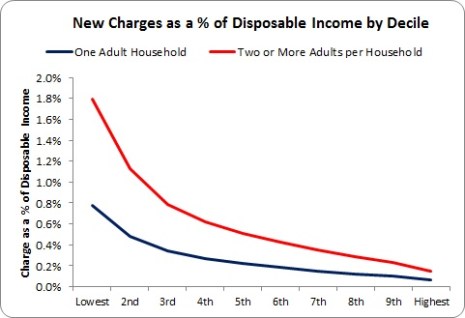
I have approximated the charge as a percentage of income by decile – more detailed analysis which has access to data on household type per decile would be necessary. And it is not likely there will be many two-adult households in the lowest decile. But at the end of the day, the charge will be regressive.
- The lowest income households will pay nearly eight times the amount of the new charge as the highest income households – as a percentage of disposable income.
And here’s the irony – all this is done to get water services expenditure off-the-books by ensuring that 50 percent of revenue comes from non-government sources; namely, the household and business sector. The government might achieve this goal (though Eurostat won’t make a ruling on this until the spring of next year), but it will have created an agency whose ability to borrow in the markets and, so, invest may be hamstrung because the revenue stream is minimal and tentative. The government will have created a fiscally hobbled water company.
There’s one more twist: what happens to the ‘off-the-books’ status if a small section of the population refuses to pay? Since the projected revenue stream from households only barely gets the Government across the 50 percent line, even a small section of water users refusing to pay (say 15 percent) could stop Irish Water from getting the necessary revenue to bring its finances off-the-books. Eurostat won’t be looking at projected revenue stream; they will be examining actual revenue.
This is all chaos squared. We will have a new system that does not act as an incentive to conserve, has a significant regressive impact on low/average income households, makes meters redundant for at least four years and possibly longer (anyone want to redo the cost/benefit analysis on that expenditure) without any guarantee that Irish Water will be off-the-books, never mind establish a robust company capable of driving a sustained and substantial investment programme.
The government could make a new start by abolishing the charges. As pointed out here, abolishing the charges won’t undermine their fiscal deficit target. But it would allow the government to start over with an inclusive and informed dialogue on the future of water services. It would allow them the time and opportunity to get it right.
We desperately need an equitable, economically efficient, conservation-minded system of financing water investment in the future. The Government’s new proposals will fail this test.


 Notes on the Front
Leave a reply to Ernie Ball Cancel reply