
Headlines and sound-bites abound: ‘austerity is over’, ‘the beginning of the end of austerity’, ‘we beat austerity’ and so on and whatever and sure, why not.
Let’s cut to the chase: austerity is not over. It is entering a new phase. We will now experience austerity ‘below the waterline’. Austerity by stealth, austerity beneath the radar: give it any description but have no doubts. We will continue to suffer austerity, probably up to the end of the decade.
You don’t have to believe me – just look at the Government’s own projections. They clearly show what is in store. And it is not pretty.
The following comes from the Budget 2015 Full Report (Table A.2.2, page 99). In this table the Government projects their spending plans out to 2018. You’ll see that spending pretty much flat-lines, with some slight downward pressure, up to 2018. However, this is what’s called the ‘nominal’ spend – the actual Euros and cents. To get a real world sense you have to factor in inflation.
The Government provides the inflation or deflator figures in Table 5. They estimate that inflation (for the economy, the inflation figure is the GDP deflator) will be over six percent up to 2018. Therefore, public spending – if it is to maintain its value – must rise by that amount. If it falls below that figure, we have a real cut; if it rises above that figure, we have a real increase. So what do we find?
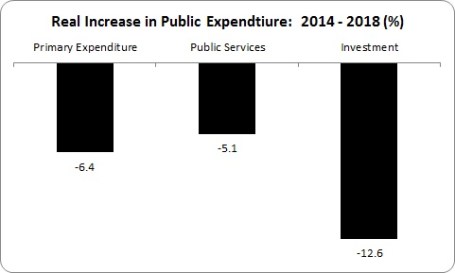
Primary expenditure excludes interest payments; therefore, it is the total spending on public services, social transfers and investment, with other small categories such as subsidies. We find that total real spending will fall by over six percent by 2018.
In regards to public services (estimated on the basis of figures produced in Table A.2.1 on page 97), we find that real spending will fall by five percent. That’s five percent less than we have today to fund schools, hospitals, policing, transportation, enterprise supports – all our public services. That is going to put a real squeeze on the breadth and quality of our services.
As to investment – the key to long-term growth – the Government intends to cut its spending by nearly 13 percent. This will undermine our infrastructural and business capacity. We will fall further behind our trading partners (and competitors) who are investing far more than us. Of all cuts this is the most irrational from an economic growth point of view.
But there’s another twist to this. For populations do not remain static. Our population is estimated by the IMF to grow by over three percent up to 2018 – which means more people to provide services and income supports to. So if we take the real spending cuts above and break them down on a per capita basis what do we get?
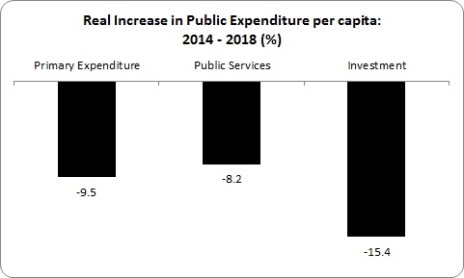
It is worse. Now overall real primary spending falls by nearly 10 percent, with public services falling by over eight percent and investment taking an even bigger hit.
There will be some claw back on reduced unemployment costs. The Government estimates unemployment will fall to 8 percent by 2018. However, the number of pensioners is rising and people are living longer. So this will increase not only pension costs, but related expenditure – medical care, social services, and in-kind supports and other social transfers (free travel, Household Benefits Package, etc.). Therefore, much of the savings on reduced unemployment will be cancelled out by rising elderly-related expenditure.
This is certainly not as bad as the last six years. But it is important to describe the situation as it is – and not let government press releases and newspaper headlines determine uncritically shape our analysis. This is the new phase of austerity – below-the-radar. Ministers can claim they are running an ‘expansionary’ public expenditure programme but all that has happened is that projected cuts did not materialise. It doesn’t affect the actual year-on-year spending trends.
The grim truth is that we will be exposed to further squeezing of public spending at a time of rising demand and in the context of many services that are being held together by organisational plaster and over one million people living in deprivation. The plain fact, on the basis of the Government’s own projections, is that spending will not match the rise in inflation.
This is a real cut.
This is austerity.
And it will be with us for years to come.


 Notes on the Front
Leave a reply to Michael Taft Cancel reply