Notes on the Front

Commentary on Irish Political Economy by Michael Taft, researcher for SIPTU

Appreciating Facts

Last night on Prime Time Brendan Burgess, from Ask About Money, stated that high-income earners in Ireland pay more tax than high earners in other countries.

‘We have a very low direct tax economy in this country for the lower and the middle paid and very high taxes for the upper paid.  And that’s something people don’t appreciate.  And they need to appreciate that.’

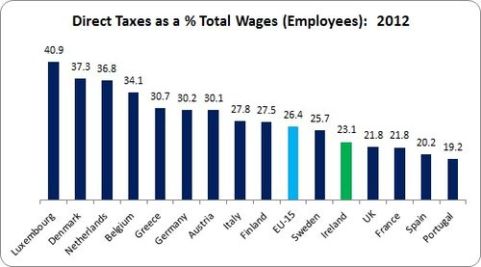
Let’s do some appreciation.  Are we a ‘very low’ direct tax economy?  Direct, or personal, taxes include income taxes, social insurance (PRSI) and other taxes on income such as Ireland’s Universal Social Charge or Germany’s surtax.
High Earners Tax 1

We are low-tax, well below a lot of other countries.  But we are not that far behind the EU-15 weighted average, not that far behind ‘high-tax’ Sweden and ahead of another ‘high-tax’ economy, France.  So I don’t know that I would call it ‘very low’ but we certainly should be doing better.

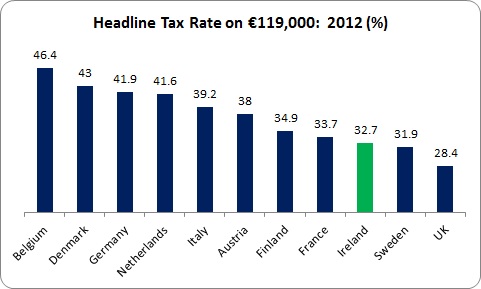
But what about that ‘very high taxes for the upper paid’?  We don’t have ‘effective’ tax rates for different income groups to compare (that is, the tax rate when all reliefs and deductions are taken into account).  We only have ‘headline’ tax rates – which only include basic reliefs like personal tax credits.  But the following headline tax rates come from the OECD Benefit and Wages database.  The highest level of income for Ireland in the database is €119,000 (a couple, both working) so I’ll use that to compare with the same level of income in other countries.
High Earners Tax 2

Headline tax rates on Irish high-earners are well below most other countries.  If they were living in Germany they’d be paying €11,000 more in income taxes and social insurance.

There is caveat in this.  In Ireland, taxpayers get relief on pension contributions, mortgage interest, health insurance and a rake of business investments.  Do taxpayers have access to the same level of reliefs and allowances?  More?  Less?  We don’t have easily accessible comparable data.  (Also, the tax rate for Italy in the above chart is for €107,000 – the highest level of income in the OECD database).

However, when looking at headline rate, Irish high-earners are not over-taxed in comparative terms.

And there are some further explanations needed (the type of explanations that rarely get a hearing on current affairs programmes).  Take the example of Sweden.  The chart above shows Swedish headline rates lower than Ireland.  In the first total direct taxation chart, Sweden is only slightly above Ireland.  Some might find this surprising since we all think of Sweden as high-taxed.

The fact is that direction taxation on Swedish employees are relative modest (though there are high consumer taxes such as VAT).  It is high-tax because of the huge (and I mean huge) contribution from employers.  For instance – on incomes of €119,000:

  • Irish employers would pay €12,800.
  • Swedish employers would pay €37,400.

It is a similar story with France, where employers could pay nearly €48,000 In fact, Swedish and French employers pay more in social insurance than employees pay in direct taxation.  In Ireland employers’ pay only 34 percent of the amount paid by employees. 

 High employers social insurance contributions in these countries effectively subsidise lower rates on employees – while at the same time paying for a range of services that we don’t have (free health care, subsidised prescription medicine, a range of benefits (pensions, unemployment, sick-pay) that are pay-related, subsidised childcare, etc.).

We are comparable to the UK but even here there is a catch.  The above table refers to taxes on income. But in the UK, there is a very high level of property tax (Council tax).  Take the example of the two high-earners in Ireland and the UK, owning a house valued at €600,000 (or £487,000 in the UK).  What are their levels of property taxes?

  • In Ireland:  €1,080
  • In the UK:  €3,100

The UK figure is for Islington Council.  There will be variations depending on the Council but the level of Council tax will be much, much higher than our property tax.  When this is factored in, the gap between Irish and UK levels of tax narrows considerably.  (As an aside, I don’t know why we feel compelled to compare ourselves with a country with high levels of poverty and inequality, low wages and low productivity).

To conclude, Irish high-earners are not overly taxed – nowhere near it.   When it comes to direct taxes, we are a low-taxed economy for all income groups.  There is a need to take a cold, hard look at how we organise our taxation system – in particular, looking at the ultra-low level of contributions from employers.  We need a long-term strategy instead of knee-jerk, regressive calls for tax cuts.

Most of all, we could do with fewer assertions on current affairs programmes that fly in the face of facts.  But maybe that’s a wish too far.

4 responses to “Appreciating Facts”

  1. 6to5against Avatar
    6to5against

    We could probably also benefit from current affairs programmes that challenge their guests to cite references when they make assertions of fact.

    Like

  2. Brendan Burgess Avatar

    Hi Michael
    Check out the OECD’s Taxing Wages 2014.
    http://www.keepeek.com/Digital-Asset-Management/oecd/taxation/taxing-wages-2014_tax_wages-2014-en#page71
    A single person in Ireland on 67% of the Average Wage pays 12.6% of their income in deductions compared to a eurozone average of 24.5%
    For 100% of average wage,the figures are 18.7% and 28.8%
    For the higher paid on 167% of the AW, it’s 31.9% compared to 34.6%
    Public Policy.ie quotes the OECD as saying that we have the most progressive income tax system in the EU:
    http://www.publicpolicy.ie/progressivity-of-irish-income-tax-system-2013/
    When you claimed in the past that high earners in Ireland are taxed at relatively low rates, Seamus Coffey answered you comprehensively:
    http://economic-incentives.blogspot.ie/2013/01/is-ireland-low-tax-again.html
    Brendan

    Like

  3. Michael Taft Avatar

    Thanks for that, Brendan. You are correct in quoting the OECD’s Taxing Wages but you have to ensure you’re comparing like with like. Example: In Germany, a single person on the average would have a tax rate of 39.8 percent (in 2012, using the OECD Benefit and Wages, which is derived from their Taxing Wages). In Ireland, the rate for a single person on the average wage would be 17.9 percent.
    The problem is that the tax rate is comparing different wage levels. In Germany, someone on the average wage earns, according the OCED estimate, €45,170; in Ireland, the average wage is much lower – at €32,381. For an Irish worker on the average German wage the rate would rise to 27.4 percent – still lower than the German rate, but a more comparable figure than taking the one from an Irish worker earning so much less.
    This is one problem with OECD Taxing Wages database which their own Benefits and Wages database rectifies, allowing us to take a produce more comparable results. Of course, there is an argument to use relative, rather than direct, wage levels (relative to the average in each country). But that has to be accompanied by a breakdown in wages and gets us into another interesting debate – about wage levels (one that I am more than willing to participate in – but that’s for another day).
    What is interesting, though, if you keep with the Taxing Wages database, is to make some further relevant comparisons which the numbers you rely omit. For instance, the net take-home pay of the average paid German worker (single) is €26,682 – almost exactly the same for the net take-home pay for the average paid Irish worker: €26,680.
    When we apply purchasing power parities, we find a very interesting situation. The value of the net take-home pay for the average-paid German worker is €28,400 while for the average-paid Irish worker, net-take home pay is only worth €23,800. The German worker is far better off. And here’s the real kicker:
    The Irish worker has to go out in the private market to purchase healthcare, prescription medicines, pensions, childcare – something the German worker doesn’t have to because they are heavily subsidised by the state. Not only does the average-paid German worker have a far higher level of take-home pay, they have a far higher living standard. Those costs to the Irish worker should be treated as a ‘tax’ – a private market tax. This is the biggest flaw in the OECD databases: it doesn’t compare living standards.
    I hope you take the time to go through the OECD Benefit and Wages database and compare the highest earners on a like-for-like basis. If you find that I have made a mistake (and it wouldn’t be the first time) let me know and I will address it.
    I also hope you consider the points above. The debate over taxation and related issues of wages and living standards have, for too long, been subject to sound bytes and unsubstantiated assertions. A more detailed examination not only throws up some interesting facts about the way we are taxed; it also throws up how we live and organise society.

    Like

  4. The Dork of Cork Avatar
    The Dork of Cork

    You are stuck on this for some funny reason.
    You are trying to tax highly wasteful bank credit production be it internal or external credit.
    There is not much wealth remaining after the corporate sector extracts its dole.
    Imagine how we trade for tokens today (given we don’t produce internal credit)
    Some tourist flys into Dublin , drives to SW Ireland via a new rented car.
    He might buy a Ice cream or something in Sneem but the amount of purchasing power that the average resident person can gain from accessing this trade is a extremelly negative number.
    TAX IS NOT THE ISSUE.
    ITS THE VERY STRUCURE OF TRADE developed under a extrmely scarce money / token system.

    Like

Leave a reply to The Dork of Cork Cancel reply

Navigation

About

Commentary on Irish Political Economy by Michael Taft, researcher for SIPTU