
The drums are beating. Throughout the nation we hear a growing chorus demanding tax cuts (including the leader of the Labour Party) to relieve ‘hard-pressed’ families. And this demand is being buttressed by some highly misleading claims that Ireland is a high public spending country.
According to Brendan Keenan, using recent OECD data, we are a high-spender. There’s even a cartoon in the article showing Ireland ‘fat’ with too much public spending, compared to ‘lean’ European countries. Is Ireland a high spender compared to European countries? Of course not. One has to know how to read these figures.
For instance, the OECD data for 2011 includes special bank payments arising out of the financial crisis. When this is removed (and it represents some 5 percent of GDP), Irish spending falls well down the table. It is highly misleading to claim that Ireland is a high-spending country while including payments to banks; unless one wants to make the argument that Ireland is a ‘high bank-subsidising’ country which is certainly true.
So, can we assess Ireland’s ranking in the EU-15 spending table? Yes, with the help of the EU’s AMECO database. We’ll look at 2014. Even though this money hasn’t been spent yet, AMECO is working off of country’s estimated expenditure under their individual Stability Programme updates. Any change would be marginal. We’ll also exclude interest payments since we want to focus on spending on public services, social protection, subsidies and investment. Further, we’ll exclude defence spending.
So what do we find when we examine government spending per capita (after all, Keenan says ‘spending per person tells its own tale’)?
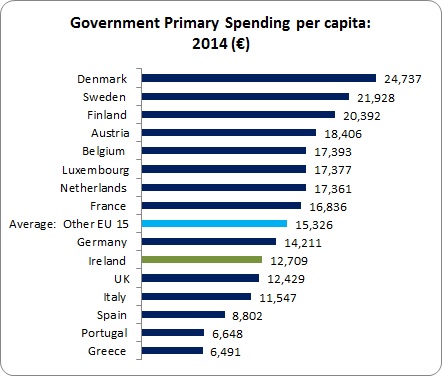
Well, this does tell a tale. Clearly, Ireland is not an ‘over-spender’. It is well below most other European countries and well below the average. Ireland would have to spend substantial amounts just to reach EU averages:
- To reach the average of other EU-15 countries, Ireland would have to spend an extra €12.2 billion in 2014.
- To reach the average of other EU-15 countries not in bail-out (excluding Greece and Portugal), Ireland would have to spend an extra €19 billion in 2014.
- To reach the average of our peer group – other small open economies in the EU-15 – Ireland would have to spend a phenomenal €36.1 billion extra in 2014.
We will burrow further into these numbers over time; for instance, to assess the impact of expenditure on the elderly (other EU countries have a much larger elderly population which necessitates higher spending on pensions), factoring in purchasing power parities and to breakdown expenditure under different categories. We will also take into account economic capacity (the higher you're GDP, the more you can spend sustainably). So the above table should be treated as a base-line, the beginning of a more in-depth analysis. But here’s a teaser.
The AMECO database also estimates government spending out to 2015. This is a bit more tenuous (who knows where we will be early next year, never mind in 2015). However, it shows that EU-15 countries not in bail-out will increase primary government spending (excluding interest payments) by 2.5 percent on average. Ireland will cut its spending by 4.1 percent. We will slide even further down the table.
Social protection payments have been cut in real (i.e. after inflation) terms over the last three years; 24 percent of the population suffer multiple deprivation experiences; we badly need investment in pre-primary education, childcare and eldercare; we are in an economic and business investment crisis – there are a number of areas crying out for more resources.
Yet, all we get is the drumbeat of tax cuts. And to clear the way for this race-to-the-bottom agenda we get highly misleading commentary about the levels of public spending.
2014 looks set to be an ‘interesting’ year in the public debate.

 Notes on the Front
Leave a reply to The Dork of Cork Cancel reply