
Cuts in Child Benefit, Youth Programmes, school capitation
grants, higher education, student grants, youth unemployment payments – the economic
war on youth has run into hundreds of millions and cost the life-chances of hundreds
of thousands: emigration, unemployment, falling wages. At the start of this crisis who would have
imagined this war would have run for so long and been so destructive?
The first rule in an economic war is to discredit the
victim. One of the most malicious comments during this
crisis was aimed at youth (though attacks on public sector workers were equally
outrageous) and came
from a Labour Minister:
‘What we are getting
at the moment is people who come into the (social protection) system straight after school as a
lifestyle choice. This is not acceptable, everyone should be expected to
contribute and work.’
Yes, there are so many jobs available but our lazy, lazy
kids choose to hang around the house
in their underwater drinking Red Bull and watching DVDs all day. We have to incentivise their indolent backsides. And cutting youth unemployment payments is
one of those ways.
It’s bad enough to suffer cuts – in public services, income
supports, job, wages. But then to be
told that you are to blame . . . And then to be told that you are lazy, too . .
.
This may make for some popularity among the Sunday
Independent, populist, socially-vindictive set.
But it is wrong, terribly wrong, demonstrably wrong. And it diverts attention from the real
issues, as scapegoating is intended to do.
It has been pointed out by many commentators that there are
approximately 32 unemployed for every job vacancy. This is a national average. It is likely to be higher for younger
people who are disadvantaged in the labour market (e.g. less job experience)
unless they possess skills in labour shortage areas. This alone tells us a lot. But there’s another way to approach this
issue.
If there is a gene in the Irish youth make-up that predisposes
them to sloth, we should be able to historically track it. The following two graphs refer to the ‘employment
rate’ as measured by Eurostat. The employment
rate is the proportion of the working age population in employment. This is a better measurement than the
official unemployment rate which can be altered by administrative rules.
So what did our lazy kids do prior to the crash? They worked.
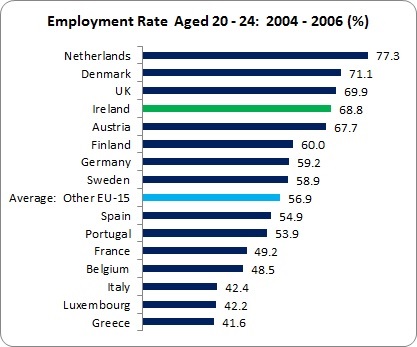
For young people aged between 20 and 24, the Irish
employment rate was the fourth highest in the EU-15 – considerably above the
average of other EU-15 countries.
However, we must be aware that in this age group there would be a high
level of young people still in education.
But of those in the workforce, nearly 70 percent of Irish youth were
working.
Looking at the employment rate for those aged between 25 and
29 years is helpful as almost all of this group would have left education. How do the Irish hold up in the lazy
stakes? Pretty poor, actually. People were just too determined to work.
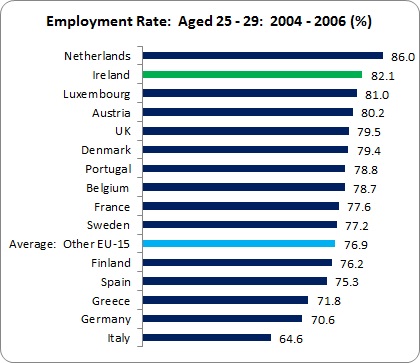
The employment rate for Irish people in this age category
was the 2nd highest in the EU-15.
We even ‘worked harder’ than the hard working Germans – much harder.
What does this tell us?
It’s quite simple. Young people
didn’t need social protection cuts to be incentivised to work hard – in 2004 to
2006 unemployment
payments actually increased by an incredible 32 percent but still people
preferred to work; they didn’t need to be threatened to have their dole cut if
they didn’t take up that JobBridge
internship in a petrol shop in Mullingar; they
didn’t even need a letter from the Department telling them it’s better to work
– they had figured that out all on their own a long time ago.
All that was necessary to establish a high employment rate
was work availability. And that’s why in
both the age categories, the employment rate has crashed. For instance, for the 25 to 29 age group, the
employment rate has fallen from 2nd highest pre-crash to 4th
lowest in 2012, just above other peripheral countries. Why
has it fallen? Because the pool of available work is too small.
It’s that simple. It’s not about being lazy; it’s not about
incentivising young people; it’s not about lecturing them or hectoring them or
hassling them. It’s about putting more
jobs in the work pool.
Unfortunately, in the economic war on youth, there’s a
drought – and young people are blamed if they don’t go around rain-dancing hard enough.


 Notes on the Front
Leave a reply to David Cancel reply