
There is a common assumption that deprivation is a condition
associated with unemployment. But if you
get a job, you can work your way out of poverty and deprivation. That is the theory, anyway. However, there are huge swathes of households
where income from work is not enough. We have high, and growing, levels
of deprivation among in-work households.
Welcome to the new way of working – take-home pay with take-home
deprivation.
The CSO sets out a menu of deprivation indicators in the EU Survey of Income
and Living Conditions. If an individual
suffers two or more of these conditions, they are included in the deprivation
rate.
Without heating at
some stage in the last year • Unable to afford a morning, afternoon or evening out
in the last fortnight • Unable to afford two pairs of strong shoes • Unable to afford a roast once a week • Unable
to afford a meal with meat, chicken or fish every second day • Unable to afford
new (not second-hand) clothes • Unable to afford a warm waterproof coat • Unable
to afford to keep the home adequately warm • Unable to afford to replace any
worn out furniture • Unable to afford to have family or friends for a drink or
meal once a month • Unable to afford to buy presents for family or friends at
least once a year
Deprivation throughout Ireland is on the rise. In 2008, the first year of the recession,
13.8 percent of all individuals were officially categorised as deprived. In the last year we have data for, 2011,
deprivation increased to 24.5 percent.
Over 1.1 million Irish people now suffer multiple deprivation
experiences. This is grim.
 The loss of employment, combined with cuts in social
protection income, has been a major contributor to the growth in deprivation. However, another major contributor – and one
which is rarely referred to – is the rising levels of deprivation among those
in work.
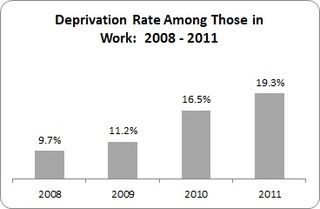
In 2008, 10 percent of those in work suffered multiple
deprivation experiences. With three
years this rate doubled – with nearly one-in-five of those in work officially
categorised as deprived. This is equally
grim.
Unsurprising, the deprivation rates vary depending on the
number of people at work in the household.
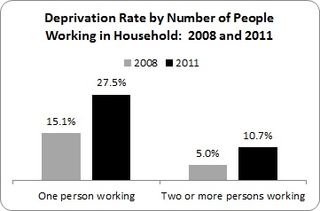
In households where there is one person working – either full
or part-time – the deprivation rate is 27.5 percent. More than one in four people in one-income
households suffer multiple deprivations.
This percentage is higher than the national average (24.5 percent). However, even among households with two or
more incomes, deprivation affects more than one-in-ten.
There are a number of factors contributing to rising levels of
deprivation. Previously two-income households
may fall into deprivation if a partner loses their job. Someone previously unemployed may have found
part-time work – but still suffer from deprivation. These are not static categories.
Clearly, falling incomes are a contributor – either through wage cuts or reduced working hours. Between 2008 and 2011, the average gross income fell by 2.4 percent. But people have taken another financial hit through increased taxation. On the average income, a single earner in a two-adult household suffer a fall of 7.8 percent in take-home pay, owing to increased taxation–
and this this doesn’t count increased service charges, VAT and excise, and the property
tax.
Another factor is rising costs – especially for households
with children. As children grow older,
costs increase with many households having a first or additional child during
this period. And with Child Benefit being
slashed during this period by €312 annually per child, many households are
running and still not able to standstill.
And, of course, there is the issue of debt and trying to get
out from under it.
There are a number of issues involved in rising deprivation
but, at root, it is that we are working less and taking home less while trying
to deal with rising costs and heavy debt loads. The resulting bottom-line is rising deprivation in work.
One could hope that the Government will take this issue on
board but I’m a tad pessimistic. Further
austerity measures are being planned (whether its €3.1 or €2.8 billion
represents only a small difference). We
should expect higher taxation; the property tax will double automatically with
further excise tax increases to be expected.
There is some employment generation in the economy but nothing on the
scale that the Government is claiming, with many of these jobs being precarious
(under-employment, zero-hour contracts, etc.).
And the debt situation is not going away anytime soon.
If we want to ‘make work pay’ we need new labour market and
fiscal policies, we need decent wages and decent working conditions. We need greater focus on one of the most
troubling aspects of the recession – that one-in-five people at work suffer
multiple deprivations.
That statistic
alone should inject some urgency into policy.

 Notes on the Front
Leave a reply to bigred Cancel reply