
Kevin
O’Rourke links to an interesting paper by Jeff
Frankel which discusses different ways recessions are measured. The standard European measurement says that
when an economy falls two quarters in a row it is officially in recession (we
know all about that given our official double-dip). This measurement has the advantage of being
statistically clear and simple. This,
though, can lead to false readings. For
instance, over two years the economy declines in half of the eight quarters –
leaving it much lower. If, though, none
of those quarters were consecutive, then according to the European measurement,
there was no recession even though output has fallen. This may be an extreme case but it shows how
quirky this measurement can be.
The US has a different way of measuring recessions. According to Frankel:
‘In the United States, the arbiter of when recessions begin
and end is the Business Cycle Dating Committee of the National Bureau of
Economic Research (NBER). The NBER
Committee does not use that rule of thumb (Europe’s two consecutive quarters of
decline), nor any other quantifiable rule . . . When it makes its judgments it
looks beyond the most recently reported GDP numbers to include also employment
and a variety other indicators, in part because output measures are subject to
errors and revisions. The Committee
sees nothing special in the criterion of two consecutive quarters.’
The problem with this approach is that there is no single definitive
measurement so disputes easily arise.
I’d like to introduce another way to measure a recession. It is based on the sinking-ship metaphor. A ship starts sinking. It eventually stops and starts to rise
again. While it’s rising back to the
surface we can say that it is in recovery mode.
However, it will remain below water until it gets back to the surface.
Similarly with an economy:
an economy goes into decline, eventually stops falling and starts
rising. However, it remains
metaphorically below water until it returns to the point at which it had
started sinking. If an economy is below its
pre-recession levels it remains ‘recessed’.
Take, for instance, the US Great Depression in the
1930s. The economy tanked big time in
1929. However, by 1935 the economy had experienced
nearly three years of rising GDP, employment, consumer spending and
investment. However, no one then (or
now) would have said that the Great Depression was over by 1935 – it was still well
below its 1929 level.
Let’s apply the sinking-ship measurement to the Irish
economy, using the IMF
projections out to 2018.
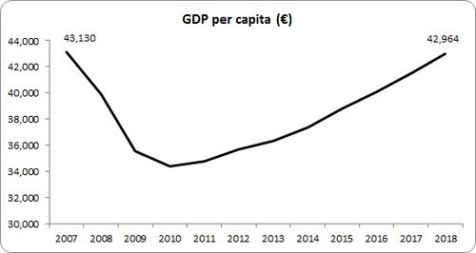
In 2007, the economy was generating a little over €43,000 for
every woman, man and child. As seen, according to the IMF projections, even by
2018 the economy will not have returned to the 2007 level. It won’t happen until 2019. In other words, the economy will remain under-water
for 11 years – in other words, ‘recessed’.
Of course, this is GDP – which is flattered by
multi-national accounting practices (profit-tourism, etc.). What does it look like when we measure GNP
per capita? Here we use the Government’s
own assumptions in their end-of-the-decade scenario.
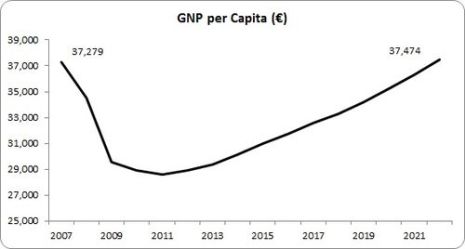
When looking at this domestic measurement (with all its
faults) we find that the economy will be underwater for 14 years. 14 years.
We won’t find ourselves above pre-recession levels until 2022. And if that’s not depressing enough, the ESRI’s
John Fitzgerald estimates that even our GNP figures are over-stated given the
presence of re-domiciled multi-nationals.
The real GNP figures are substantially lower which suggests that a
return to the surface could take even longer based on projected trends.
Staying with the metaphor, when the ship returns to the
surface what kind of shape will it be in?
Even though the economy has returned to the surface, many people will
still be underwater. The Government’s end-of-the-decade scenario
projects double-digit unemployment by 2019.
Average real wages may not return to pre-recession levels until 2020 and
even later. How many will still be
living in deprivation, how many in poverty, how many will have emigrated? The ship may be back on the surface, hundreds
of thousands won’t be.
To give another idea of what we’re facing into, let’s use
the Government’s assumptions to track the ‘jobs recession’.
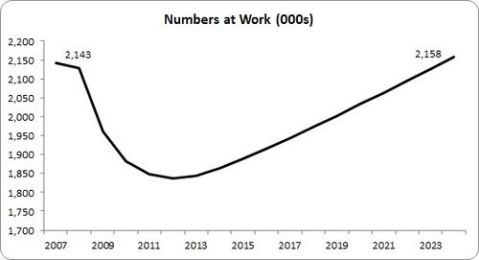
We won’t return to pre-crisis levels of employment until
2024. That’s 16 years under-water.
So when we start growing again – GDP, domestic demand,
employment – just remember: we will have
to grow for a long-time just to get back to where everything started
collapsing. In other words, the ship may
start rising soon but we will be underwater for a very long time.
Hopefully, you can hold your breath.


 Notes on the Front
Leave a reply to bedroom furniture Cancel reply