
The Government will soon be issuing a consultation paper on
the forthcoming Broadcasting Charge to be levied on all households. This is intended to replace the television
license fee and will be applicable regardless of whether a household has a
television. The rationale for this move
is that people access television content via other devices such as tables and
smartphones.
There will be a number of issues debated, notably the funding
of other media outlets besides RTE (though it should be noted that already 7
percent of the license fee revenue goes to the BCI Broadcasting Fund for projects
of a public service nature produced by independent producers and broadcasters).
Minister Pat Rabbitte has given a commitment that the charge
will not exceed the current television fee of €160. Given that there is near universal television
ownership, the move to a household-based, rather than a television-based charge
is not unreasonable. According to the CSO’s
Household Budget Survey, over 97 percent of households own a television,
with 65 percent owning two TV sets or more.
If one accepts that a television is a necessity – not only
for communication but recreation as well; if one accepts that public service
broadcasting is a ‘public good’; then even the television license fee could be
considered a tax by any other name. The Broadcasting
Charge will confirm that – all households will be required to pay it.
I suspect that the Government will introduce a flat-rate
charge at the current level of the TV license fee. This would effectively mean no change for households. But
is there an alternative means to finance the broadcasting charge – one that is
more socially equitable and economically efficient?
First, let’s look at the distributional impact of the
television fee – that is, how it impacts on particular households by income
group. The following examines the
license fee as a percentage of net disposable income broken down by deciles.
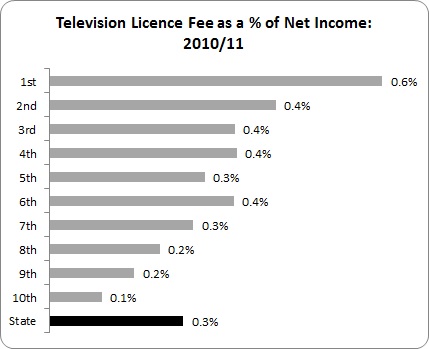
Unsurprisingly, the license fee is regressive – impacting more
harshly on low-income groups. For the
lowest income groups, the license fee takes up over 0.6 percent of net income;
for the highest income group it makes up only 0.1 percent of net income. The national average is approximately 0.3
percent.
This is to be expected.
Any flat-rate charge, fee or levy is going to be regressive. Of course, not every tax or charge need be,
or can be, progressive. VAT, for
instance, is highly regressive but it raises over €10 billion a year. Instead, one has to look at the overall
impact of the taxation system.
However, where possible, we should minimise the extent of
regressive charges and levies. And the
new broadcasting charge is an opportunity to do so. Why not levy income – all income: work income, social protection, capital
income (i.e. capital gains, inheritances, etc.). Since everyone will be charged why not attach
it to the ability to pay?
On average, households pay 0.26 percent of net income on the
television license. What would happen if
we turned the flat-rate charge of €160 per household into a 0.26 percent levy
on all income?
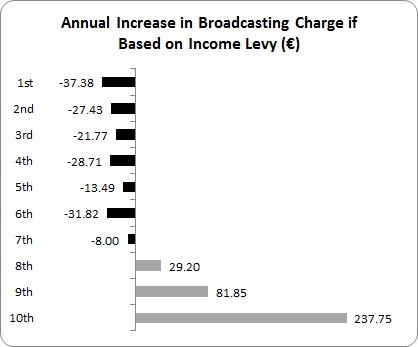
As seen, the majority of households would benefit. Higher income households, in particular the
top 10 percent, would experience an increase in the charge.
The social equity benefit is obvious but there is also an
argument in economic efficiency. The
benefit to the lower households would no doubt result in higher consumer spending
which would boost domestic demand, while the higher impact on the top income
deciles would mostly result in reduced savings.
While the amounts per household are small, if you multiply that by over
1,000,000 million households, the benefit mounts.
There may be administrative obstacles to implement an
income-based levy, though for in-work income, including capital income, the
Revenue Commissioners could collect it on an agency basis. The levy could be deducted at source by the
Social Protection department, though there may be legal issues that would have
to be addressed. Even with deduction at
source, social protection recipients would experience considerable gain. For instance, a lone parent household with
two children currently pays €160 for the television license; under the above proposal
the cost would fall to less than €42.
There would be additional benefits. First, it would greatly reduce avoidance
(which the Minister puts at 20 percent).
Second, as incomes rise, the revenue from the charge would rise
automatically. This extra revenue could
be invested in non-RTE supports for community and non-profit media outlets
including on-line, in order to develop alternatives to commercial and oligopolistic
media.
This is only a small intervention. But social equity and economic efficiency is
about a multitude of small interventions as much as it is about major policy
departures. Certainly the proliferation
of charges impacts most on low-income groups:
bin charges, the upcoming water charges.
So wherever we can convert a charge or levy into a more progressive
structure we should.
In time the small benefits would mount up.


Leave a Reply