
I usually don’t do too much work on property prices. However,
an article in the Sunday Business Post regarding the sale of high-end
residential properties got me interested.
If there is a pick-up in residential sales, where is it occurring; what
can this tell us about the state of the economy and, just as important, the
impact on different income groups?
The Residential Property Price Register gives some useful
insights. Here are some global numbers
for the first six months of the year:
- The number of residential sales in 2012 (first six
months): 9,559 - The number of residential sales in 2013 (first six
months): 10,151
So the number of residential sales rose by 6.2 percent. How much money was spent on residential
properties?
- The amount of residential sales in 2012 (first six
months): €1,807.7 million - The amount of residential sales in 2013 (first six
months): €1,983.0 million
Money spent on residential properties rose by €175 million,
or 9.7 percent.
We have sales and expenditure rising. So what is the distribution of the money
spent on these properties? How much is
being spent on high-end properties and how much on average-priced
property. This is where it is
potentially interesting.
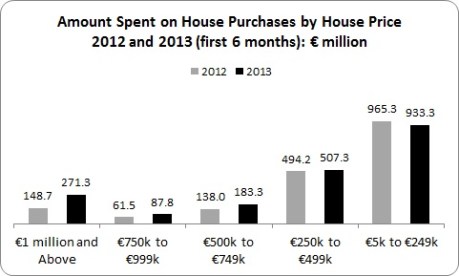
The increases in money spent on house purchases are
concentrated in high-end property. For
instance, €266 million was spent on houses priced over €1 million – an increase
of 82 percent over the previous period in 2012.
As always, though, we have to be careful of headline figures. In 2013, one residential property went for
€61 million – driving up the amount in this category. But even excluding this single property,
money spent on houses worth more than €1 million increased by 72 percent.
In short, of the €175 million expenditure increase on
houses, 70 percent went on housing valued at €1 million or more.
The increase expenditure in the residential property market
is skewered.
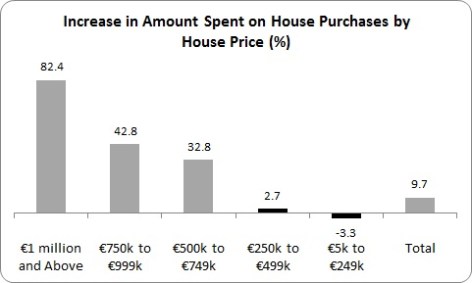
Even noting the impact of the single property in the €1
million plus category, we find that the money being spent in the residential
property market is concentrated in the higher end. Houses priced between €500,000 and €1 million
saw an increase in expenditure of 36 percent.
For houses priced between €250,000 and €500,000 expenditure increased by a modest 3 percent while below-averaged priced houses –
below €250,000 – saw expenditure fall by over 3 percent.
What can this tell us?
First, there is more money being spent in the residential property
market. Second, it is flowing to
high-priced housing.
The bottom-line is that there is money in the economy –
money that is being spent by income groups well above the average. If someone is buying a house worth €750,000
they are not likely to be on average earnings.
Could this be indicative of a larger trend – money flowing to the top while those on modest
incomes are struggling, or postponing house purchase due to lack of confidence
in their own future or in anticipation of further house price falls?
Could this shed some light on banks’ claims that they are selling
more mortgages? They may well be – but
they are for high-income groups; others may struggle to get a mortgage.
Readers may have some other insights, caveats and perspectives;
and there may be issues with the Residential Property Price Register that
doesn’t accurately reflect activity in the property market. So, please, leave comments.
But this could be one more indication that there is a
recovery for some, but a continuing stagnation for the rest of us.


Leave a Reply