
It is reported that the Minister Richard Bruton will propose
that tax cuts are needed to keep the economy on course. Well, at least this has the virtue of consistency
since this is the same Minister who proposed that high-paid company executives
should pay hardly any taxes at all. Over
the next few months we will get a Goldilocks debate over taxation – is it too
hot, is it too cold, is it just right. But
there’s an elephant in the room ready to stomp on the poor girl – and this will
hardly get a mention.
For we are a low-waged, low-earning economy – and it is getting
worse.
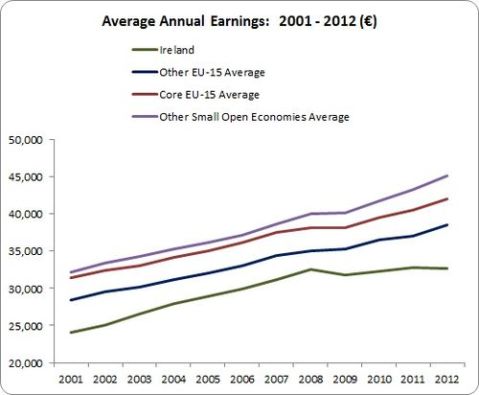
According to Eurostat Irish earnings have always been below EU averages. Even in 2008, when Irish earnings peaked, we
were still well below average. Today,
after four years of wage stagnation, we are falling further behind. In 2012 average earnings for:
- Other EU-15 countries was €38,525
- EU-15 countries not in bail-out: €41,963
- Other Small Open Economies: €45,123
- Ireland: €32,626
Since 2008 Irish earnings have flat-lined. In other EU-15 countries, earnings have
increased by 10 percent while in other small open economies, earnings have
increased by 13 percent.
To give another perspective, average Irish earnings would
have to rise by 18 percent just to reach the average of other EU-15
countries. They would have to rise by 29
percent just to reach the average of core EU-15 countries. And they would have to rise by a phenomenal 38 percent just to reach the average of other small open economies.
Of course, there is that little matter of the ‘recession’. Many might argue that in a recession, what
can you expect? Yes, recessions don’t
help average earnings. But neither do
discretionary pay cuts. To what extent
that pay cuts or freezes are opportunistic on the part of the employer is
difficult to assess. The rise in
profits, however, is not. The EU AMECO
database shows profits in Ireland rising by 24 percent since the profit trough
in 2009; in other EU-15 countries the rise has been 7 percent – in line with
growth in average earnings.
As always, we have to be careful when comparing data like
earnings. Much depends on the
composition of the workforce. For
instance, if more people are working in manufacturing, the wage will be higher
than in economies where the number of hospitality workers is high. So one would have to do a sectoral comparison
to get more insight.
Further, if there are high levels of part-time workers, this
will reduce the average.
However, there is strong support from other data coming on
stream for the proposition that our wages and earnings are well below the
European averages. The following is from
Eurostat which measures hourly labour costs in the business economy, which is
essentially the private sector.
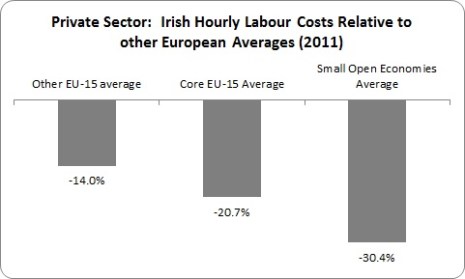
Private sector hourly labour costs in Ireland are 14 percent
below the average of other EU-15 countries.
This falls to 21 percent when compared with the core EU-15 countries;
and when compared to the average of other small open economies, it falls to 30
percent below average. Are we seeing a
picture here?
We are a relatively low-waged economy, we are a low-earning
workforce. And such economies find it
hard to generate tax revenue. But you
don’t get that perspective to the agenda and you certainly won’t hear it from
Government ministers. They are too busy
trying to drive down wages – whether it is in the public sector, the banking
sector (where 40 percent of bank staff earn €30,000 or less), in the low-paid
sectors where many of the protections under the Joint Labour Committee have
been undermined under Government ‘reforms’.
All this talk about ‘increased competitiveness’? Cut wages.
So when you hear some commentator or Minister, pretending to
champion the hard-pressed workers by calling for tax cuts, just remember: the tax cut is a diversion.
The real issue is pay and earnings.


 Notes on the Front
Leave a reply to Michael Taft Cancel reply