
Public sector pensions – is there any three-word formulation
more likely to angry up the blood? Not
likely (except, maybe, ‘public sector pay’). Mention public sector pensions in polite
company and animal sounds will be heard.
We are constantly told that we can’t afford public sector pensions, they
are a burden on the taxpayer (the private sector taxpayer, the public ones
don’t count as they will become a burden when they retire), that they will in a
few years sink the economy. Listening to
the debate, you’d think it was public sector pensioners that caused the fiscal
and economic crisis, sank the banks and forced us into a bailout.
But a few facts that are emerging suggest otherwise (a few
facts are always a healthy tonic to unsubstantiated assertions). WorldByStorm over at Cedar Lounge Revolution pointed
to the Sunday Business Post article based on documents obtained under the Freedom
of Information legislation:
‘A quarter of public service pensioners receive a pension of
only €5,000 annually, according to government documents [and] almost half of all public service pensioners
get a pension of about €10,000 or €11,000 annually.’
25 percent received a pension of only €5,000? Almost half on €11,000 or less? Can this be true? And, if so, where does that leave the ‘public-sector-pensions-are-ruining-us-school’?
Well, yes, it can be true.
The latest Analysis
of Exchequer Pay and Pensions Bill shows that the average public sector
pension is €20,800 a year. It should be
noted that much of this includes payments for spouses. Further, many recipients do not receive a social
insurance top-up pension.
Of course, this doesn’t cost the state an average €20,800
per year. Some of this will be returned
via the tax system. Further, the pension
income is returned to the economy in spending, resulting in greater economic
activity and consumption tax revenues.
This doesn’t deter the great campaigners. Eddie Hobbes on Prime Time railed against the
cost public sector pensions. He
claimed he didn’t want to go after low and average income pensioners, only the
ones at the top, However, when it was pointed out that cutting
pensions at the top would save very little money, Hobbes avoided the
question. So much for the great
campaigners against public sector pensions.
I have not yet been able to find a full income distribution
breakdown of public sector pensions (more time spent on the wonderful
KildareStreet.com might elicit this).
However, I did find a breakdown for civil service pensions. This doesn’t include health, education and
local authorities.
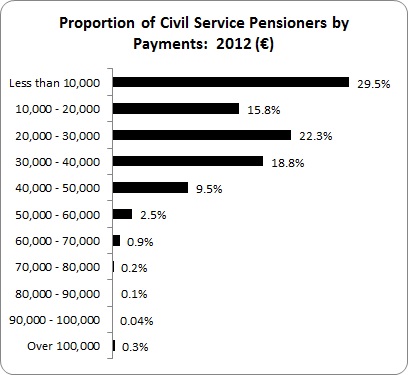
- 45 percent of retired civil service employees receive a
weekly pension of €385 or less (or an annual €20,000). 68 percent receive a pension of €577 per week
or less.
- On the other hand, only 4 percent receive pensions of over
€50,000 and only 76 civil servants received a pension of over €100,000 (0.3 percent).
The average civil service pension is approximately €22,800
so this is probably a good proxy for the remainder of the public sector.
So what would happen if we started taking a slash-hook to
public sector pensions? How much money
would it save? A series of cuts was put
to the Minister:
- €12,000 or less:
exempt - €12,000 – €24,000: 6
percent reduction - €24,000 – €60,000: 9
percent reduction - €60,000 – €80,000: 20
percent reduction - €80,000 to €100,000:
50 percent reduction - Over €100,000: upwards
of 100 percent reduction
How much would this save?
According to the Minister it would come to €10 million. And, correctly, he further stated this would
be reduced by lost taxation. I was
surprised at how small this amount is but one reason is that so many public
sector workers have pensions of less than €11,000 (nearly half).
So we get a lot of smoke on this issue but few facts. We have people attacking public sector
pensions but, in truth, they are attacking retired people on very small
pensions. We have unsubstantiated
claims, and scare-mongering.
Just what we’ve come to expect from what can be loosely
called ‘the national debate over the economic crises’.


 Notes on the Front
Leave a reply to Orla Cancel reply