
Unemployment falling to 13.7 percent. Employment increasing by 20,000. THe CSO's new Quarterly National Houshould Survey should be good news. So why isn’t it? When we dig a little under the numbers, what
do the numbers tell us about the kind of economy that is emerging? Why should we be concerned?
First, let’s run the headline numbers.
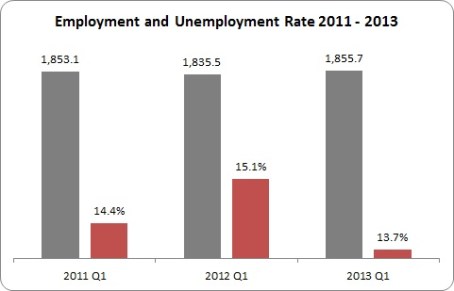
On the face of it, these are positive numbers: employment up by 20,000 over last year –
returning to the level of employment in 2011 while unemployment has fallen by
well over 1 percent. But now, let’s look
at some numbers below this headline.
(a) The Rise of the Precarious Work
Probably the most disturbing aspect of the CSO release is
the rise in precarious work. This can be
seen in the rise in under-employment.
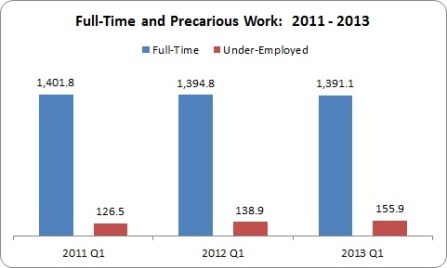
The economy is still shedding full-time jobs. In the last year, the numbers working
full-time fell by 6,000. The difference
was larely made up by an increase of 17,000 in precarious work (a 12 percent increase)
– people working part-time but wanting more work.
Some might argue that when the economy is on the floor, the
first work available will be part-time and that this will turn into full-time
work once recovery sets in. Let’s hope
so but there are grounds for questioning whether this is part of a normal post-recession
pattern or a more qualitative change in the nature of work.
Precarious work is part of an employer strategy to minimise
costs. Courtesy of the Government’s
policy to cut employers’ PRSI on low-paid work, employers are offering
part-time jobs to cut their PRSI bill.
They may have full-time work available but they are breaking them
up. This ultimately costs the State
through part-time unemployment supplement, lost tax revenue, higher Family
Income Supplement costs. But it also
costs employees: over one million people
suffer multiple deprivation experiences in the state. Of this, approximately half live in
households where there is at least one income from work. No doubt, this is concentrated in the
low-paid precarious sectors.
It is also a policy to discipline employees. If you are depending on getting extra hours
you don’t want to go around trying to organise your work-mates into a union, or
complaining about working conditions, etc.
The employee must keep quiet, suffer anything the employer throws at
them, all in the hope that they will more hours on the next roster
assignment. The Government could end this
by implementing the EU Directive on
Part-time work – which would give part-time employees the right to any extra
hours in a firm when it becomes available – but so far they haven’t indicated
any willingness to do so.
So there is a very real possibility that we may be entering
into a period where precarious work becomes the norm and not just a feature of
a weak labour market.
(b) The Weakness of the Market
Employment
Over the last year agricultural, fishing and forestry
employment increased by 16,000. This is
a good performance for this sector. But
are we getting a true picture? The CSO
has recently starting re-adjusting their samples to align them with the 2011
census. This will be phased in over the
year. In the meantime they provide a
caution about interpreting trends in this sector. In the survey for the last quarter they
state:
‘In the case of the Agriculture, forestry and fishing sector
it can be noted that estimates of employment in this sector have shown to be
sensitive to sample changes over time. Given the introduction of the sample
based on the 2011Census of Population . . . particular caution is warranted in
the interpretation of the trend in this sector at this time.’
So we have to be careful about this 16,000 job improvement. We may find that previous estimates of
employment in this sector in the past were under-stated and, so, the total
level of employment in the economy.
So how can we look at this. The following breaks down employment in three
sectors: agricultural/fishing/forestry, the market economy and the non-market
economy. The non-market economy includes
public administration, education, health and other sectors (recreation leisure)
– these are dominated by public sector employment.
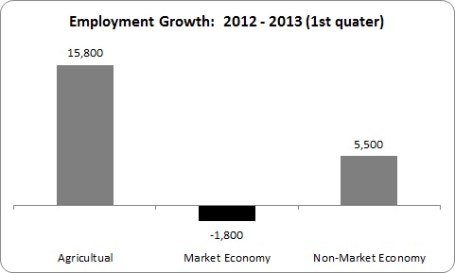
Nearly 2,000 jobs were lost in the market economy, an
improvement on the 2011-2012 figure which showed a loss of 8,000. We have, though, still to bottom out in this
sector which employs 63 percent of the labour force and is the driver of
value-added and exports.
Just to note, the increase in non-market employment is not
related to the public sector which has been losing jobs. There was, however, an increase of 8,000 in
the health & social work sector – driven by the private sector.
(c) Increase
Due to Rise in Self-Employed
The employment rise in the last year has been almost
entirely due to an increase in self-employment.
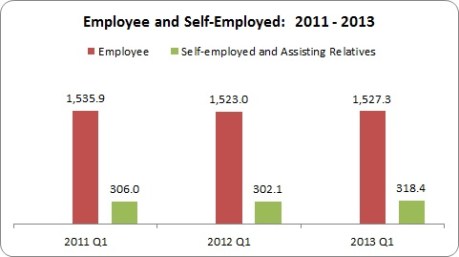
As seen, while employment rose by 20,000 in the last year,
this was due to the rise in self-employment – which made up 16,000 (there was
another small increase in assisting relatives of 2,700).
Of course, this increase in self-employment is to be
welcomed (better than a decline). But
the question here is how long-term this work will be and to what extent the
numbers have been impacted by the CSO’s sampling adjustments. Many, believing they won’t find work, will
try their hand at own-work. This can be
tenuous and low-income with an eventual high-failure rate. One insight is that the number of
self-employed who, in turn employ people, actually fell over the last year by
over 3,000. This was made up by a bigger
increase in the numbers of self-employed without employees.
Meanwhile, PAYE employment has stagnated over last year –
recording an increase of only 4,000; still, better than a decline. However, when we strip out the numbers on
Government schemes (Community Employment, Jobsbridge, etc.) the number of
non-scheme employment rose by only increased by 1,700.
* * *
So what do we have?
We have some good headline news but much of this melts away when examining
the details.
- Full-time employment is still falling
- Employment in the market economy is falling
- Precarious work is on the increase – substantially so
- The number of employees remains much the same as last year –
especially when those on Government schemes are taken into account. - The main growth has been in the self-employed sector – but not
in that part of the sector which employs people; that’s still falling - Some of the increase might be due to statistical factors
unrelated to what is actually happening the economy.
Then there’s the question of emigration. With the labour force actually falling by
over 9,000 (despite new entrants from education), much of the decline in the
unemployed numbers will no doubt be due to people searching for work elsewhere.
This is not a good news story. At best, it’s mixed. And to the extent that it presages permanent
changes in the labour market – namely, the rise in precarious employment – it is
depressing.


 Notes on the Front
Leave a reply to EWI Cancel reply