
Haven /
ha-ven: (n) a place of safety or
sanctuary; shelter. [Old English hæfen,
from Old Norse höfn; related to Middle Dutch havene, Old Irish cuan
to bend]. Example: ‘Ireland is a safe haven from (insert: e.g. dragons, personal ownership of semi-automatic
rifles, taxation on corporate profits)’.
The level of self-delusion over Irish corporate tax rates is scaling the heights of the fantasy world we constructed for ourselves
during the property boom. 'There is
nothing wrong with our tax code', 'we are playing by the rules', 'its’ the fault of
other countries','everything in our cocoon is fine – don’t bother us'.
To the question –is Ireland a tax haven – we get a torrent
of answers: some defiant (‘we are not, nor have we ever been, a tax
haven’); some convinced (‘are we a
tax haven? Of course, we are; what
planet are you living on’); and some more nuanced (‘we have many of the attributes of a tax haven’).
Personally, I’m not terribly interested in the labels. What’s important is what is actually
happening. Let’s look at a table
produced by Dr. Jim
Stewart of TCD, based on a US Government report. This research into the tax paid by US
multi-nationals in various countries found the following:
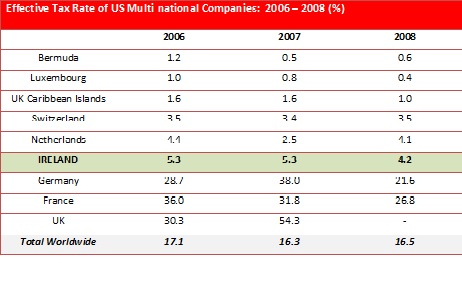
As seen, Bermuda is a league-leader in providing the most
secure ‘haven’ from corporate tax liability followed by Luxembourg and the UK Caribbean
Islands. Next up is Switzerland, the Netherlands and, ahem, Ireland. A long way off is Germany, France and the UK.
There is the argument that it’s not Ireland’s fault, it’s
the fault of US tax law. Ok, for those
who don’t have a grasp (and don’t pretend to have one) on the complex world of international corporate
tax accountancy – and I’m one of them – we can make two observations:
- Either those US companies operating in Germany,
France and the UK are either ignorant of the ability to reduce their tax
liabilities, or
- There is something in the tax law of Bermuda,
Ireland, etc. that allows US companies to drive down their tax liabilities –
something that is missing in the tax laws of, say, Germany and France.
Which is the more reasonable I leave to you.
And, my, some are getting downright self-righteousness. Take the example of
France. How dare the French authorities
attack us when their effective corporate tax rate is so low? The oft-quoted figure for France’s effective
tax rate is 8 percent – compared to Ireland’s 11.9 percent. However, this is incorrect – by a country
mile. This claim is based on a PricewaterhouseCooper
and International Finance Corporation study. Here is what Jim Stewart wrote about that
report:
‘ . . . the PWC/IFC
data cannot be relied on to estimate effective tax rates because it is based,
not on real data, but on a “standard firm with 60 employees”, a standard size
(102 times income per capita) and a fixed gross profit margin of 20% (p. 13).
Existing nominal tax rates are then applied in estimating tax paid. This means
that estimated tax rates apply to small companies employing less than 50 and
with capital employed of under €3 million. Interpreting such results can be
difficult given that many countries have low tax rates for small firms, for
example 15% in France. A new incorporated entity in Ireland is exempt from
corporation tax for the first three years.’
So the claim that France has a lower effective tax rate is
not based on data but on a standard model firm which enjoys a low rate of tax for
small companies in France (a feature of many other countries). Can we get a broad estimate of effective tax
rates in other countries? Yes, by
showing the amount of corporate tax paid as a proportion of net profits
(operating surplus minus investment).
This is a ball-park figure but Seamus
Coffey shows similar results.
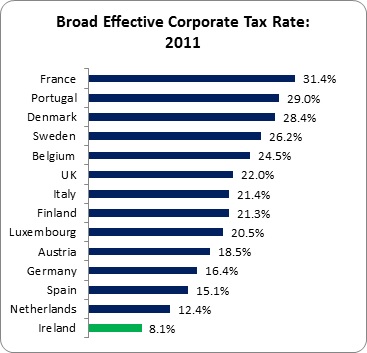
This is an economic measurement, not a company account by account compliation. The actural effective rate is likely to be slightly lower in all cases. But it shows French companies paying nearly four times more than companies
in Ireland. In fact, every country pays
a higher rate than Ireland. Ireland is a
low corporate tax regime.
Another interesting insight is the multi-national profit per
employee in the EU-15 states. The
following is taken from Eurostat for 2010 (for Denmark, Spain, Luxembourg,
Portugal and the UK the figures are for 2009) and it excludes financial
institutions. Further, it refers to gross operating surplus – that is, before investment in tangible goods.

These kinds of stats surely do help the Irish Government to
woo foreign investment – ultra- low tax rates and ultra-high profit
levels. No wonder that some
multi-nationals refer to us as ‘Treasure Ireland’.
Now put that all together with the facilities that Ireland
offers to multi-nationals in terms of using the country as a transit point in
an international chain of tax avoidance – and you have a real package. And it is our package – the story in the
Sunday Business Post yesterday suggesting that Ireland may abolish the ‘double
Irish’ tax vehicle shows that it’s not all the fault of other countries.
Unfortunately, the debate is focused on tensions between
Ireland and the US, France, Germany, Britain, etc. What is not appreciated is the damage that
Ireland’s tax regime is doing to developing countries. As Dr. Sheila
Killian of NUI Limerick states:
‘A wider problem is that it’s not just the US that is losing
tax . . . the loss in relative terms to countries in the global south is even
greater. A
recent Action Aid report details the case of a Zambian sugar company
routing interest and dividend payments through Ireland and the Netherlands in
order to avoid tax in Zambia; this in a country where 45% of children are undernourished,
and 90% of rural dwellers live in poverty. Lives are, quite literally, at stake
here.’
Lives at stake – that puts Ireland’s corporate tax regime
into some perspective.
So is Ireland a tax haven?
What does it matter what we call it.
Some use the term semi-tax haven,
to acknowledge that foreign companies here engage in real economic activity (in
Bermuda all you need is a postal address).
Others such as Richard
Murphy of Tax Research UK refer to us as a conduit-tax haven – pointing out
our helpful role in the international chain of tax avoidance.
Tax sanctuary, tax refuge, tax harbour, funny tax place – put whatever
name you want on the tin.
But when it comes to the final tax bill we are a lot closer
to Bermuda than Germany.
If only we had their weather.

 Notes on the Front
Leave a comment