Notes on the Front

Commentary on Irish Political Economy by Michael Taft, researcher for SIPTU

A Really Really Special Case Requires a Really Really Special Solution

With considerable speculation about an impending deal on bank
debt, with the Taoiseach and the German Chancellor jointly stating that Ireland
is a ‘special case’, it is helpful to remind ourselves just how special a case we
are. 

Eurostat, the EU Commission’s data agency has calculated the
cost of the banking crisis
in each EU country.   The following focuses on the cost to general
government budgets.  Ireland has really
taken one for Team EU.
Really Special Case 1

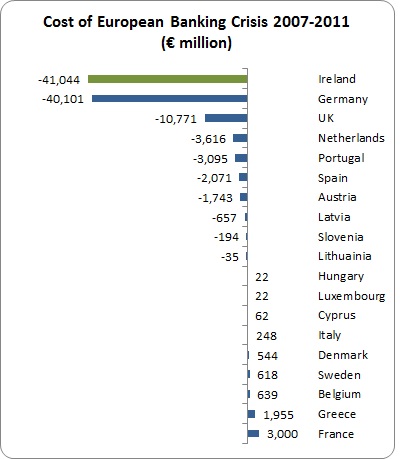
Yes, there’s wee Ireland up at the top, just edging
out Germany for the dubious title of spending the most on the banking
crisis.  €41 billion to date according to
the Eurostat accounting data (this doesn’t count the billions ploughed into the
covered banks from our National Pension Reserve Fund as this was not counted as
a ‘cost’ to the General Government budget). 

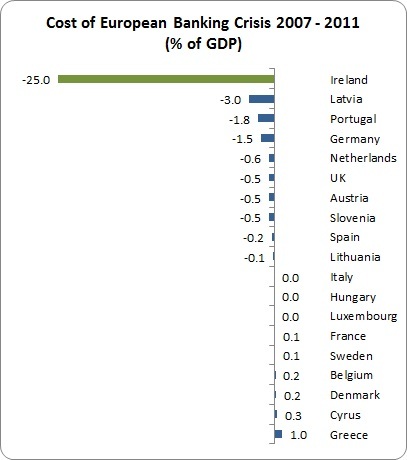
Of course, this doesn’t give the best picture.  What happens when we look at the cost as a
percentage of GDP?
Really Special Case 2

Ireland may not win football’s European Championship but
when it comes to banking debt we are Barcelona, Bayern Munich and Manchester
United all rolled into one with Real Madrid for a bench.  Germany may have run Ireland close in the
nominal amount of banking debt but when it comes to a proportion of GDP, it is just
pennies behind their sofa. For Ireland, it’s the entire house.

Here’s another little stat to chew on.  The European banking crisis is just that – a
European crisis.  But as we know, this
has not been addressed at European level. 
Rather, the cost has been delegated to individual countries regardless
of their size or ability to pay.  For
instance:

  • Ireland makes up 0.9 percent of the EU
    population
  • The Irish economy makes up 1.2 percent of EU GDP

Ok, we’re small.  So
how much of the entire European banking debt have we paid?

  • The Irish
    people have paid 42 percent of the total  cost of the European banking crisis

We may be minnows when it comes to population and economic
size, but when it comes to banking debt we are the whale in the pond.

One more breakdown. 
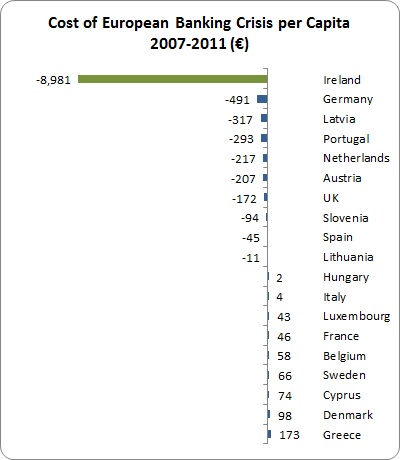
How much have countries paid per capita?
Really Special Case 3

The European banking crisis to date has cost every
individual in Ireland nearly €9,000 each. 
The average throughout the EU is €192 per capita.  I really don’t know what you can say after
that. 

So, Ireland is a really, really special case.  We require a really, really special
solution.  The Government (and we must
always remember that this mess wasn’t created on their watch) has a real
challenge in the negotiations over bank debt. 
But there is a bottom-line here.

If any deal does not qualitatively alter these dismal
statistics, then it won’t be a deal worth applauding.  The Government may be tempted to
return to the Irish people waving a sheet of paper claiming ‘a bank debt deal for our
time’

But if are still paying nearly €9,000 each while the
remainder of the EU pays only a fraction of that, then it is no deal at all;
just a re-arranging of Euro notes – a lot of Euro notes – on the decks of a sunken
ship.

25 responses to “A Really Really Special Case Requires a Really Really Special Solution”

  1. Ciaran Avatar

    Given the zeal with which they’re approaching ‘negotiations’ in relation to basic working conditions in the public sector, I’m sure the Government will really play hardball when it comes to our bank debt.

    Like

  2. Diarmuid O'Flynn Avatar

    Would love to see the above tables and graphs/histograms using the TRUE bank bailout figure cost to Ireland – €69.7bn.
    Details here:
    http://namawinelake.wordpress.com/2012/07/08/e69-7bn-the-gross-cost-of-bailing-out-irelands-banks-so-far/

    Like

  3. Michael Taft Avatar

    Diarmuid – looking at the Eurostat numbers, they may not construct the numbers in that way. They have, apart from impact on general government finance, assets, liabilities and contingent liabilities. I’ll look into this more. But be assured, we’re a league leader no matter what the measurement.
    Ciaran- that’s the spirit. Keep reaching for that rainbow!

    Like

  4. Andrew Avatar

    You can’t argue with these stats – bears out Brian Lenihan’s statement that this was the cheapest bailout in history. Cheapest for the EU sans Irelande!

    Like

  5. Robert Nielsen Avatar

    Out of curiosity, could you explain the Greece figures? They seem to imply that Greece has gained from the crisis

    Like

  6. Hugh Sheehy Avatar

    Great information.
    The residents of Ireland saw their human rights infringed in a major way and yet no European law or institution has yet even tried to help them. Not even Ireland’s own government.

    Like

  7. NAMAwinelake Avatar

    Am having difficulty opening the source Eurostat spreadsheets but I thought the Greek bank rescue was much more expensive than indicated above.
    See Dep Stephen Donnelly’s presentation
    http://www.greystonesguide.ie/irelands-comparative-per-capita-bailout-costs/

    Like

  8. Michael Taft Avatar

    NWL and Robert – the Eurostat data that I took, and referred to in the blog, only refers to banking costs that impacts on the General Government Deficit. It is not the cost of bank bail-outs in their totality. According to the Euruostat (and they are the last word on what goes on our deficit and debt for the purposes of the Maastricht excessive deficit produure)this is total amount of costs up to 2011 that Government must include in their GGD.
    Other bail-out costs (those that are treated as investments, from savings, etc.) may not be counted as impacting on the deficit.
    Therefore, its not that Greece hasn’t been hit (but I’m not familiar with the Greek details), its just that it hasn’t impacted on their deficit for the purposes of Maastricht compliance.
    The Eurostat tables also list a range of other measurements: assets, liabilities and contingent liabilities.
    So these numbers shouldn’t be taken as the cost of the bail-out, only those that have hit public finances for the purposes of determining the deficit.
    NWL – try this link. http://epp.eurostat.ec.europa.eu/portal/page/portal/government_finance_statistics/excessive_deficit/supplementary_tables_financial_turmoil
    If you have trouble, get back to me.

    Like

  9. laxx Avatar

    Only complaining about how much you guys gotta pay is easy. But you should maybe also include how much you have caused…

    Like

  10. James McGrath Avatar
    James McGrath

    Do we have a cost of the banking crisis across Europe compared to GNP ?

    Like

  11. Gregg Avatar

    Fiat $$, yet another violation of our rights. The gov’t constantly violates our rights.
    They violate the 1st Amendment by caging protesters and banning books like “America Deceived II”.
    They violate the 4th and 5th Amendment by allowing TSA to grope you.
    They violate the entire Constitution by starting undeclared wars.
    Impeach Obama.
    Last link of “America Deceived II” before it is completely banned:
    http://www.amazon.com/America-Deceived-II-Possession-interrogation/dp/1450257437

    Like

  12. Ed Avatar

    “Only complaining about how much you guys gotta pay is easy. But you should maybe also include how much you have caused…”
    Everything in those sentences hinges on ‘you / you guys’. Who would this ‘you’ be? Irish private banks lent money recklessly to Irish private construction capitalists. In turn they were lent that money by European private banks, British, French, German etc. At no point were Irish citizens consulted about the lending policies of the private banks (nor, for that matter, were British, French or German citizens).
    There is no ‘you’, there is no ‘we’.

    Like

  13. Alex Avatar

    “Germany may have run Ireland close in the nominal amount of banking debt but when it comes to a proportion of GDP, it is just pennies behind their sofa. For Ireland, it’s the entire house.”
    unless a house costs about ten pennies, that’s a metaphor which is vastly exagerrated.
    also, why are there no graphs on EFSM contributions or debt acquittals in this piece. seems rather one sided right now. and no, am not propagating against international solidarity.

    Like

  14. CMK Avatar

    @Alex, what debt acquittals?

    Like

  15. jackie Avatar

    our pensions are costing us to much, one pension for each civil servant including tds, then go find a real job and earn money, not keep getting state paid, tds going into bank, another pension, paid by tax payers, it has to come to an end , its rip off ireland

    Like

  16. Jimmy Keenan Avatar
    Jimmy Keenan

    We are being bled dry by a a system which feeds off the weakest.Is it not obvious for all to see that Greed for profit is the driving force behind all of these numbers.

    Like

  17. http://burberryoutlet2012.info Avatar

    I agree with the too expensive garbage thoughts. I can’t stand the search, sound and feel in the Beats.

    Like

  18. Ibis Avatar

    This is a very poor and misleading use of statistics! The “bailout costs” as presented by Taft are nothing of the kind – they are the contribution of the bailouts to general government debt according to the Maastricht criteria. As such, the more existing cash went into the bailout, the “less” the bailout cost in this set of statistics. Any use of Special Purpose Vehicles or other accounting trick that kept borrowings off the GGD would likewise result in a “lower” bailout.
    That’s why our bailout as recorded here is smaller than the real cost by the amount put in from the NPRF and Exchequer cash piles.
    To use such a set of statistics as a comparison is utterly misleading, particularly where the author probably has no idea what accounting tricks were used in the various bailouts.
    See: http://www.politics.ie/forum/economy/204386-no-wonder-europe-loves-us.html

    Like

  19. Michael Taft Avatar

    Just to repeat what was stated in the post – this is the cost as it impacts on public finances as recorded by Eurostat. It does not purport to represent the full costs of the bail-out, either here or throughout Europe. That is why I didn’t use the phrase ‘bail-out costs’. ibis, please take note. As always, it is helpful to read a piece before commenting, never mind being insulting.

    Like

  20. Ibis Avatar

    I had read that from the post, Michael, but the exercise of comparing these costs across Europe remains entirely meaningless and misleading. I’m sorry if you find that insulting, but there’s little I can do to avoid being insulting where that fact itself is what you find insulting. These figures are so detached from the real costs of bailouts that the only possible reason for using them is because they show Ireland as having the “largest” cost, which is misleading, while the comparison it appears to provide between countries is meaningless.
    Seriously – the UK’s bailout is accepted as being £66 billion, and you have it there as €10.7 billion? What on earth can possibly be the point of putting the “Eurostat debt figures” side by side when they’re so entirely unrepresentative of the real cost of the bailouts?
    And, I hate to say it, but you haven’t really been clear that your figures are essentially meaningless as bailout comparisons:
    “Yes, there’s wee Ireland up at the top, just edging out Germany for the dubious title of spending the most on the banking crisis.”
    That is a false statement, isn’t it? We haven’t spent the most – the UK has spent more than us, for example, £66 billion to our €62.5 billion.
    I’m sorry if you consider it offensive to have this pointed out, but it was your choice to write the article.

    Like

  21. Jonathan Avatar

    “That is a false statement, isn’t it? We haven’t spent the most – the UK has spent more than us, for example, £66 billion to our €62.5 billion.”
    But if those are the final figures, then per capita we have spent ten times what the UK has, as our population is a tenth of the UK’s. There are several different ways of looking at things…

    Like

  22. Ibis Avatar

    @Jonathan
    Yes, that’s a fair point, but is a pretty unsurprising outcome of the fact that we’d let our bank balance sheets balloon to the highest per-capita ratio in the EU.

    Like

  23. Ibis Avatar

    Hmm. Having had a look (finally) at Taft’s source here, the figures don’t look a bit like his graph. Germany’s bailout is recorded by Eurostat as €294bn euros of liabilities and €67.6bn of contingent liabilities. How does that work out as less than ours?
    Turns out the answer is that Michael has (without noting the fact) subtracted from the cost of the bailout the notional value of the bank assets thus acquired. This makes a huge difference, because while Germany spent €294 billion, the bank assets it acquired during the bailout (ie the value of the banks) is judged to be €252 billion. Our banks, on the other hand, are valued at minus €2.5 billion.
    It may seem reasonable to net the figures in this way, but it means that the figures have even less value as “cost of bailout” than I originally thought. The final figure for each country has, on one side, the amount of debt acquired – not the full cost – and on the other has a current valuation of assets such as bank shares.
    Taft’s analysis therefore comes up with the “net cost” of Ireland’s bank bailout as largest because our banks are currently regarded as worthless, whereas other countries’ banks are not. The moment that Irish bank shares rise – and BOI shares have risen since the 2011 valuation Taft uses, never mind the changes in the share values of other countries’ banks – Taft’s picture is out of date, as it is already. The value he uses is not the cost of our bailout, but is instead a snapshot of its notional net current value from two years ago.
    Again, this is a very unimpressive misuse of statistics.

    Like

  24. Ibis Avatar

    @Jonathan
    I should perhaps point out, in the interests of fairness, that Ireland’s #1 per-capita position does stand up in terms of the amount of general government debt acquired. Well, at least until you take out the promissory notes, because we haven’t actually paid them yet (that’s the whole point of them), even though they’re booked on our GGD – which means that the Ireland figure ought to be €28 billion smaller.
    (The net cost per capita, on the other hand, still depends entirely on the price of bank shares, and still won’t be known for a while.)
    Our bailout-related debt per capita is €9,951, comfortably beating the next contender, Luxemburg, at €4,780, Germany at €3,594, Netherlands at €2,663, plucky little Belgium at €2,271, and the UK at €1,946.
    If you leave out the promissory notes we haven’t actually paid, though, we drop to second place with a bailout cost per capita so far at €3,836, behind Luxemburg.
    Statistics, eh?

    Like

  25. Nick Avatar

    Thank you for an excellent article.
    We should not give the Government time to think on this, they should be dragged into the street gutter and told to go.

    Like

Leave a reply to CMK Cancel reply

Navigation

About

Commentary on Irish Political Economy by Michael Taft, researcher for SIPTU