
With negotiations over an extension of the Croke Park
Agreement starting today, it is helpful to remind ourselves how daft it is to
downsize the public sector payroll in the hopes it will reduce the
deficit.
There are two ways to downsize the public sector
payroll: cut public sector employment
and/or cut public sector pay. Since the
crisis began, we have been doing both. Public
sector pay has been cut twice through the pension levy and the wage cuts of
Budget 2010. Public sector employment
has been cut by approximately 29,700
since late 2008, or 9.3 percent.
Yet, the Government finds that it must cut more than it had
already planned. It needs €1 billion more in austerity measures
to achieve their targets. It’s like
running in quicksand – cut, sink, cut some more.
Yet, downsizing the public sector produces little benefit in
stabilising public finances. Why? Because it is so darned deflationary – it bleeds
the economy of employment, consumer spending and growth. When you factor in the economic consequences
of the cuts, you find the Exchequer hasn’t saved as much as it hoped.
Let’s look at the
estimates from the ESRI.
Public Sector
Employment
Even using common sense, without the aid of calculators or
models, cutting jobs in a jobs recession is not a very good idea. The ESRI’s model confirms this. They took the example of ‘saving’ €1 billion
by cutting public sector employment.
Because this is a model, they assumed the cut would happen in one year
(but there would be little difference if this was spread out over years). So what would be the impact by 2015?
- Impact on domestic
growth: ‘Saving’ €1 billion would
reduce GNP by €1.85 billion, or 1.3 percent.
This is the most deflationary of the six budgetary cuts/taxes that the
ESRI estimated.
- Impact on employment: There
would be 20,000 job losses. In the last
budget the Government was estimating that employment would grow by 43,400
between 2012 and 2015. However, if it
seeks ‘savings’ through public sector job losses, employment growth would be
reduced to 23,400. Unemployment would
rise from 13.1 percent to 13.8 percent in 2015 – and that’s only if there is
increased emigration.
So growth and employment is cut, with a rise in
unemployment. Consume spending would
fall by 1.2 percent (or approximately €1.13 billion) in 2015, putting more
pressure on domestic businesses. What
would be the impact on the deficit?
A €1 billion ‘savings’ would only reduce the budget by only
€420 million – or 42 percent of the headline cut. This is extremely inefficient. In percentage terms, the deficit would fall
by only 0.23 percent. That’s all.
Whatever the reasons for cutting public sector employment,
reducing the deficit is not one of them.
Public Sector Pay
The ESRI did the same exercise with cutting public sector
pay by €1 billion (or approximately 6 percent).
While the deflationary impact is not as high, it is also inefficient at
cutting the deficit.
- Impact on domestic
growth: ‘Saving’ €1 billion would
reduce GNP by €700 million, or 0.5 percent by 2015.
- Impact on employment: there would be a loss of 3,700 jobs. These would be private sector jobs, lost
through reduced domestic demand.
Naturally, consume spending would also be hit – almost as
severe as cutting public sector jobs.
Consumer spending would be cut by over €950 million.
After all this, the impact on the deficit would be
minimal. By 2015, the deficit would be
reduced by €479 million – or 0.26 percent.
This is approximately the same impact as cutting public sector jobs.
What Could Happen
The Government has stated that they are looking for a mix of
pay and job cuts in the public sector. So
let’s use the ESRI numbers to estimate the impact of €1 billion ‘savings’ with
half coming from both wage and jobs cuts.
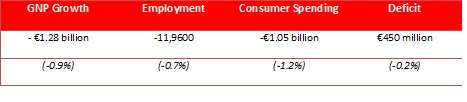
Over a billion Euros is lost in growth and consumer
spending, nearly 12,000 jobs lost; and the deficit falls by only 0.2
percent.
Of course, models are not very nuanced. They just take numbers on the large stage and
apply them through a number of indicators.
For instance, what happens if you cut the pay of higher-income
earners? The impact on demand would be
less, so the damage to the domestic economy would be reduced. But the revenue gain could, ironically, be
even less – in particular, given that the marginal tax rate of high-income
public sector employees is
62.5 percent (tax plus pension levy).
So a €1 billion cut would reduce direct tax/pension levy revenue by €625
million – and that’s not counting the loss from spending taxation. Given that
there are only 6,800 public sector employees earning over €100,000, there’s not
much change in that.
But a real problem with these estimations is that they were
made in 2010. The base-line the ESRI
used was one of modest growth (from the World Recovery Scenarios). What might such estimations look like against
a base-line of lower growth and following on from substantial cuts in pay and
jobs? It could be reasonable to assume
that the risks to these estimations are on the down-side – that is, if they
change, they are likely to change for the worse.
This raises fundamental questions: is the large economic price worth the small
fiscal gain? Is there a better way of
reducing the deficit? And is the best
suggestion that the Government can come up with?
We elected a new Government but all they did was to take
over Fianna Fail policy – a policy of down-sizing. A new Government could have taken a step
back, tested these policies against the best available evidence, and engaged in
some new thinking. They didn’t. Its’ all rote and automatic pilot.
If we can’t elect another new Government, can we at least
elect some new ideas?


 Notes on the Front
Leave a reply to Colum McCaffery Cancel reply